doc w/ Pen

journalist + medical student + artist

Tag: medicine

Enjoying San Antonio

Posing along the lovely San Antonio River Walk

While I was in San Antonio last week, I enjoyed not only the conference I was attending, but the city too. I took several strolls along the famous San Antonio River Walk. As I discovered, you can follow the bank of the San Antonio River for several miles along a network of paths that are inset one story below the hustle and bustle of automobile traffic. For part of the River Walk, you’re surrounded by hotels, restaurants, and shops, with river taxis and tour barges whirring by. But past the commercial district, it’s all peace and quiet. On that leg of my walk, I saw more ducks than people. This was quite the change for me, coming from New York City. The place to go for “green” in NYC is Central Park. No matter when you go though, there are gobs of people there, on all the paths and lawns. I definitely enjoyed the solitude and silence I found in San Antonio. Here are some photos from my excursion on the River Walk.

Being in the Southwest, I also enjoyed the prevalence of Latino culture. As I made my way along the River Walk, I stopped for lunch at a Mexican restaurant. While waiting for my enchiladas, the table decor, a large sheet of paper protected under a layer of glass, caught my eye. At the top of the paper, the title read “Serpientes y Escalaras.” I realized this was a game board — in Spanish — for “Shoots and Ladders,” which I’d played so many times as a kid. I couldn’t resist taking pictures of the board, including the Spanish-language instructions.

All in all, it was a wonderful trip — I got to both learn and unwind. Still, it’s always good to be home.

Presenting a poster, and reigniting my passion

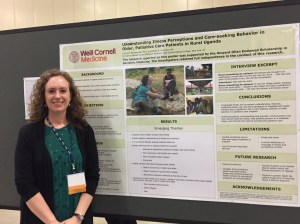
Posing with the poster I presented at the American Geriatrics Society’s annual meeting this past week in San Antonio.

I spent the last few days in San Antonio at the American Geriatrics Society’s annual meeting. I wasn’t just an attendee — I also presented a poster on the palliative care research I did last summer in Uganda. It was a wonderful experience to go through the process of writing and submitting an abstract, creating a poster, and then presenting my work to other medical practitioners.

Talking with people about my research, getting feedback on what we’d done in the past and hope to accomplish in the future, also reignited my passion for the project. I’m ready to dive back in and use the information we learned last summer to try to make positive change. I won’t have to wait long to do that. I will be continuing my work in Uganda during my four-month “Area of Concentration” research block next year.

The work we did last summer was a pilot project that aimed to better understand why some patients in rural Uganda do not seek medical treatment until their condition has progressed to being terminal, and therefore present for palliative care. We also hoped to learn what the patients understand about their illnesses, and what both patients and medical workers see as barriers to seeking medical care. Here is a link to a larger image of the poster I presented, detailing our results and conclusions: Understanding Illness Perceptions and Care-seeking behavior in Older, Palliative Care Patients in Rural Uganda.

One key thing we learned last summer is that poor communication from providers to patients is a factor that affects whether people seek medical care. Patients don’t trust the medical establishment because they feel belittled rather than heard or understood. So they are discouraged from seeking medical care from physicians. Instead, the patients turn to traditional healers who actually listen to their concerns. This is a problem when a patient has breast cancer, for example, and months or years of using ineffective herbal treatments means that her cancer progresses beyond the point where it can be cured. So my project for next year is to develop a multimedia educational module to teach better communication skills to medical workers. Specifically, the module will address the topic of how to deliver bad news to patients, such as a frightening diagnosis. We’ll be using film footage that was taken during palliative care home visits in rural Uganda last summer. The project has yet to be formally approved by my research committee, but so far I’ve gotten very positive initial feedback. I look forward to sharing my progress as this new project moves forward.

It truly takes a village to make a project like this possible. It’s impossible to mention everyone who played a part, but these are the key players. Thanks to my research mentor, Dr. Randi Diamond, for her hard work, dedication, and ongoing support. I also want to thank Weill Cornell’s Division of Geriatrics and Palliative Medicine for sponsoring my trip to the conference, as well as my initial research funding from the Howard Olian Endowed Scholarship in Geriatric Medicine. I also want to acknowledge those who worked with me on the project last summer. From New York: Dr. Howard Eison, Dr. Jemella Raymore, Dr. Carol Capello, Dr. Veronica LoFaso, Dr. Cary Reid, Dr. Ron Adelman, Dr. Kelly Trevino, Lauren Meador, Allison Maritza Lasky, and my fellow MSTAR/Adelman scholars. From Uganda: the St. Francis Naggalama Hospital administration, physicians, and staff; and the Naggalama Hospital Palliative Care Outreach Team.

My own unsolved mystery

I’m a mystery junkie. My favorite TV shows and podcasts all involve drama, sinister intrigue, and crook catching. Right now I’m immersed in “Accused,” a nine-episode podcast about the unsolved 1978 murder of Elizabeth Andes.

And now I have an unsolved mystery of my own.

My unsolved mystery is not at all sinister though. Quite the opposite — it’s sweet; a puzzling act of kindness that I can’t completely explain.

Allow me to present my case, and the physical evidence I’ve collected.

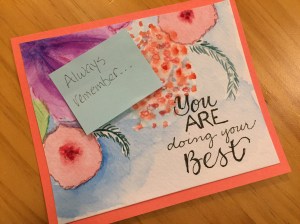
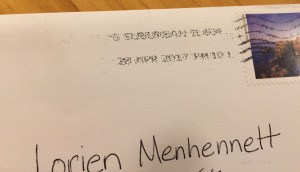
I don’t get much mail. Not even the junk mail senders or credit card companies have found me yet. But about two weeks ago, a nondescript, cream envelope appeared in my mailbox. It was hand addressed to me in black ballpoint pen — clearly not an advertisement — but there was no return address. Curious, I opened the envelope and found a lovely card inside. The message — “Always remember … You are doing your best” — was exactly what I needed to hear that day. I’d had a long, rough afternoon at clinic and really needed some encouragement.

I was so grateful for this surprise act of kindness. But I didn’t know whom to thank.

The card itself looks handmade, which makes me think maybe it came from someone artistic. But that’s not much to go on. So I scoured the envelope for clues. I tried to make out the blurred postmark (of course the postmark would be blurred!). I think part of it says “SUBURBAN IL,” but I’m not sure. No other revealing markings on the inside or outside. I didn’t recognize the handwriting either. This wasn’t from either of my parents, my two sisters, or the friends who send me mail from time to time. My mystery writer would have needed help finding me, though. So I could try asking my parents and sisters whether they’d recently been asked for my address.

But here’s the thing: I’m not sure I want to solve this mystery. Which surprised me at first, since I’m all about the thrill of the chase. But the fact that my mystery writer sent me this beautiful card in an envelope without a return address was no mistake. She or he wants to remain a mystery. And I want to respect that.

Since I don’t know who sent this to me, I can’t thank them directly. But just maybe, my mystery writer will see this blog post and know how much this seemingly small act meant to me, how it truly lifted my spirits when they were low. I want them to know that I keep the card on my refrigerator to remind me that I am doing my best, and also to remind me that there are so many people out there who have my back — more than I even know.

So if you’re out there, mystery writer, thank you.

Subway syncope

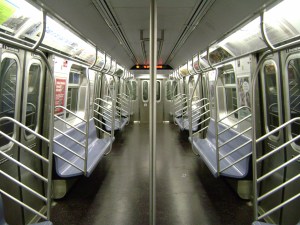
The view from inside a NYC subway car, where I evaluated a woman for syncope (fainting).

Sitting on the New York City subway, immersed in the world of my true crime podcast, I suddenly heard a commotion. I looked up and saw that a group of passengers had stood up and gathered in front of me, staring at the woman directly across the aisle. She was slumped over against the shoulder of the woman next to her.

I pulled off my headphones, my ears alert. What I gathered from the murmuring passengers was that the woman had suddenly passed out. In doctor-speak, she had a “syncopal episode.” She was awake now, but obviously woozy.

Usually in this sort of situation, someone with medical qualifications presents to help — a doctor, nurse, PA, paramedic. No one did so. I realized I might be the person with the most medical qualifications in the train car. That was a scary thought.

You are 9-1-1.

The words of my CPR instructor from nearly two years ago rang in my head. That was his response when one of my classmates proposed “calling 9-1-1” as the appropriate course of action in an emergency. Of course, there is some truth to both perspectives. When an emergency happens outside the hospital, you should call 9-1-1 if that’s an option. The paramedics have equipment and knowledge that you don’t. The CPR instructor’s point was, though, that in that critical moment you are the one who is actually there and can make a difference. So if you are appropriately trained, you should act.

With that in mind, I yanked my stethoscope out of my backpack, slung it around my neck, and crossed the aisle to evaluate my “patient.”

By this time, we had pulled into the next train station. Someone alerted the conductor about the emergency, so we stayed put while the paramedics were summoned. In the meantime, I conducted my initial assessment.

I explained that I was a medical student. I cradled the woman’s wrist in my hand so I could take her pulse — faint and slow, I noted. I tried to listen to her heart but it was difficult to hear anything with everyone around me talking. I decided it was more important to take her history. I asked whether this had happened to her before, if she ate or drank sufficiently that morning, whether she had any medical problems.

“Are you a nurse or something?” asked the policeman who was standing in the open doorway of the train car, watching me.

I felt a prickle go up my spine. Clearly, old-fashioned assumptions about gender roles were very much alive, even in progressive New York City in the year 2017. I doubted he would have asked a man with a stethoscope around his neck the same question. But my goal here was to practice medicine, not feminism. So I swallowed, and calmly answered.

“I’m a medical student.”

This seemed to satisfy him. He told us the paramedics were on their way. Another passenger offered to stay with the woman who’d passed out until help arrived. The two women slowly stood up and exited the train car.

Minutes later, the doors whooshed shut, and we were on our way. I sat down, my own heart still racing.

My physician preceptor told me later that morning that as the medical professional, I should have stayed until the paramedics got there. Not necessarily because this woman was going to need more intervention. But because I could better communicate her condition to the paramedics, and because I could prevent bystanders from doing something like starting CPR if she passed out again. Lesson learned for next time.

I learned a lesson about myself that morning, too — about how I respond in an emergency. Namely, that I did respond. I remembered what I’d learned over the last two years and applied it.

In medical school, we hear about how being a physician entails great responsibility. There is a standard of professionalism, and the so-called “social contract” that we’re expected to maintain. As a medical student, I didn’t expect to put that into practice — at least, not without supervision — for some time. I’m honored I had the opportunity.
Narrative medicine: my soul’s monthly nourishment

Once a month, a handful of people gathers in a small conference room on the 14th floor of New York Presbyterian Hospital’s Baker tower for an hour-long narrative medicine group. We discuss a poem or prose piece, sometimes about medicine sometimes not, then write a reflection to a related prompt. The composition of the group varies by who can come that day: librarian, doctor, social worker, medical student, chaplain. Just like our job titles, our experience with interpreting literature, with writing, and with life itself, varies. But that’s exactly what makes the group so rich. With my crazy clerkship schedule, I can’t always make it. But I know when I do, I will leave feeling refreshed, fed. Here is the poem we read last week, along with my written reflection.

“In a landscape of having to repeat”

In a landscape of having to repeat.
Noticing that she does, that he does and so on.
The underlying cause is as absent as rain.
Yet one remembers rain even in its absence and an attendant quiet.
If illusion descends or the very word you’ve been looking for.
He remembers looking at the photograph,
green and gray squares, undefined.
How perfectly ordinary someone says looking at the same thing or
I’d like to get to the bottom of that one.
When it is raining it is raining for all time and then it isn’t
and when she looked at him, as he remembers it, the landscape moved closer
than ever and she did and now he can hardly remember what it was like.
— Martha Ronk, 2004

Prompt: Write about a time you remember looking at a photograph.
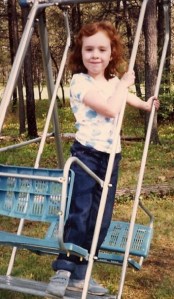
When do memories begin? I think I remember being there, tell people I do. Sitting on my pink bicycle in a Minnie Mouse bathing suit, our golden retriever Jake-a-pup reclining on the lawn in the foreground. Flying high on the swingset in my dark blue jeans and the white T-shirt with the pretty blue flowers. Hanging upside down on said swingset, my face flushed red and my eyes half closed. Blowing out candles on the green-frosted caterpillar cake that my mom baked. But are they really memories? Or just pictures in a photo album?

‘No one gets a diploma alone’

Almost every day, I pass by this bus stop billboard, which is across the street from Weill Cornell Medical College.

The message — “no one gets a diploma alone” — is so true. It’s true whether you’re talking about a GED, B.S., or M.D. So every time I see this advertisement, I think of all of you.

And when I say “you,” I’m talking about a lot of people.

My family and close friends play enormously supportive roles. I wouldn’t be here without them. I can’t thank them enough. My classmates, too, play a key part.

But “you” is even broader than my family, friends, and classmates. One of the most difficult things about medical school is the pervasive feeling of isolation. So knowing that there are people across the globe reading my story — many of whom I’ve never met, and am unlikely to ever meet — that helps too.

To each one of you, for your unique contribution: thank you, from the bottom of my heart.

Central Park self-portraits

When I was in college, one of my favorite (and most time-intensive) classes was photography. This was before the ubiquity of digital cameras — we shot with 35 mm, 400 ISO film, all black and white, manually developed and printed in buckets of smelly liquids under red safety lights. My final project was to tell a “story” in a series of still photographs. I decided to share my daily jogging route. I started and ended with a picture of my running shoes to give context. In between were images of the route itself, the trees, bushes, houses, fences, and streets. I took each photo while slowly panning a scene, blurring the images slightly to give the impression of movement. For my presentation, I mounted each image on rectangles of black art board, with little cutouts along the top and bottom to look like segments of a film strip.

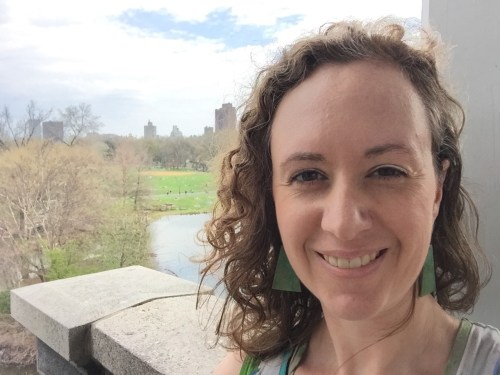
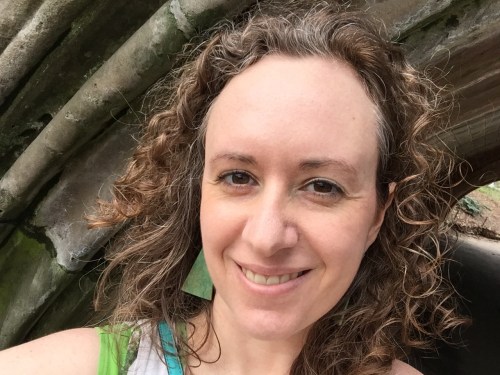
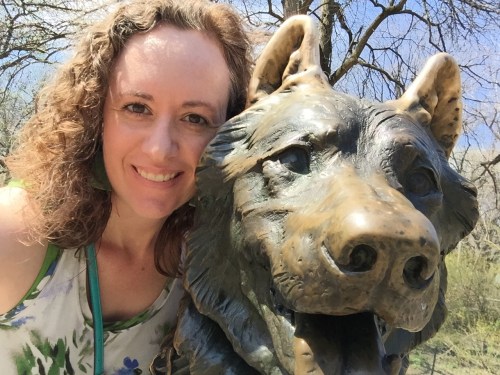
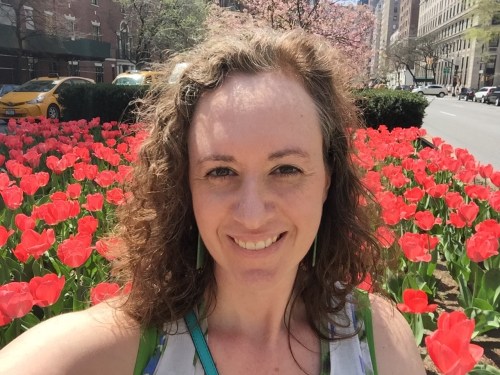
I don’t jog anymore; I prefer an exercise bike, an elliptical machine, or simply a long walk. The photos I present here (digital, obviously — how times have changed!) tell the story of my recent walk to, through, and from Central Park. I am eternally grateful to those who had the foresight to guard this giant swath of land as a nature preserve, and I visit it often. The park changes throughout the seasons. Here is what it looks like on a sunny, spring day.

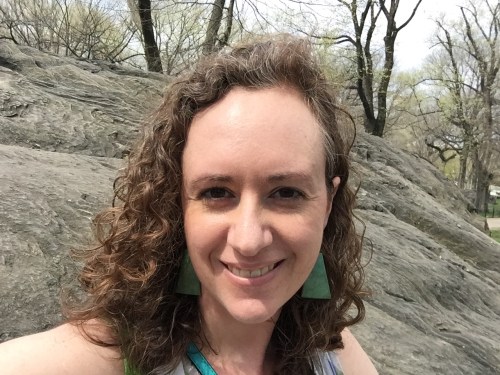
The park has many boulders suitable for scrambling or simply sitting.


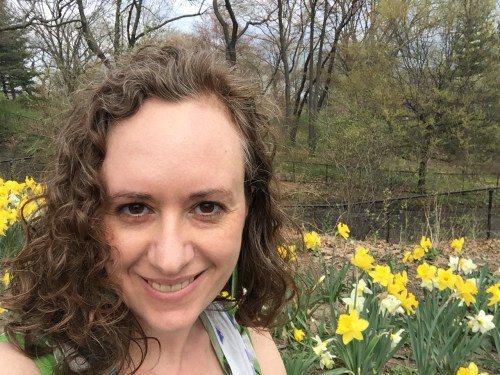
In April, there are patches of daffodils all over the park.


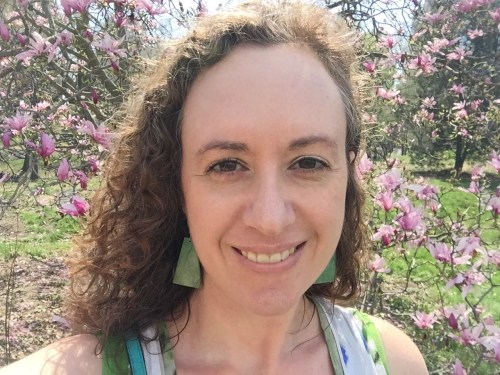
Blooming magnolias remind me of my childhood home in Forest Park, Illinois.


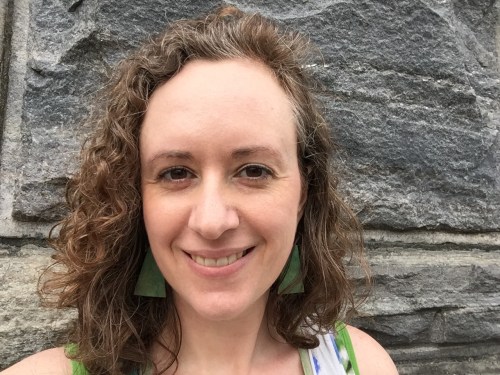
Central Park even has a castle — this is me against its wall.


From above, there’s a lovely view of one of the park’s ponds, a giant lawn, and the city skyline in the background.


The park paths meander, with many overpasses and underpasses. Here is one of them.


Commemorative statues dot the park, including this one of Balto, the sled dog famous for helping transport diphtheria treatment to combat an epidemic in Nome, Alaska in 1925.


My walk home was lovely too. This is me in front of the tulip-laden Park Avenue median.

Primary care doctors: masters of flexibility

One week into my primary care clerkship, and I have developed an incredible new respect and appreciation for this group of doctors.

First, a little about the clerkship itself. At many schools, this would be a family medicine clerkship. (Family physicians being doctors who treat the whole family, from babies to kids to teens to adults, including pregnant women.) But Cornell does not have a family medicine department, so for this clerkship we spend time at various ambulatory care sites. Being at five different clinical locations throughout the week was disorienting at first, but I do think it will give me a good sense of various ambulatory settings. I’m in Brooklyn with an internist on Monday, and on the Upper East Side the rest of the week for dermatology, ob/gyn clinic, more internal medicine, and the emergency department.

So what’s so incredible about primary care doctors? Plenty, but what I want to focus on right now is how adaptable they are. In primary care, when a patient comes in for an appointment, you might know what her ongoing medical problems are — diabetes, hypertension, etc. — but you don’t know why she’s here today. You need to be prepared for anything, quite literally. You manage acute and chronic complaints in all systems: heart, lungs, stomach, liver, brain, muscles, bones, and so on. And when you do a physical exam, you don’t just listen to her heart, lungs, and belly. If indicated, you might do a focused musculoskeletal exam for back pain, or a neurologic exam if she has trouble with balance.

I’ve seen this flexibility as a patient, of course, when visiting my own primary care doctor. It seems so natural. But it’s different being on the other side of that doctor-patient relationship. There’s so much information to filter through during the patient interview, so many potential physical exam maneuvers, so many diagnostic possibilities to consider. In some ways, this is intimidating for me as a medical student. It’s all so new, and I have so much yet to learn. But it’s also incredibly rewarding to help solve these clinical puzzles — and to help these patients.

A refreshing spring break

Last week was my much-welcomed spring break. I spent a few days of it in Chicago visiting my much-missed family. As usual, we talked, laughed, played games, watched movies, ate wonderful food, and drank beer and sparkling wine (not simultaneously, of course).

I also made a trek back to the Garfield Park Conservatory. I’ve been visiting this gigantic, tropical greenhouse since before I can remember, and posted about my time there at Christmas. One reason I love Garfield Park is that every time I go, I discover something new. Sometimes, it’s at a seasonal flower show. Other times, I come across something that’s always been there and I simply see it in a new way. Both happened during this most recent visit.

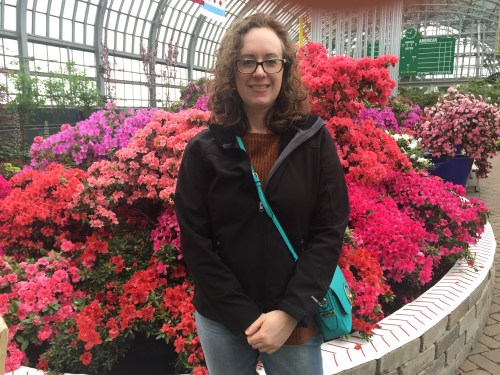
When I went last Friday, the spring flower show was underway. I’ve never seen such vibrant azaleas or Persian buttercups.

Brilliant azaleas at the Garfield Park Conservatory’s spring flower show.

In the fern room, a childhood favorite for games of hide-and-seek, I noticed unusual patterns of fern spores. Usually, fern spores aggregate in little round, brown balls that line the underside of the leaves. But I discovered that they arrange themselves in other beautiful ways — in straight lines and in zig-zags, for example.

Schismatoglottis — parasite or plant?

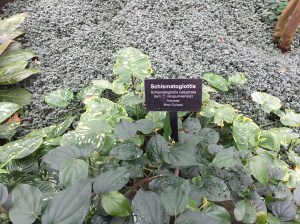
Part of how you see things depends on your perspective. And I was looking at the plants as a medical student. So when I saw a plant called Schismatoglottis (pictured at left), I immediately thought the placard read “Schistosomiasis” — a nasty parasitic worm you contract by exposure to infected water.

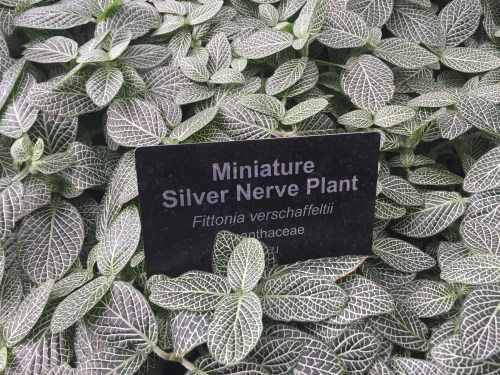
And looking at the miniature silver nerve plant, I had flashbacks to our brain and behavior unit last fall. The veins in the leaves do bear resemblance to axons and dendrites.

Miniature silver nerve plant

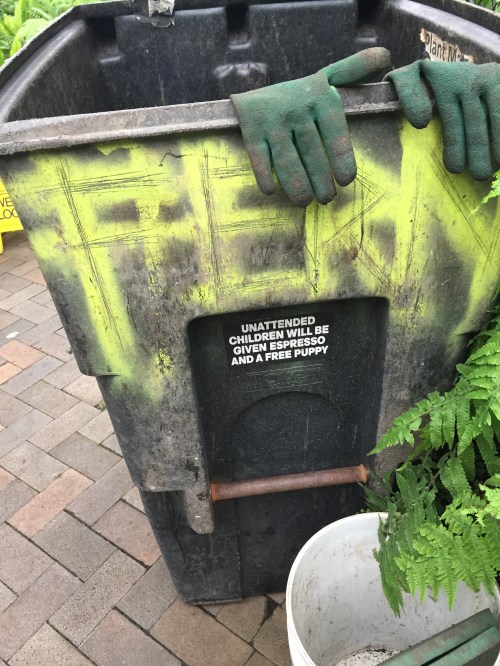
I found unexpected humor at the conservatory too. In the same room where my sisters and I had run amok as kids, I saw this gardener’s bin. I’m glad to see childhood playfulness is still welcomed — even encouraged.

And now, after such a refreshing spring break, it’s time to get ready for my next clerkship: primary care.

The one thing I can do as a medical student: listen

Show me a medical student who only triples my work and I will kiss his feet.

This is one of the “laws” from the satirical novel The House of God, by Samuel Shem. Now that I’m a medical student, I can see the truth in what that fictional medical resident said. It does take extra time to involve the medical student. And the scope of what I can do as a student is very limited. Of course, being included is the only way I’m going to learn — it’s the only way any doctor has ever learned. But when there’s so much to be done, I know there are moments of frustration for the nurses, residents, and attendings.

What I’ve discovered in the last few weeks, though, is that there is one job I can always do: listen. I’m in a unique position to do this. Most of the time the doctors and nurses simply don’t have time to sit there with a patient for very long. They have other patients to attend to, other more pressing tasks.

As I saw during my time rotating through ob/gyn, patients are often scared or upset. Just being present in the moment, hearing a woman’s concerns and holding her hand, makes a huge difference. Two encounters where this happened stand out in my mind.

One woman had presented to labor and delivery after falling. Trauma in pregnancy can induce labor or potentially cause a placental abruption (where the placenta prematurely separates from the uterus, resulting in painful, dangerous bleeding). She didn’t have any worrisome signs or symptoms, but was there for monitoring. I was the one to initially take her history, and noticed right away how anxious she was. Women who come in to triage, which is the emergency department for pregnant women, are all put on electronic fetal monitoring. She kept asking me how her baby was doing. After taking her history, I left to present the case to the resident. We returned together to see the patient. A little while later, my gut told me I should go back to check on the patient. She was still frightened. My reassurances that the baby was doing fine didn’t seem to help. So I went for the distraction technique. I asked whether she had a name picked out, whether she had a nursery ready. Almost immediately, the woman’s demeanor changed. For a few minutes at least, rather than concentrating on the angst of the moment, she focused on how excited she was to welcome this baby into the world in a few short weeks. Clearly wanting to share her excitement, she urged me to feel the baby kicking against her bare belly. It was obvious that a deep love for this unborn child was driving this woman’s fear. My heart went out to her. I know I didn’t take away the anxiety. But for the time I was there, I think she felt understood, cared for, and listened to. I believe that made some sort of difference — if only temporarily.

While on labor and delivery, I was also involved in many births. Some went smoothly, others less so. One woman in particular had a rough labor. This was during one of my night shifts. She’d been in the hospital for hours and hours, accompanied by her very supportive husband. She was exhausted. Her labor was not progressing well. I had been in the room for about two hours, helping her push. When the attending physician came into the room and recommended a C-section, the woman was devastated. The husband and I listened to her frustration. He held her hand, and I put my palm on her shoulder. The next morning, after the surgery, I ran into the husband as I left the unit. I was headed home after my 14-hour overnight shift for much-needed sleep. I walked up to congratulate him on the birth of his child. He dodged my outstretched hand and engulfed me in a hug. He thanked me for being there for his wife. He told me I had a marvelous bedside manner, and that I would make an excellent doctor. Suddenly every moment of my brutal night shift was worth it: I had really helped these people in their time of need. I walked the few blocks home exhausted, but on an emotional high.

Spending time with patients like these, listening to their life stories, jokes, or concerns, may not lessen anyone else’s work load. But I think it does help the patients. And that’s what I’m here for.