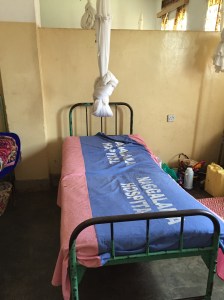
Conditions in this rural Ugandan hospital are very different from those in the urban New York City hospital affiliated with my medical school. Grief, though, is very much the same — as is the importance of listening to patients express their grief.
In palliative care, it’s called a “warning shot.” When you’re about to give someone bad news, you give them a heads up before you drop the actual bomb. One late afternoon, I got a warning shot in the operating theater here in rural Uganda when I witnessed my first Caesarean section. But like so many people, I believed in the best. So the next morning when I returned to see the mother and new baby, I did so with hope.
I didn’t expect that my first birth, nor my first Caesarean section, would be in Uganda. I’m learning that here, the unexpected is the expected. We had simply gone to the hospital for a quick tour. We ran into one of the doctors just as he was headed to do a C-section. He was happy to let me and Jemella, who is a palliative care physician from New York, watch. As Jemella and I watched the surgery, she talked me through what was happening — she described the layers of flesh the surgeon was cutting through. She prepared me for the gush of amniotic fluid (cause for the surgeon to wear a plastic apron and white rubber galoshes). What neither of us was prepared for though was the actual birth — a premature baby, umbilical cord wrapped around his neck, skin blue blue blue. That’s all I could think when the doctor pulled the baby out through the incision in the woman’s abdomen — “I can’t believe how blue that little baby is.” I wondered to myself: “Is he even alive?”
Not how I expected this birth to be. I expected the baby to come out pink and healthy, to wail, to be placed in his mother’s chest as she roused from her anesthesia. I expected to see that maternal glow as she saw her child for the first time and stroked his head. None of that happened.
I was standing near the foot of the operating table with a good view of the surgery, which was still in progress. The doctor was closing the uterus with sutures and sutures and more sutures. As he did so, the woman started to wake up and moan — clearly not enough anesthetic was used. At the same time, I watched with horror as across the room, the nursing assistant (I think that’s what she was) massaged the baby’s chest, suctioned out his nose and mouth, put a tube in his nose for oxygen, tried to help him breathe with a mask. It felt like forever before he made a sound, before I saw his fingers wriggling in the air.
There were just so many things wrong with the picture, to me as a medical student coming from the United States. When that baby was delivered blue, he should have been rushed to a NICU, surrounded by a team of neonatologists. His mother shouldn’t have nearly awakened from her anesthesia. But other things too, smaller ones — we were all wearing green cloth masks and cloth headscarves. Rather than gauze for soaking up blood from the surgery, they used sterilized cloth. One of the surgical assistants was actually wearing a scrub dress, her legs exposed, and open-toed plastic sandals on her feet.
Those differences, and their potential impact on patient care and safety, burned in my mind when we returned that next morning to check on the mother and her new baby. He had died in the night. His mother never even got to see him, much less hold him. She was distraught and traumatized, and for good reason. Babies aren’t supposed to die. Not ever, and especially not like that — in a way that might have been prevented had he been born somewhere else.
As I stood there with the grieving mother and her family, I had no words. I had gone into her surgery so excited for the outcome — my first baby! I imagine maybe she went into her surgery excited too, excited to meet her new child. If I felt like this, like someone had cut out my heart and wrung it dry, how must she feel? How humbling that she would allow Jemella and me in her life at this dark moment.
And yet, as Jemella and I turned to leave, she and every family member there shook our hands and thanked us for having come to see her. For what? What had we done for her? In practical terms, nothing. Her baby boy was still dead. She was still in the postpartum ward at the hospital, recovering from her surgery and listening to the echoes of other women’s babies crying when that’s something her own baby would never get to do.
We had listened, had held her hand, had tried to reassure her that this wasn’t her fault. Whether it helped I don’t know. But I hope so.



 It’s been years since I’ve taken a major international trip. And even longer since flying to a hub like Doha, Qatar, where I switch planes to Entebbe, Uganda. Even before taking off from New York’s JFK airport, my experience was already an international one. Living in NYC, I’m used to distinct people wearing distinct clothing. But the crowd taking my flight is of all colors — literally. There’s the man wearing a brown-and-blue plaid suit and a black fedora, and women in flowing headscarves, gold, pink, jet black. Then lots of people like me, wearing T-shirts, jackets, and casual pants — trying to be comfortable for this 12-hour flight. Standing in line on the jetway, waiting to board, I yawned. I’d gone to bed too late and gotten up too early. “Tired?” The white-haired, lanky, black man in front of me asked. “Yes,” I said, smiling. We started talking — he’s from the Chicago area, Wheaton to be precise. The same suburb where my best friend from childhood lived so many years ago. He’s headed to Sudan to visit his parents. “I’ve never been to Uganda,” he told me when I mentioned my own destination. “But I’d like to go.” There’s been lots of rain in Africa lately, he added — cools things off. Good to know.
  doc w/ Pen