doc w/ Pen

journalist + medical student + artist

Tag: Africa

The importance of cultural exchange — and of cows

You are no longer a woman. You are a bushwoman.

Driving into the Ugandan bush during my safari. During a safari, you spend hours in the car, going from one animal sighting spot to another. I had a wonderful guide, so the time on the road -- and our many conversations -- became part of the whole experience.

Driving into the Ugandan bush during my safari. During a safari, you spend hours in the car, going from one animal sighting spot to another. I had a wonderful guide, so the time on the road — and our many conversations — became part of the whole experience.

That’s what my guide, Joseph, jokingly told me as we drove into the African bush on the first day of my safari. I didn’t know it at the time, but during those four days, I would learn so much about Uganda — and he about the United States.

It started shortly after Joseph and I hit the road. At one point, he and some boda-boda (motorcycle taxi) drivers were joking in Luganda, the local language. One thing I really appreciated about Joseph was that he would translate these conversations for me. So he promptly told me that I had been the subject of that conversation.

“That’s a beautiful woman you have,” one of the drivers had laughingly said to Joseph. “How many cows do you want for her?”

This launched us into a discussion about marriage customs in Uganda, customs that to me as an independent America woman were hard to wrap my head around. Apparently, the bridegroom often gives a gift to the bride’s family — in the form of cows, if you’re from a certain part of the country. Joseph emphasized that culturally, this is not seen as actually paying for the bride. It’s more a gift of appreciation. But before that happens, the man has to have an “introduction” — kind of like an engagement party, where the future groom buys the whole village a bunch of food both to celebrate and to prove that he’s a good guy. This introduction, Joseph said, is actually more important than the wedding itself. Then to get engaged in the church, you need a letter from the parents, granting approval. So for a man, between the introduction and the dowry, getting married can be an expensive proposition.

I continued to learn about Uganda throughout the trip, things you might not read about in guidebooks. As we drove through one particular town for example, Joseph commented that HIV was an especially big problem there. It’s a stopover place for truckers coming from both Kenya and Tanzania, he said — and some of the truckers look to hire prostitutes during their time there.

Our conversations, though, were well balanced between heavy and light topics. Toward the end of the trip, I asked Joseph about the hand motions I’d seen him make time and time again out his driver’s side window. He explained that it was a sort of sign language oncoming drivers used to query about road conditions up ahead. The oncoming driver would blink his lights. There were three possible responses, Joseph told me. If things are fine, you stick your hand out the window, palm parallel to the road, and wave your hand left to right and back again. If there is a problem immediately up ahead for the oncoming driver, with your hand out the window and your index finger pointed down to the road, you move your hand up and down. If things are bad — but not for some distance — you make a sine-wave motion with your hand. And then after the wave motion, you point your index finger down toward the road several times. I told Joseph I fully support adopting this system in the United States.

Another view from the road, this time of a grassland savannah. During a safari, you spend hours in the car, going from one animal sighting spot to another. I had a wonderful guide, so the time on the road -- and our many conversations -- became part of the whole experience.

Another view from the road, this time of a grassland savannah.

During our many hours in the car, I made a number of important contributions to Joseph’s understanding of America and Americans too. I did my best to explain some of our inexplicable vernacular expressions, including the old-fashioned phrase “knock on wood.” He understandably thought that was silly. I don’t blame him.

Perhaps the most significant knowledge I imparted relates to my hometown, Chicago. I told Joseph that I live in New York City now, but that previously I was in Chicago. When he heard that, this was his first question: “Do they raise cows there?” You can imagine my confusion. I quickly realized, though, that Joseph’s question made total sense when you think about one of Chicago’s favorite sons, Michael Jordan of the Chicago Bulls. Why would they use “bulls” for the team’s mascot if they don’t have cows in Chicago? Joseph wondered. Good question. I still don’t have a good answer.

There was plenty that surprised me about Uganda, and Joseph about the United States. Some of it was confusing, and some of it was beautiful. But learning about another culture, the differences and similarities, regardless of whether they make sense or not — that’s part of why I travel. I’m so grateful that my guide, Joseph, felt the same way. It made for a wonderful four-day trip.

One who listens

In addition to this blog, I also write a monthly column called Bio-Lingual for the online magazine The American In Italia. I don’t usually cross-post. But the piece that was just published there is about my time in Uganda so I wanted to share it here, with those who are following my experiences. Here is the link:

One who listens

A brief preview, in case you’re deciding whether to click on the link: In the essay, I explore the kind of doctor I want to be. Being in Uganda for two weeks helped me better understand how I want to treat patients.

Does anybody really know what time it is?

The men’s ward at Naggalama Hospital. I would sometimes see Joshua*, a patient we cared for there, sitting in a wheelchair outside in the shade.

“Time” is perceived differently in Uganda than in the United States, at least by some people. In the United States, so often we’re tied to our watches, computers, and cell phones — all of which help us get where we need to be right on time. In Uganda, time is a more fluid concept. Many people think of their lives in terms of events and stories — not in terms of hours or days. Kenny, the Ugandan man who was assisting the documentary film crew working with us, explained this to us midway through our two-week time doing medical work in rural Uganda. After that explanation, so many mysterious things suddenly made sense. We asked patients many questions that relied on our American concept of time. Questions like this: “When you took the morphine, how long until the pain came back?” Some patients struggled with these questions. After Kenny’s words, it became clear that this difficulty might not be with our wording, but with a broader concept of memory and time-keeping. I’m not sure how you bridge that gap, but it’s something to think about for future visits.

Toward the end of my time in Naggalama, I realized that my own memories of this trip may have more in common with the Ugandan concept of time than the American one. The long days there, spent first rounding in the hospital and then in the community making house calls, quickly blurred together for me. I couldn’t tell you that on Monday, we saw patients A, B, and C, whereas on Tuesday we saw patients X, Y, and Z. Half the time I didn’t know what time it was — only whether I was hungry or thirsty or tired (which was most of the time, given the rigors of this work). It was all a jumble — a jumble of people and faces. And especially of their stories. Here are a few such stories that stood out to me during my two weeks in Naggalama, both from the hospital and from house calls.

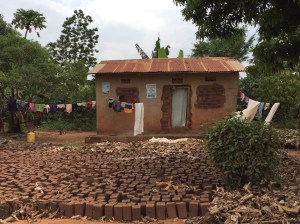
Rural home 4

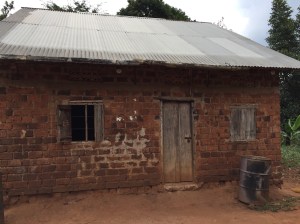
This is the kind of home that most of the palliative care patients lived in.

While working in Uganda, we saw many women with breast cancer. In the United States, breast cancer has a high cure rate if caught early. But in Uganda, women often present late to the hospital, too late for treatment, and they die. Two women with this disease especially stand out to me. We met Margaret* outside her house. We all sat on straw mats in the dust to talk. Like many women, Margaret didn’t seek conventional medical treatment when she first became ill. Now, her tumor was very advanced. Surgery and chemotherapy were no longer options for her. But we could still help her pain, which we did, with medications. We could also help her in other ways. Margaret was extremely poor, even by Ugandan standards, and had only one dress. A Dutch woman who helps fund programs at Naggalama Hospital had sewn Margaret a skirt and a blouse. When I presented them to Margaret, she immediately slipped them on, stood up, and began dancing. I’ll never forget how something so simple brought this woman so much joy.

In contrast to Margaret, Elizabeth did have surgery for her breast cancer. She told us that as soon she felt a lump, she went to the hospital. We asked why she had decided to go the hospital immediately. Elizabeth softly started to cry, telling us that her daughter had developed a breast lump some years earlier. Her daughter did not go to the hospital and died. Because of this, Elizabeth didn’t listen when her friends and neighbors told her going to the hospital would be the death of her. Elizabeth’s situation represents the potential for public health education, in the form of patients telling fellow villagers about their positive experiences with medical care.

Cecilia was an older woman who had fallen and apparently dislocated her shoulder. That was months ago. At this point, it would take surgery to correct — a surgery that wouldn’t likely be done in Uganda. So Dr. Howard Eison, one of the New York physicians on our team, fashioned a makeshift sling. Howard rested Cecilia’s arm in a long, narrow swath of lacy fabric and tied the cloth in a knot behind her head. Then to further immobilize the shoulder, he wrapped a purple-and-white scarf around her upper body and tied it at her side. After applying the two-piece sling, Cecilia was able to be pulled into a sitting position. She started talking, even laughing — no small miracle.

We found Michael lying on a foam mattress in his small, brick house. His limbs were sticks. We learned from a neighbor that he had essentially been abandoned, unable to fetch food or feed himself. As we talked with the neighbor, she found a bottle of orange soda next to his mattress. She put a straw in the bottle and held it to his lips. Michael sucked until the drink was gone. Watching her care for him, we decided to take a chance and give the neighbor a small sum of money (about $3 U.S. dollars) to buy him food. Whether she would use that food for Michael or her own family, we didn’t know. But we had to do something.

I’ll never forget Jane’s face. Most of the time, I saw it behind mosquito netting. Even through the tiny pin holes, I could see the peeling burns. Jane had been brought in one night early on in my stay in Uganda with horrible burns over much of her body. But in Naggalama, there’s no intensive care unit. No dedicated burn unit. She was left on the general medical ward like everyone else.

Talking to Joshua in his bed, listening to him speak softly in Luganda entwined with broken English, he struck me as such a gentle man. Joshua was in the hospital with a very serious leg infection. He needed an expensive skin graft. We saw Joshua every day to check on his leg and his pain. Sometimes I would see him outside the medical ward, sitting in a wheelchair in the shade. We would both smile and wave to each other.

I may never know how these stories end. I can only hope that the small role we played made at least the tiniest impact. I can only hope that we brought some joy or happiness, some comfort or relief, to people who are, in my American eyes, experiencing so much tragedy.

*Patient names changed to protect privacy.

Typical weekday in Naggalama

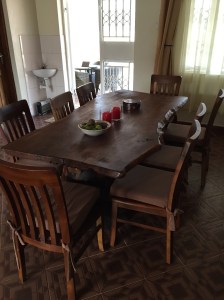
Dining room table

The table in the guesthouse where we ate our meals.

While I’ve written extensively about my experiences in rural Uganda, it occurred to me that I never made it clear what a typical day was like. And that’s an important piece of my time there. Although I have listed times here, these varied by day. We learned to expect the unexpected.

7:30 a.m. – 8:30 a.m. — breakfast. Our group gathered at the table in the main guesthouse for this very important meal. I say “very important” because during the week, we never ate a full lunch, merely snacks on the go; we were out in the community all day. Breakfast usually consisted of hardboiled eggs, toast, fruit, and coffee or tea. (And after two straight weeks of daily hardboiled eggs, I still have no interest in eating one.)

8:30 a.m. – 10:30 a.m. — hospital rounds. Randi, Howard, Jemella, and I headed to check on the hospital patients who had been referred for palliative care, mostly pain management.

Typical home

The view of a typical home in the rural community, seen through the window of the palliative care team’s van.

10:30 a.m. – 5:30 p.m. — house calls. After hospital rounds, we met up with the local palliative care team (a nurse trained specifically in palliative care and her two nursing assistants) to head out into the community for palliative care house calls. Some patients lived in nearby towns; others lived in villages an hour away on rutted, dirt roads. The distances we often traveled, plus visits that might last 30 minutes to an hour, meant we usually saw no more than four or five patients a day. I knew that these visits would be emotionally challenging. Some of them were. But I learned, through watching Randi, Howard, and Jemella, how to better listen to patients — and how rewarding that kind of intimate interaction could be. What I wasn’t expecting were the physical challenges of being out in the community for six or seven hours. We all got hot, sweaty, tired, hungry, and thirsty (and didn’t drink much water because there weren’t any bathrooms).

5:30 p.m. – 8 p.m. — decompress. After a long and intense day, we’d come home to both unwind and to process what we’d experienced. This usually happened over cheese, crackers, and hummus — delicacies procured in Kampala, the capital city. Sometimes we sat in the living room; sometimes outside on the lovely back patio.

8 p.m. — dinner. Meals in Uganda consist of a lot of starch — potatoes, also called “Irish,” as well as rice and pasta. Vegetables and meat were accents. That was a big change from my diet in the United States, which is mainly fresh produce and protein. So food was a challenge for me. Though I must say, the housekeeper certainly made some mean french fries.

10 p.m. — bed. Growing up, I always wanted a canopy bed. That never happened. But in Uganda, I slept every night under a mosquito net, which is pretty much the same thing, but with a purpose!

My "canopy" bed.

My “canopy” bed.

Reading the signs

Seek firstMaybe it’s my training as a journalist — knowing that every whiff, sound, and sight might whisper a crucial part of the story I’m trying to grasp, and eventually tell. One facet of that story at Naggalama Hospital was the collection of signs scattered around the campus. In pictures and printed words, they revealed priorities, attitudes, and struggles at this rural Uganda hospital.

HIV testing and treatment. One of the few free things at Naggalama Hospital is HIV testing. HIV/AIDS is much more widespread in Uganda (and the rest of Africa) than in the United States. And it’s a major public health priority.

Malaria treatment. This is another major health issue in Uganda. Mosquitoes carry the disease, so people are encouraged to sleep under netting at night to prevent infection.

Malaria treatment

Blood tests. Some of the same laboratory tests that are done in U.S. hospitals are available at Naggalama, as evidenced by this sign. However, due mainly to cost (from my understanding), these tests are rarely done, even for the sickest patients.

Available blood tests

The hospital stay in rural Uganda

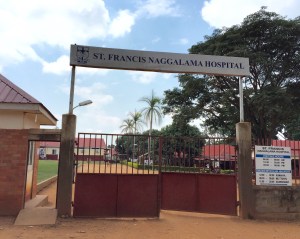
Naggalama HospitalWhen I had my tonsils out in 2014, I spent a couple days in the hospital after minor complications with the surgery. It was by no means a vacation. But I certainly felt well cared for. I expected it. And I took for granted the clean sheets, three daily meals, and constant (amazing!) nursing care. My time in Uganda taught me that my hospital experience is not necessarily the norm, and I shouldn’t take it for granted. These pictures are from Naggalama Hospital, but I also spent a day at Mulago, the government hospital in Kampala. The same principles applied there, from what I could tell.

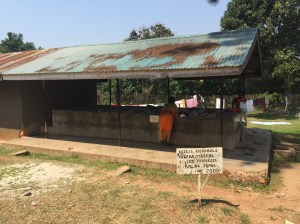
Hospital laundry

Attendants must wash patients’ clothes and bed linens behind the hospital.

Three things that are expected in an American hospital — clean bedding, three daily meals, and constant nursing care — aren’t part of the hospital stay at Naggalama. As a hospital patient, you are required to bring an “attendant” to care for you. This person is usually a family member. He or she washes your clothes and bed linens (there is a washing station behind the hospital). The hospital doesn’t provide bed linens or gowns; you have to bring these in yourself. The attendant also either cooks or brings in your food (there is a place to cook behind the hospital, as well as a small restaurant called St. Peter’s). There are nurses, but few of them, and they serve many patients. Nurses administer IV medications, but attendants hand out the oral drugs, after receiving instructions from the nurse.

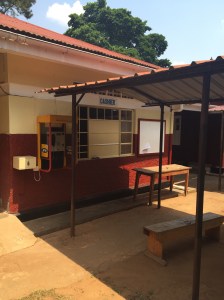
Cashier

Attendants pay in advance for medical services with the cashier.

The attendants also play a major role in the patients getting proper medical services. If a patient needs a blood test, the attendant must take the doctor’s order to the cashier, pay for the blood test in advance, and then bring the receipt back to the ward so the nurse can draw the blood. Some medications must also be paid for in advance. The bulk of the hospital bill, though, is settled upon discharge. The patient can’t leave, however, until the bill has been paid. Supplies are precious and expensive, so the bills are incredibly detailed, down to every pair of latex gloves used in the patient’s care.

Having been both a hospital patient and a hospital employee (and now a trainee), I have a certain picture of what a hospital room looks like. At Naggalama, the majority of adult patients are not in rooms. They are in the male or female wards. There are a handful of private rooms, but these are very expensive, by Ugandan standards. The wards are made up of units (my own term). Each unit has two rows of three or four beds facing each other. The units are separated by walls that go about halfway from the floor to the ceiling, so you can see across the ward. Above each bed is a knotted mosquito net, pulled down at night to protect the patient from malaria-carrying bugs. Next to the beds you will find colored straw mats where the attendants sit during the day, and where they sleep at night.

Here is a brief, visual tour through the adult ward, and several other parts of the hospital. (Click on any image to enlarge and begin a mini slideshow.)

Adult ward:

OPD (outpatient department):

Emergency room:

Hospital laboratory:

Hospital pharmacy:

Staff housing on the hospital campus:

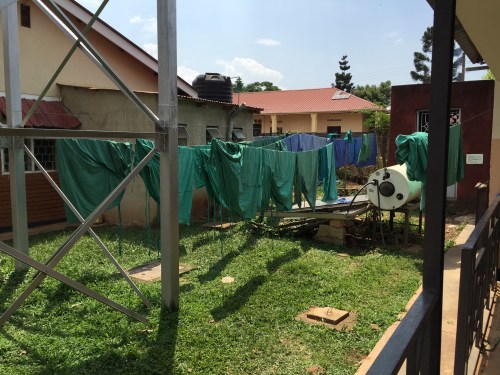
Surgical gowns drying outside after being washed:

Surgical laundry


Creating a kid-friendly space in a kid-unfriendly place

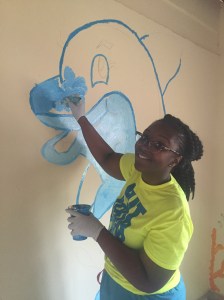
Jemella, quite the talented artist, painting her masterpiece dolphin.

Jemella, quite the talented artist, painting her incredible dolphin.

The hospital is a scary place for kids, regardless of what country you’re in. Eva, a Dutch woman who funds various programs at Naggalama Hospital, recently had a children’s playroom constructed adjacent to the pediatrics ward. Before opening it to the kids, she wanted it decorated. So one Sunday afternoon, we (Eva, Randi, Howard, Jemella, and I) all got together and painted the long, narrow room in an aquatic theme — Jemella’s idea. We each took a wall as our personal canvas, then worked together to fill in the gaps at the end. Here are photos of some of the masterpieces. Click on each image for a larger version. (I don’t have pictures of Randi’s or Eva’s work, but it’s amazing too!)

After the paint had dried, Eva gathered toys and books to fill the space. Walking by the room now, even from the outside, you can hear the excited squeals of kids playing with those toys, happy to be away from their hospital beds. Happy to be distracted, if only for a little while. It’s a good feeling to have had a little part in that.

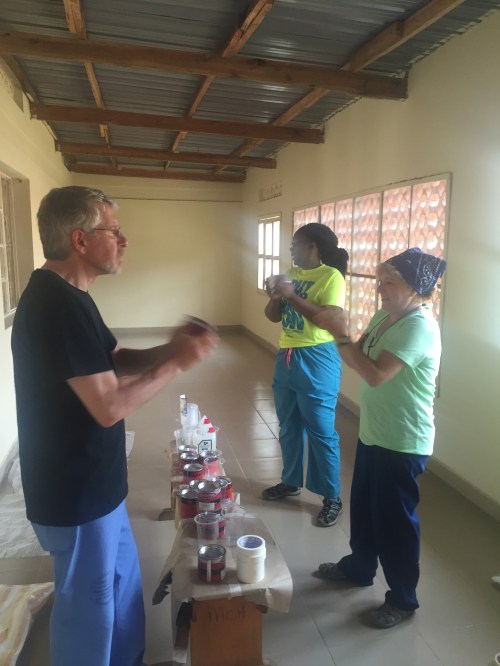
Howard, Jemella, and Randi shaking up the paint cans before starting our works of art. The only type of paint available was oil-based paint, and there were very limited colors. So we did a lot of mixing in the plastic cups you see here. As a result, the playroom is a vibrant mix of all colors, shades, and hues.

Howard, Jemella, and Randi shaking up the paint cans before starting our works of art. The only type of paint available was oil-based paint, and there were very limited colors. So we did a lot of mixing in the plastic cups you see here. As a result, the playroom is a vibrant mix of all colors, shades, and hues.

Being in Naggalama: “You are welcome”

It’s impossible to represent a region — much less an entire country — after only a few weeks there. But through working with the palliative care outreach team from Naggalama Hospital, I got a taste of life in and around this rural area. These are images and impressions from my time spent there.

To get to patients who live rurally, we took rutted roads for an hour or longer. "Bumpy" completely fails to describe the experience. To quote Jemella, who sat in the backseat with me: "This is what it must be like to be groceries in a bag."

To get to patients who live rurally, we took rutted roads for an hour or longer. To quote Jemella, who sat in the backseat with me: “This is what it must be like to be groceries in a bag.”

To put things in context: each weekday, we would leave from the hospital in vans and head out to patients’ homes to see people who needed palliative care (most often pain management). Some people lived in nearby towns; others on dirt roads an hour or more away.

I was immediately struck by how different life is in Naggalama compared to the places I’ve lived in the United States — Chicago, the Upper Peninsula of Michigan, Tucson, and now New York City. But United States or Uganda, people are people. So as much as I will remember the bumpy dirt roads and cramped brick houses, I will remember the gracious and kind souls who invited us into those houses with a warm smile, a light handshake, and this local greeting: “You are welcome.”

Note: Click on any photo to enlarge and start a mini slideshow.

Rural setting:

Town setting:

Getting around:

The boda-boda is a sort of motorcycle taxi. Most people don't wear helmets, and accidents are a major cause of morbidity and mortality.

The boda-boda is a sort of motorcycle taxi. Most people don’t wear helmets, and accidents are a major cause of morbidity and mortality.

Flora and fauna: Being at the equator, all kinds of things grow here — bananas, coffee, avocados, corn, passion fruit, jack fruit, mangos, and more. Many people here are subsistence farmers who sell a little produce at the local market. Having animals is a sign that you possess a little (though not necessarily much) money.

Cute kids

Thumbs-up“Mzungu.”

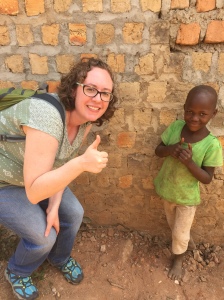
That essentially means “white person” in Luganda, the local language in the central region of Uganda. As we’d walk down a street, through a village, or up to someone’s house, we’d often hear little people yelping out the word, in reference to all the big white people (us) traipsing around. I don’t think it meant as an insult, though, at least not in these situations. The kids were simply curious. We certainly stuck out. And they wanted to see what all the hubbub was about.

Who were we to disappoint these little darlings? So we put on a show. We would all snap pictures of the kids with our phones, and then show the kids what they looked like on the screen — something that inevitably brought out shouts of excitement. We shook hands and traded high-fives and thumbs-up. I think Randi was their favorite because she doled out lollipops and balloons (often with our help).

Some kids were shy. But most were friendly, waving vigorously and calling out as we walked back to the van to leave. Some of my happiest moments during the day, brief but key moments that kept my spirits up, were spent with these kids. Here are pictures of those shared moments.

(Click on any photo to see an enlarged slideshow.)

Why many people in rural Uganda don’t go to the doctor


Bicycle.jpg

How do you decide between potentially life-saving cancer treatment (sell your bicycle) and your children’s education (keep your bicycle)? That’s precisely the decision one patient I met had to make. He kept the bicycle, pictured here hanging from the wall of his home.


Quick, decide: your health, or your children’s education?

No one should have to make that choice. Yet that’s exactly the choice one of the Naggalama Hospital palliative care patients had to make when he was told he had cancer and needed treatment at Mulago, the government hospital in Kampala. He said the only way he could afford this potentially life-saving cancer treatment was to sell his bicycle. But without the bicycle, his children couldn’t attend school. This father made his choice last year — his children’s education — and this year we saw that his cancer has spread.

This is a common story among patients I’ve met here. Someone is diagnosed with a serious illness. The disease has often already progressed because people here frequently don’t seek medical attention when first becoming ill (the subject of my research project). Once diagnosed, the person is usually referred for treatment at Mulago. Often, they don’t go. Or they delay. The reasons for this are complex, I’m learning.

Some people fear Mulago, and not without cause. For starters: it’s an enormous hospital, 1,500 beds, I’m told, with a census that can reach 2,500. Those extra patients sleep on the floor. (Although renovations are now underway in an attempt to fix the overcrowding, and when I visited Mulago I didn’t see any patients on the floor.) Lines are long. Drugs are often out of stock, so the patients’ attendants have to search for medications elsewhere in Kampala. There are few doctors, fewer nurses, and many mosquitoes.

People’s fears are sometimes based on misunderstandings, though. I heard one woman say that she was initially afraid to go to Mulago for a mastectomy because she had seen other women get the same treatment and die soon after. It is likely that those women died because they presented late for surgery and their cancer was too advanced — not that they died from the surgery itself. Because of such fears, people may seek treatment from local herbalists first. When that doesn’t work, they finally go to Mulago. By then, it is often too late.

Beyond the fear, many patients simply can’t afford the treatments at Mulago. One woman told me that after she was diagnosed with breast cancer, it took her family two years to gather the funds so she could have surgery and appropriate chemotherapy at Mulago. I heard about another woman who barely scraped enough money together for her chemotherapy treatment, only to be told after the treatment that her funds covered only one dose. She would need many more doses, the Mulago doctors said — something she hadn’t understood. She couldn’t afford it. So she just stopped going. Her cancer has now progressed too.

Like so many things here, I don’t know what the solution is. Medical care here is cheap compared to in the United States. So it’s easy to say “I’ll pay for this patient’s chemotherapy” or “I’ll pay for that patient’s surgery.” Obviously though, one person or one group can’t pay for everything and everyone. I know being here makes a difference in some people’s lives. The patients all say that. They are grateful beyond belief. But it’s hard to avoid a sense of frustrated futility sometimes.