doc w/ Pen

journalist + medical student + artist

Labels and culture in Uganda


Coke.jpg

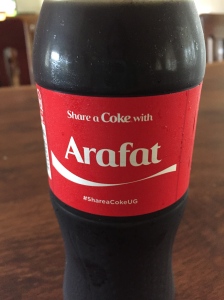
Uganda’s version of the “Share a Coke with …” campaign. My first thought when seeing this was of Yasser Arafat, the Palestine Liberation Organization leader. But I’m guessing that’s not what Coca-Cola was going for here. Another soda bottle (I didn’t get a picture of this one, unfortunately) read: “Share a Coke with Blood.”

As a foreigner, there are certain things that stand out to you that a local person might find completely normal. Here are two Ugandan product labels that, as such a foreigner, I found quite interesting. Note that this is a personal reaction based on my own cultural upbringing, not any sort of criticism. I shudder to think what people from Uganda would make of many American product labels and advertising … 

Nice double entendre going on here with this bottle of African honey.

Necessity is the mother of medication

In the United States, we’re used to any medications or supplies being available at any time in any dose: ask and ye shall receive. In Uganda, that’s not the case. Only certain drugs are available through Naggalama Hospital. For example, morphine is the only opioid. Even medications that should be available often run out (and morphine did run out while we were there). For those medications that are actually present, the pharmacy might only carry one dose — a dose that’s certainly not appropriate for every patient. With all of these constraints, palliative care (and any care, really) becomes a challenge unfamiliar to visitors. You learn to make due, and to get creative. Here are a couple of examples of how that played out while I was there.  

Amitriptyline.jpg

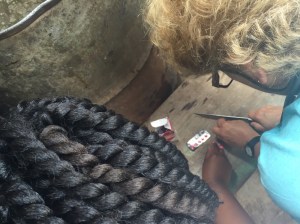
Drs. Jemella Raymore and Randi Diamond halving 25 mg tablets of amitriptyline for a patient with spinal stenosis. We hope the medication (now at a more appropriate dose) will help relieve her neuropathic pain as well as her depression.

One day, we visited the home of a patient with horrible spinal stenosis. Her lower limbs were essentially paralyzed. She was unable to walk or even stand. Her upper limbs had become extremely weak too. She could no longer raise her arms above shoulder height, and grasping anything in her hands had become impossible. To help treat her neuropathic pain and her depression, the palliative care team decided to use a drug called amitriptyline. But the only dose available, 25 mg, was far too high for this situation. The round, bright pink pills were coated, so couldn’t be broken easily by hand. Thankfully, though, they were scored in the middle. So we asked for a knife. What we got looked like a small rusty machete, but it did the trick, and now she has a more appropriate dose. 

Zofran is a great drug to treat nausea after chemotherapy. But it’s expensive, and therefore not available at Naggalama. So for a woman who’d had a mastectomy, and is now undergoing chemotherapy, the team decided to try a drug called haldol. A dose of 0.5 mg or 1.0 mg is where we would start in the United States for a case like this. But the only dose available was 10 mg — enough to completely knock her out. So as we sat talking to the woman in her home, Dr. Randi Diamond broke the round, white pills into halves, and then quarters, to get a 2.5 mg dose (roughly). It’s something. And hopefully it will control her nausea and vomiting without making her too tired.

Getting patients their medications is a start, but just like in the United States, medication compliance is another issue — though perhaps for different reasons. The woman with spinal stenosis, for example, was afraid to take her morphine (and other medications) without a family member around because she gets dizzy. And no one is around on weekdays. So she’d only been treating her excruciating pain on the weekends. The palliative care outreach team from Naggalama Hospital does supply its patients with needed drugs like morphine and amitriptyline. But for many other people, the cost of medication — priced in Uganda at pennies a pill — is simply too expensive.

Spanish? In Uganda?

“Es un día de turquesa!” I belted out as Jemella and I walked down the path to the adult medicine ward at Naggalama Hospital. I was commenting on the fact that four of us had randomly worn turquoise shirts and khaki pants that day. Obviously, no one here speaks Spanish. It’s the weirdest thing. Being here in Uganda, hearing the local language (Luganda) all around me, I suddenly have the urge to speak the only foreign language I do know — Spanish.

This is what I’ve concluded about that impulse: Most of the international traveling I’ve done has been in South America. I’m fluent in Spanish, so language wasn’t an issue there. I told my taxi driver where to go, ordered pisco sours, bought fresh bread, and did pretty much everything else without a problem. Uganda is a different case entirely. I know all of four words in Luganda. With so many strange sounds flying around, I think I’m grasping at something with both foreign and familiar flavors (Spanish). While not helpful in the slightest, the urge remains. And it remains unhelpful, though entertaining.

Dr. Randi Diamond and me, out in the field doing palliative care house calls — in our matching turquoise and khaki outfits.


“I will not repeat”

Dr. Jemella Raymore, the ward nurse, and I must have talked with him for a half hour. He was a slight man, wearing black pants too big for his spindly legs. His shirt, camel colored with blue plaid sleeves and collar, was only buttoned halfway up. He was seated on his hospital bed, which was covered with a purple- and gold-flowered fleece blanket. He kept his hands folded and his eyes down, speaking softly, almost inaudibly, as if he weren’t even here. Or didn’t want to be. We were almost the same age, I realized as I looked at his chart. He looked so sad. He’d swallowed poison two days ago and been brought in on a motorcycle. He survived the suicide attempt, and was about to be discharged. But he was clearly still in great distress. So his doctor consulted the palliative care team. 

This man’s case isn’t technically a palliative care case. But it seems that any time feelings are implicated, the palliative care team gets called. (Under normal circumstances, this means calling the local palliative care nurse and her assistants, but it also means calling the American doctors when they’re visiting.) There’s unease around feelings, and what doctors can, or should, do about them. So Jemella and I talked to this man. We listened to his story, one I guarantee no one else at the hospital had heard: his family and his wife have been verbally abusing him. He told us that as a result of this abuse, he’d thought about suicide before, even picking up the poison, but always putting it back down again — until a few days ago. We asked him about his life. About his children, his work, what brings him joy. We encouraged him that his life matters — to his friends, and to us, even though we may be strangers. We encouraged him that finding someone to talk to about his struggles, whether a religious figure or a friend, is not a sign of weakness. It’s a sign of strength. We told him he’s a strong person for enduring so much pain. 

We also asked whether he still felt like hurting himself. At that, he finally made eye contact. The nurse translated his words as this: “I will not repeat.” 

My first birth, and a death

Conditions in this rural Ugandan hospital are very different from those in the urban New York City hospital affiliated with my medical school. Grief, though, is very much the same — as is the importance of listening to patients express their grief.

In palliative care, it’s called a “warning shot.” When you’re about to give someone bad news, you give them a heads up before you drop the actual bomb. One late afternoon, I got a warning shot in the operating theater here in rural Uganda when I witnessed my first Caesarean section. But like so many people, I believed in the best. So the next morning when I returned to see the mother and new baby, I did so with hope.

I didn’t expect that my first birth, nor my first Caesarean section, would be in Uganda. I’m learning that here, the unexpected is the expected. We had simply gone to the hospital for a quick tour. We ran into one of the doctors just as he was headed to do a C-section. He was happy to let me and Jemella, who is a palliative care physician from New York, watch. As Jemella and I watched the surgery, she talked me through what was happening — she described the layers of flesh the surgeon was cutting through. She prepared me for the gush of amniotic fluid (cause for the surgeon to wear a plastic apron and white rubber galoshes). What neither of us was prepared for though was the actual birth — a premature baby, umbilical cord wrapped around his neck, skin blue blue blue. That’s all I could think when the doctor pulled the baby out through the incision in the woman’s abdomen — “I can’t believe how blue that little baby is.” I wondered to myself: “Is he even alive?”

Not how I expected this birth to be. I expected the baby to come out pink and healthy, to wail, to be placed in his mother’s chest as she roused from her anesthesia. I expected to see that maternal glow as she saw her child for the first time and stroked his head. None of that happened.

I was standing near the foot of the operating table with a good view of the surgery, which was still in progress. The doctor was closing the uterus with sutures and sutures and more sutures. As he did so, the woman started to wake up and moan — clearly not enough anesthetic was used. At the same time, I watched with horror as across the room, the nursing assistant (I think that’s what she was) massaged the baby’s chest, suctioned out his nose and mouth, put a tube in his nose for oxygen, tried to help him breathe with a mask. It felt like forever before he made a sound, before I saw his fingers wriggling in the air.

There were just so many things wrong with the picture, to me as a medical student coming from the United States. When that baby was delivered blue, he should have been rushed to a NICU, surrounded by a team of neonatologists. His mother shouldn’t have nearly awakened from her anesthesia. But other things too, smaller ones — we were all wearing green cloth masks and cloth headscarves. Rather than gauze for soaking up blood from the surgery, they used sterilized cloth. One of the surgical assistants was actually wearing a scrub dress, her legs exposed, and open-toed plastic sandals on her feet.

Those differences, and their potential impact on patient care and safety, burned in my mind when we returned that next morning to check on the mother and her new baby. He had died in the night. His mother never even got to see him, much less hold him. She was distraught and traumatized, and for good reason. Babies aren’t supposed to die. Not ever, and especially not like that — in a way that might have been prevented had he been born somewhere else.

As I stood there with the grieving mother and her family, I had no words. I had gone into her surgery so excited for the outcome — my first baby! I imagine maybe she went into her surgery excited too, excited to meet her new child. If I felt like this, like someone had cut out my heart and wrung it dry, how must she feel? How humbling that she would allow Jemella and me in her life at this dark moment.

And yet, as Jemella and I turned to leave, she and every family member there shook our hands and thanked us for having come to see her. For what? What had we done for her? In practical terms, nothing. Her baby boy was still dead. She was still in the postpartum ward at the hospital, recovering from her surgery and listening to the echoes of other women’s babies crying when that’s something her own baby would never get to do.

We had listened, had held her hand, had tried to reassure her that this wasn’t her fault. Whether it helped I don’t know. But I hope so.
Qatar Airways #704

It’s been years since I’ve taken a major international trip. And even longer since flying to a hub like Doha, Qatar, where I switch planes to Entebbe, Uganda. Even before taking off from New York’s JFK airport, my experience was already an international one. Living in NYC, I’m used to distinct people wearing distinct clothing. But the crowd taking my flight is of all colors — literally. There’s the man wearing a brown-and-blue plaid suit and a black fedora, and women in flowing headscarves, gold, pink, jet black. Then lots of people like me, wearing T-shirts, jackets, and casual pants — trying to be comfortable for this 12-hour flight. Standing in line on the jetway, waiting to board, I yawned. I’d gone to bed too late and gotten up too early. “Tired?” The white-haired, lanky, black man in front of me asked. “Yes,” I said, smiling. We started talking — he’s from the Chicago area, Wheaton to be precise. The same suburb where my best friend from childhood lived so many years ago. He’s headed to Sudan to visit his parents. “I’ve never been to Uganda,” he told me when I mentioned my own destination. “But I’d like to go.” There’s been lots of rain in Africa lately, he added — cools things off. Good to know. 
Seated next to me on the flight was a brown-haired, petite nurse, on her way to the Philippines to visit her college-age daughter. She works in a plastic surgery practice in Manhattan. We talked about medicine, how it’s nurses who really take care of patients, how some wealthy people are nice and others are bit**** (just like normal people, I told her), how her daughter wants to go to medical school someday. 

Most people, though, aren’t much for conversation — they’re either tuned out or plugged in. There are more movies available on this flight than I’ve ever seen, in languages from English to Spanish to German to French to Portuguese to languages in cryptic, non-Latin characters I can’t make out. A slice of the world is up here at 30,000 feet with me.

Exploring NYC: American Ballet Theatre

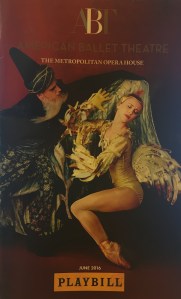
ABT programAs a kid, I always had at least one friend who was taking dance lessons. So I attended my fair share of ballet performances. But until this past Saturday night, I’d never been to the real ballet. The professional ballet, that is. It was an experience I won’t forget, and one I hope to repeat soon.

To be honest, I didn’t know what to expect. Ballet always seemed a lot like modern art to me—fascinating, beautiful in its own right, but inherently mysterious. Maybe this is why: I’m a writer. So it’s hard for me to understand how you can tell a story without words. But the American Ballet Theatre dancers did a phenomenal job of telling the story of “Romeo and Juliet” through movement, music, and costumes. I think it did help that I knew the story in advance. (Good ol’ freshman English—Mrs. Bailey’s class, and my first taste of Shakespeare. I remember being so fascinated with the line “Do you bite your thumb at us, sir?” and how biting your thumb in Shakespearean times was equivalent to flipping someone off in today’s culture.)

What was so marvelous was how the ballet dancers told the story. There were no words, obviously, but there was plenty of drama. The dancers’ movements ensured that, as did Sergei Prokofiev’s orchestral music. What surprised me was how characters were distinguished from each other. When you watch a movie, you can see each person’s face, enabling recognition. From my perch, I couldn’t see any faces. What the ballet used instead was color. The costumes for the Montague and Capulet families each had a different color palette. Tybalt, Romeo, and Juliet especially had clothing that stood out.

I don’t pretend to be a ballet aficionado now, to truly appreciate the dance. But I certainly enjoyed it—and look forward to my next night of ballet at the Metropolitan Opera House.

Summer plans: Research and palliative care in Uganda

My visa to Uganda.

My visa to visit Uganda.

One of the reasons I was so interested in Weill Cornell is its emphasis on global health. This isn’t a passing fancy. I studied abroad in Valparaíso, Chile for a semester in college, and learned more about the world—and myself—than I imagined possible. My career goal during college was to become a foreign correspondent based in Latin America. And upon graduation, I earned a minor in international studies. All that is to say: global issues matter to me.

Things are a little different now. I’m no longer a journalist. I’m in medical school. But my interest in the world outside our borders hasn’t changed. So this summer, I’m spending three weeks in rural Uganda. I’m going with a physician from Weill Cornell who travels there every summer to help provide palliative medical care in a small hospital, as well as rural home settings. The organization that funds the work is called Palliative Care for Uganda. I’ve linked to the group’s website, which has pictures of the hospital and village where I’ll be going. I’ve seen the photos and heard the stories too, but I know I’m completely unprepared for what I will find there. I don’t know how I’ll respond or feel about what I see. My only expectation for the trip is that it will change me, and how I think about things.

The main purpose of the trip is to provide medical care. We will be rounding in the local hospital. Along with the hospital’s palliative care outreach team, we will also be traveling to people’s homes to provide care there.

While on a medical mission, we’re also on an educational mission. Many people in Uganda, when they become sick, don’t seek medical attention. So their conditions worsen and may become terminal. We want to understand why they don’t seek medical care early on when illnesses are potentially treatable. There are some theories, but none have truly been investigated in Uganda. We hope the information will be useful from a public health perspective down the road, but that’s not part of what we’re doing this summer. Specifically, I’ll be interviewing patients and caregivers in their homes. I’ll ask about people’s understanding of illness, for example, and what type of medical care they sought early on, if any. Separately, I’ll also interview the health care workers. We’ll see what we find.

While in Uganda, I also plan to take in some of the sights—hopefully a weekend safari.

It’s a short trip, only three weeks. But I know it will be a life-changing experience. I will have Internet access while there (at least periodically) so plan to write about those experiences as they occur. So stay tuned.

Exploring NYC: New York Botanical Garden

IMG_1257

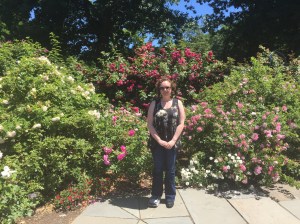
Posing in the rose garden.

New York City is a massive concrete jungle. But you don’t have to go far to get a taste of nature. Aside from Central Park (a short walk from my apartment), New York has not one but TWO botanical gardens. I visited the Bronx version yesterday, the New York Botanical Garden. I’d visited here last fall with a couple of classmates, but one of the collections I really wanted to see, the rose garden, was past its prime then. I promised myself I’d return in the summer, and so that’s exactly what I did.

IMG_1260

This rose bush, which sports both peach and pink blossoms on the same plant, was one of my favorites.

The Peggy Rockefeller Rose Garden, according to the garden’s website, has more than 650 varieties of blooming roses at its peak. It was funded by the philanthropist David Rockefeller and named after his wife, Peggy. On the day I went, Mr. Rockefeller himself happened to be touring the rose garden—not a place I expected for a celebrity sighting, but there you have it. Just walking through the entrance gate of the rose garden is an experience, both olfactory and visual. So many varieties, all different colors, sizes, and shapes. I’d forgotten how different roses can look from each other.

The top of the conifer

The top of an odd conifer.

The bottom of the conifer

The bottom of an odd conifer.

Another highlight of my trip to the botanical garden was the ornamental conifers collection. I grew up frequently visiting my grandparents’ cabin in the mountains of Colorado, so the smell of pine and the rustle of wind through the branches are among my favorite memories. The conifers here, though, were unlike any I’d ever seen. Strange shapes (like the photos here) and unusual colors abounded. I also learned something new—that some conifers lose their needles. Who knew?

It was a wonderful adventure, and all just an hour’s train + bus ride away. That’s one of the great things about New York—it has a little bit of everything.

IMG_1266

One of the garden’s lovely waterfalls.


Exploring NYC: Shakespeare in the Park

Central Park's Delacorte Theater, lit up after the show.

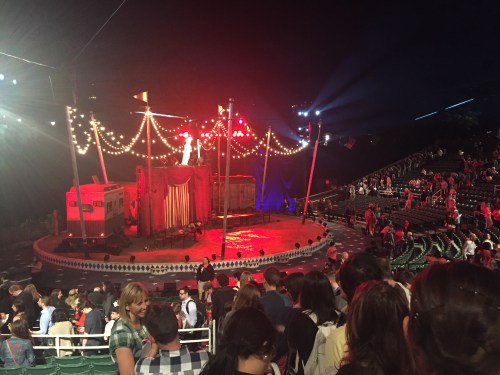
Central Park’s Delacorte Theater, lit up following the amazing performance of “The Taming of the Shrew.”

New York City has a reputation for being expensive. After being here nearly a year, I can tell you that reputation is well deserved. That said, there are some pretty cool free things to do in the city too. One of them is Shakespeare in the Park, which I attended last night with a classmate. We saw a hilarious, irreverent, rock-music-tinged version of “The Taming the Shrew” that had the audience (myself certainly including) rolling with laughter.

Shakespeare in the Park performances are held in Central Park’s outdoor Delacorte Theater. The way to get tickets is to wait in line that same morning for a few hours—a wait plenty of people find worth it. According to the theater’s website, “More than five million people have visited the Delacorte Theater for free performances, making it one of New York City’s most beloved summer traditions.”

I would certainly like to make this one of my own traditions and attend future performances. What a wonderful way to spend an evening—outside in the fresh air, watching an amazing play, and doing so in good company. Next time though, I think I’ll bring bug repellent. The mosquitoes liked the show too.