doc w/ Pen

journalist + medical student + artist

Tag: Africa

Uganda: Learning to live with limits

So much in the United States is unlimited, like our wi-fi access. Not so in Uganda, as I was reminded after a thoughtless frenzy of downloads.

Living in a foreign country means making adjustments. To respect the conservative dress code here in Uganda, for example, I wear a skirt that falls below my knees, and cover up my sleeveless blouse with a lightweight shrug.

There are technological adjustments too. The wi-fi here at Naggalama Hospital only works three weeks out of the month. By the fourth week, they’ve used up all their data.

That’s the general principle here, for technology, and otherwise. Resources are limited.

To make sure I could access the Internet for my entire four-week stay, I have a “Uganda phone.” It’s an iPhone from the United States, but with a Uganda SIM card inside, and a Uganda phone number. When I arrived, the phone was loaded with 10 GB of data, and what’s called “airtime.” Airtime can be used to call within Uganda, any phone carrier, and also to call internationally. Airtime is not to be confused with “minutes,” which can only be used within Uganda, and only with people who share your same carrier (in my case, MTN).

I didn’t plan on doing anything crazy on the Internet while here, mostly checking e-mail and writing blog posts. But I hate using the Internet on a cell phone. So mostly what I’ve been doing is using the phone’s data to set up a hotspot for my laptop, something I’ve never done in the United States (because I never had to). I’ve been religiously keeping track of my data usage, dialing the MTN “data usage” number to find out my balance every few days. After more than a week, I hadn’t even used 1 GB. Then I checked this morning. 3.5 GB gone. Somehow, over the span of a couple of days, 2.5 GB had … disappeared. How did this happen? Was there a data monster lurking somewhere, biting into my bytes while I slept? I inventoried my Internet use over the last few days, trying to account for the missing many megabytes.

An hour later, while I ate breakfast, it dawned on me. The day before, while waiting at Masaka Hospital for someone to pick me up and drive me back to Naggalama, I’d downloaded a half-dozen audiobooks from the New York Public Library. I did it without thinking. Because at home, I’m almost always on a wi-fi network. In my apartment, at school. And when I’m using my data, I’m only checking a handful of websites, maybe Google maps, or looking at e-mails. Not exactly high data use activities.

I’d downloaded so many books — hours and hours worth — because I’m picky about my narrators. Their voices, that is. So many grate on me, rub me the wrong way, for reasons I can’t always articulate. And I can never tell by the brief sample they give you. I need 15 or 30 minutes to decide whether I want to invest myself in the story, and in the voice. My dad used to read aloud to my family every night when I was a kid, and he set a high bar, it seems.

I know streaming and downloading eats up your data like nobody’s business. I know that. But I clicked the “download” button a half-dozen times with nary a thought because that’s what I always do. In the United States, data is dispensable, limitless. Like so many things.

Not so here.

I really should have known. Because after three phone calls home, I suddenly ran out of airtime last weekend, my phone call cut off mid-sentence.

Well, I have the books now, 2.5 GB later. They’re checked out for three weeks. By then I’ll be home, back to limitless wi-fi.

Lesson learned though, for while I’m here. Hopefully …
Uganda, delivered

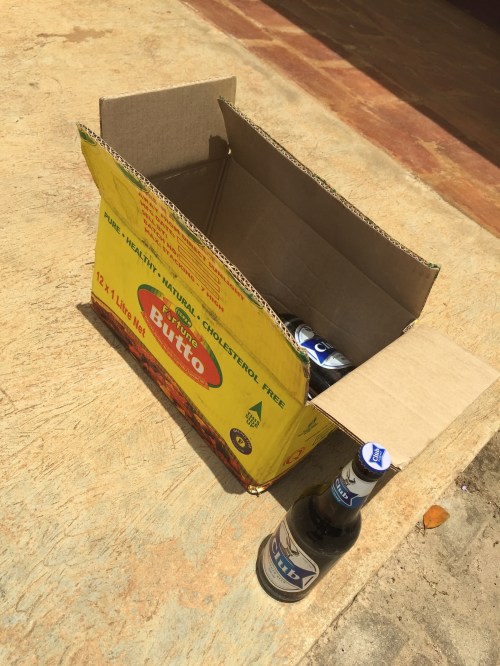
A “six-pack” (well, six loose bottles) of Club, a popular Ugandan beer, on my doorstep. It’s not a New England-style IPA. But as the saying goes: “When in Uganda …”

One of the things I love about New York City is that you can get just about anything delivered, with minimal or no extra charge. Groceries, alcohol, and take-out food of every ethnicity you can imagine are standard fare. I take advantage of the grocery services the most often, because I hate grocery shopping. I’d much rather someone else do it for me. I happily tack on a nice tip since they carry all my bags and boxes up the stairs to my fourth-floor walk-up apartment. (No elevator.)

To my surprise, there is grocery delivery here in Uganda, too.

Lately, I’ve gotten into craft beer. I’m pretty sure they don’t have IPAs here, but lager, yes. I’d run out of the Nile (a popular beer here) that we’d gotten in Kampala. I was told that Sandra, the housekeeper where I’m staying, could have beer brought to the guesthouse. I gave her 24,000 shillings (less than $7 USD), and about 30 minutes later, there was a guy ringing the bell at our front gate, carrying a box containing six bottles of Club (another popular Ugandan beer).

A couple of days later, I discovered we’d run out of milk. I prefer half and half for my coffee, but milk will do. I texted Sandra to bring some when she came to make lunch for us. She texted back that she’d send someone with it now. In less than 10 minutes, there was a man at the front door, carrying a little black plastic sack with two pouches of pasteurized milk inside.

Talk about service.

My first palliative care presentations in Uganda: Naggalama and Nakaseke

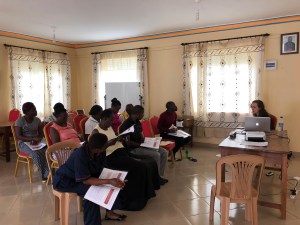
A group photo from an educational session I led in Nakaseke, Uganda.

Last week, I started pilot testing our curriculum, “Digital Modules for Palliative Care Education in Rural Uganda.” Through these three sessions, the participants have learned from me. And I have certainly learned from them.

Leading a palliative care educational session in Naggalama, Uganda.

I began by presenting the first module, “Basic Communication Skills in Palliative Care,” at my home base, St. Francis Naggalama Hospital. Naggalama is where I came to experience palliative care in Uganda in 2016, and where I am staying in between my forays to other rural locales.

Then I traveled to Nakaseke, a rural hospital about 2.5 hours from Naggalama. I presented the first module again, as well as the second, “Delivering Bad News.” We got lost on the way (PSA: don’t rely on Google maps in rural Uganda). And then the electricity went out during a rainstorm midway through my first presentation (but we adapted; Howard held up my laptop so people could see the videos, since we could no longer project them onto the wall). So in the end everything worked out there, too.

I’m now entering my data from our pre- and post-presentation surveys. And I’m processing the lessons learned from these three sessions. What is clear, though, is that people want this kind of teaching. They struggle with communication skills and delivering bad news just like we do in the United States, but don’t have access to the kind of educational resources we do. And they’re hungry for it.

-reading guide

The participants all wanted to keep the teaching guides that I brought for the sessions. I took this as high praise.

I got a variety of feedback from the three sessions, but one comment was constant. When asked what we could change about our printed teaching guides to make them better, I was told, “Let us keep them!” Suitcase weight limits (2 suitcases per person; 23 kg each) prevented us from bringing enough printed guides for everyone. But the message was clear, and I took it as high praise.

At Nakaseke, at the end of each session, the participants also did this amazing thing to show their appreciation where they clapped several times in unison and then threw out their hands toward me like they were showering me with thanks. It seemed like their version of a standing ovation. Below are still photos from this beautiful gesture.

Apparently, I’m pretty into the material too. I didn’t realize until I saw photos of myself (below) from the sessions how animated I can get.

This week, I travel to Masaka and Kitovu, two other rural sites. I will be presenting four times in two days – a much more grueling schedule. These sessions last 2-3 hours each, and at the end of each I’m exhausted. But after last week’s successes, I know I’m up to the challenge. I know there will be bumps in the road, too (both figurative and literal, given the quality of rural dirt roads here). But I also know it will be worth it – for them, and for me.

Lions, tigers, and … lizards?

Some time ago, I wrote a post about Ernest Hemingway’s use of the so-called “six-word story,” its explosion on the Internet, and my own attempt at a tiny tale. Good six-word stories, like Hemingway’s, convey an entire world with only a few strokes of the pen (or keyboard). Writers accomplish this by what they do say – the imagery and feelings they conjure directly – as well as what they don’t – the questions and curiosity they raise.

You want to know more. But there is no more. It’s delightfully frustrating.

Here is my second attempt at a six-word story. After you take in the words, think about your own interpretation. What do you think the backstory is? Then scroll down to find out what it’s really about.

There’s a lizard in my underwear!


So. Where did your mind rush to when you read those words?

Those of you who know me well may have guessed that like all of my writing on this blog, this, too, stems from reality.

I fail at fiction. Trust me. I’ve tried.

This is truth.

In fact, these very words flew from my mouth in a gasp (or maybe a growl?) of surprise this morning as I was about to sit down and drink my morning coffee.

I’m in rural Uganda. There’s a washing machine here, but no dryer. I’d gone out to enjoy my coffee on the back patio. Where, I discovered, my recently laundered undergarments were hanging, ruffling in the breeze. One had slipped to the brick floor of the patio. I stooped to pick it up and lay it across the bars of the metal clothes rack. As I did so, something small and black flopped out.

“A stick,” I postulated.

And then the stick moved. Darted is more like it.

I saw it in one spot, near my foot. Then a quick black blur, and my black stick was suddenly 6 inches away. And then another 6 inches. And another.

I realized my so-called “stick” had legs. I know it actually did have legs because when it paused briefly, and I counted them: Tiny. Four.

I grabbed my phone, the journalist in my dying to capture the evidence. In a stroke of pure luck, my hurried snapshot caught the critter next to an actual stick (a brown one) that was the same length as the lizard. That picture, and a picture of my left hand next to the same stick to provide scale, are below.

These two words, “lizard” and “underwear,” are words I never thought I’d hear in the same sentence. This is certainly not an autobiographical tale I ever planned to tell. Or yell. Or think! Not anywhere. Not even in Uganda, where I’ve learned that anything can happen.

In these anything-can-happen environments, people always tell you to “expect the unexpected.” But if it’s unexpected, how can you expect it?

After today, I know that you really can’t.

28 hours later


IMG_3980

Some 28 hours after I left my Manhattan apartment, I arrived at the Naggalama Hospital guesthouse in rural Uganda. Having just spent some 17 hours speeding through the sky in two different airplanes, and then 3 hours loping along in a pick-up truck, and having just forced my circadian rhythm ahead by 7 hours, I felt a bit … disoriented. To say the least.

At the same time, I’d felt a rush of familiarity when our Emirates flight touched down in Entebbe, Uganda and I caught a glimpse of the brick-red Ugandan soil zooming by. And my heart immediately warmed when I saw the “Welcome to Entebbe International Airport” sign.

“It was a grueling trip to get here,” I thought to myself. “But I’m so glad to be back.”


“You are welcome.” (above)
This was a phrase I learned to love my first time visiting here, two years ago. I felt the same sense of welcome as I peered through my rain-splattered airplane window and saw this sign when we landed yesterday at Entebbe. I felt similarly when I caught sight of the brick-red soil you find everywhere here, also seen through my airplane window.


Before and after. (above)
Selfies from my cab ride to JFK airport in New York City, and more than 20 hours later on my flight from Dubai to Entebbe. Notice that initially, I’m wearing makeup. My hair is in lovely, tight ringlets. I’m wearing contact lenses. In the second photo, we’re about an hour away from touching down in Entebbe. And here, I’m wearing glasses. The makeup is long gone, and my hair quite ruffled by my attempts to sleep (every single one of them foiled). I am, however, still smiling in this second picture — mostly because even though I feel uncharacteristically exhausted and unkempt, I have in my hand a cup of fresh, French press coffee. I learned on my first trip here that I could survive without my morning coffee ritual, but that I’d be much happier with it. So I brought with me a travel French press and my own coarse-ground coffee. Highly recommended for fellow coffee connoisseurs who travel internationally.

Boxes, boxes, everywhere

My pile of “savory” snacks to bring to Uganda.

In a peaceful coup, Uganda has assumed control of my tiny, 1-bedroom apartment.

There are boxes everywhere

A box of food. LOTS of food. I don’t consider myself a picky eater. But on my first trip to Uganda, which lasted 3 weeks (this one is a month), I discovered quickly that I wasn’t getting as much protein as I was used to. We had fruit, wonderful fresh fruit, but almost no vegetables — we can’t eat them unless they’ve been peeled because we can’t drink the water. In general, the diet there is very starch-heavy, which is not what I eat at home. As a result, I was also just eating less than usual. I’ve tried to remedy all that with an assortment of goodies that I’ve pictured here, separated out into “sweet” and “savory” piles on my kitchen table so you can see the variety. Some things are from Trader Joe’s, some from Amazon Pantry, some from my grocery delivery service. When I put everything into those piles, and realized how much I’d bought, I thought I’d gone overboard. I said as much to my research mentor, Dr. Randi Diamond. She didn’t think so. “Bring as much of it as you can,” she told me earlier this week. Luggage weight permitting, I will.

My pile of “sweet” snacks to bring to Uganda.

Not pictured here is the mound of coffee I’ll bring. I survived on tea last time, but it wasn’t pretty. I’m not in any way religious, except perhaps about my morning routine: coarse ground, brewed in a French press for precisely 5 minutes while my ceramic mug heats up too, filled with extra boiling water from my electric kettle. I add a little sugar and half-and-half, take a sip, and then, finally, can really take on the day. After some searching on Amazon, I found a travel French press that I’ve tested and found to pass muster. I’ll have sugar there, but no cream; refrigeration is iffy due to frequent power outages. It may be rough, but I’ll survive.

Boxes of our teaching guides. Twenty-five each of red, black, and blue plastic folders, the kind with metal prongs. One of my trip-preparation tasks has been to put the correct number of sheet protectors into the folders for each of our three modules (11, 10, and 9 sheet protectors, respectively), and then shimmy each printed page into each sheet protector.

One of the 72 little notebooks we’re bringing with us to Uganda, to encourage reflective writing.

A box of notebooks. I mentioned in my last post that in our teaching guides, we include reflection questions to try to get people thinking about how these lessons apply to their own lives and practice. We’re going to encourage discussion of their thoughts, as well as journal writing. So we’re bringing along 72 little notebooks, each with a sticker I’ve designed and stuck on identifying it as part of our program.

A box of surveys. This box holds a 4-inch-high stack of stapled packets, color coded in green and yellow printer paper so we know what’s what.

A box of office supplies. There’s no Amazon Prime in rural Uganda, no Office Depot, no Staples. So we’re bringing along our own stapler, scissors, paper clips, binder clips, pens, tape, a Sharpie, Post-it notes. Some of the items, we know we’ll need. Others we’re not sure of. But we might need them, and there’s no good way to get them in rural Uganda. So into the suitcase they go.

In addition to the boxes, I’ve also got some stacks going, and some piles.

There’s a stack of paperbacks I’m bringing with me, for my downtime. Due to limited suitcase space (and weight), I’m also downloading a bunch of audiobooks onto my phone.

Then there’s the pile of clothes and toiletries that I’ve set out to pack. Bringing everything you need for a month — but not so much that your suitcase goes over the 51-pound weight limit — requires some serious thought. Especially when you need to dress for multiple occasions. I’ll be wearing “professional” clothes (nice pants, a blouse, dress shoes) for the days when we’re out doing our research sessions at the various rural hospitals. I hope to head out with the Palliative Care Outreach Team too, during some of my downtime. On those days, I’ll wear casual clothes and tennis shoes.

I’m constantly stepping over these boxes, stacks, and piles; shifting them from kitchen table to desk to floor and back depending on what I’m doing and where I need space. But it’s a welcome merry-go-round, a constant reminder that exactly five days from the moment I’m typing these words, I’ll be at JFK airport, waiting to board my flight.

I can’t wait.

Back to Uganda …

In less than 2 weeks, I’m headed back to Uganda for another palliative care research project. This picture was taken during my first trip there in July of 2016.

I’ve mentioned in several recent posts that I’m on a four-month research rotation. Then I realized that I haven’t said anything about what I’m actually doing. It’s time to change that.

Before I delve into the details of the project itself, though, I need to provide some background and context so that the project itself makes sense.

Those of you who have been following along for a while may remember that I went to rural Uganda in July of 2016, the summer after my first year in medical school. I went with a palliative care physician from Cornell, Dr. Randi Diamond, to do both clinical and research work, looking (in part) at the understanding palliative care patients there have of their illnesses, and why people present at such late stages of illness to the medical system.

One thing palliative care patients told us during that trip was that they perceived their health care workers to have poor communication skills. And as a result, the patients were distrustful of medical workers, and the health care system as a whole.

In rural Uganda, it’s also important to know that medical workers have limited access to continuing medical education (“CME”). Much of the palliative care CME (and CME in general, for that matter) is Internet-based. As I learned during my first trip there, even in places that have the equipment for Internet, it’s completely unreliable. Not only that, but medical education materials are mostly developed for a Western audience like ours — one with incredible resources. What’s discussed and taught isn’t always relevant to medical workers in rural Africa, who work in a very different environment, as you can see from pictures I’ve included below, taken during my first trip there. (If you want to read in more detail about the hospital environment in Uganda, here is a post I wrote about it in 2016.)

All of this got Dr. Diamond and me thinking about whether we could do something to help improve communication skills among health care workers in rural Uganda.

As did some things we learned from an organization we’ve now partnered with on this new project, the African Palliative Care Organization (APCA). APCA has developed its own palliative care curriculum for use in Africa, and one of the key competencies is communication. In developing this curriculum, they did a needs assessment, and found “communication” to be one of the gaps in both skills and knowledge in health care workers there. They also found a shortage of culturally appropriate materials for teaching palliative care.

Putting all this together, there is a clear need for culturally appropriate continuing education directed at communication skills.

Both Dr. Diamond and I found ourselves in a unique place to help fill that need. During Dr. Diamond’s last two summer trips to rural Uganda (2016 and 2017), a documentary film crew accompanied her and the local Ugandan palliative care outreach team on home visits to palliative care patients. So she has footage of palliative care taking place in rural Uganda, with local medical workers, that could be used to illustrate best practices.

As part of Cornell’s curriculum, I have 6 months to do full-time research, 4 months now and 2 months at the beginning of 2019. After my first trip to Uganda in 2016, I knew I wanted to work with Dr. Diamond again, and go back to Uganda. From my past life as a textbook editor and freelance writer, I also have experience in developing educational materials.

It was a perfect match.

In less than 2 weeks, we leave for Uganda to pilot test the multimedia educational modules we have developed. There are 3 different modules:

  • Basic Communication Skills in Palliative Care
  • Delivering Bad News
  • Pain Assessment (with a focus on the communication aspect of assessing pain)

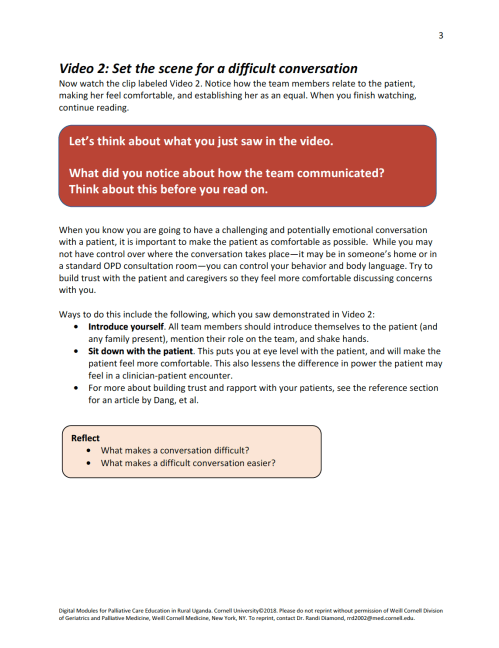
Each module includes the video clips I mentioned, and a teaching guide that Dr. Diamond and I wrote. The teaching guides have educational content as well as reflection questions to get people thinking about how what they’re learning applies to their own lives, and their own patients. This kind of “reflective practice” is so important in palliative care (and all of medicine, really). It’s not done much in Uganda, but it’s something that APCA has identified as a goal for integration into medical education there.

To give you an idea of what we’ve created, here is a page from the “Basic Communication Skills in Palliative Care” module:

Here are the basics of our research design:

Hypothesis: Communication training with culturally appropriate modules will enhance health worker confidence in, and knowledge base about, communicating with PC patients.

Methods:

  • Pilot test the modules at 6 different rural sites in Uganda, identified by APCA
    • Hoping for 6-12 participants per site (targeting medical workers such as physicians, nurses, and nurse assistants who interact with palliative care patients)
    • Planning to test 2 of our modules at each site
  • Conduct pre- and post-intervention surveys to assess the effectiveness of the modules
    • Surveys will assess both knowledge base about, and confidence in, palliative care topics and skills
    • Future data analysis will measure whether there is a change in knowledge and/or confidence after the participants complete the module

This project is not just about research, though. It’s also about leaving something behind that people can actually use. At the conclusion of each pilot testing session, we will leave printed copies of our teaching guides, as well as flash drives with the video clips and the teaching guides in PDF form. Hopefully, this strategy resolves the access issue; while Internet is spotty, these rural sites do have computers.

I’m in full trip-prep mode right now: assembling the printed guides, survey packets, mosquito repellent, and lots of protein to take with me for the month I’ll be there (the Ugandan diet is mostly starch based).

I’ll be based at the same place where I stayed during my last trip, St. Francis Naggalama Hospital, working with the wonderful Naggalama Hospital Palliative Care Outreach Team. I will sometimes have Internet access there (hopefully, more often than not). As I do, I will try to post updates on my trip.

Uganda: two months and already nostalgic

It’s hard to believe that exactly two months ago, I was on a safari in Uganda. My second year of medical school has started, which means I spend more time looking at pictures of brain anatomy than pictures of any vacation destination. But this rainy, September day is a perfect time to flip through some of my safari photos, and to remember what a magical trip it was.

(Click on any photo to see an enlarged slideshow.)

Lions: clawing their way to the top (of a tree)

The collared female lion, Harriet, sitting up and watching US.

The collared female lion, Harriet, sitting up and watching US.

Locking eyes with a wild lion and living to tell about it — that’s something few people can say they’ve done. But it was a privilege I had while on my safari in Uganda’s Queen Elizabeth National Park.

The park’s Ishasha region is known for its tree-climbing lions. Lions don’t normally climbs trees as far as I know, but these do — to escape the buzzing flies hovering low to the ground, and to gain shade from the beating equatorial sun, according to my guide.

One of the things that is so exciting about a safari is that you’re not guaranteed to see the animals. That might sound paradoxical, because you’ve gone on safari to see the animals. But their rarity, and hidden nature, reminded me that these are truly wild animals. This is not a theme park or a zoo.

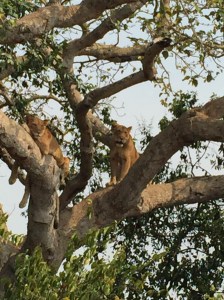
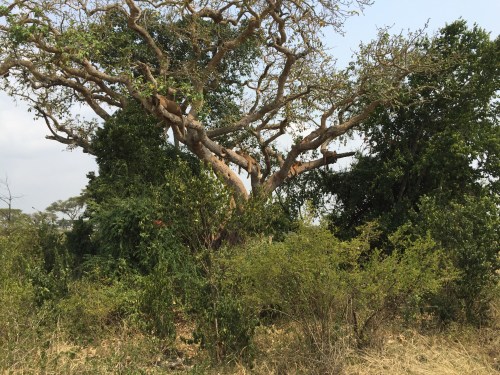
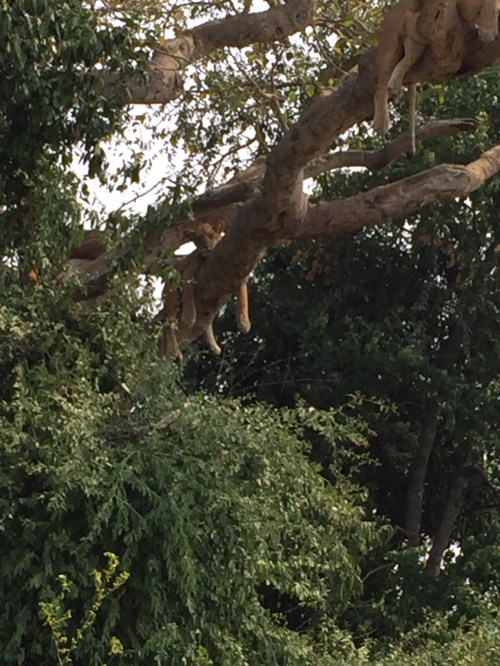
We encountered the Ishasha lions mid-afternoon, after several hours of driving. Four of them lazily reclined on the horizontal branches of a fig tree, seemingly oblivious to our rumbling van and mumbling voices. My guide, Joseph, identified the larger, collared female lion as Harriet. (Joseph later told me that on one of his other safaris, Harriet decided she was tired of being watched, and had come up to the van and started ramming its side. I appreciate that he told me this story after my lion experience. It was probably better that way.) As we watched the four lions, Harriet stretched and sat up. She yawned, displaying her razor teeth. Between that and seeing the lions’ dangling paws — and hence claws — I had no trouble keeping my distance and following my dad’s joking mandate of “Don’t pet the animals.”

Four Ishasha tree-climbing lions resting in a fig tree.

Four Ishasha tree-climbing lions resting in a fig tree.


From this vantage point you can see the lion's dangling paws -- and imagine its claws.

From this vantage point you can see the lion’s dangling paws — and imagine its claws.

Awwwwwww …

Do you like children?

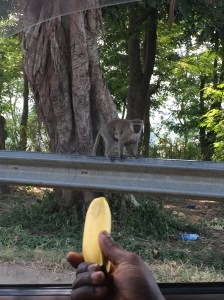
A momma velvet monkey, with her baby clinging to her chest, came down out of a tree when Joseph proffered a tempting banana.

A momma velvet monkey, with her baby clinging to her chest, came down out of a tree when Joseph proffered a tempting banana.

My safari guide, Joseph, asked me this question (I’m paraphrasing) during our six-hour drive from Kampala to Queen Elizabeth National Park. It’s a fair question. I’m almost 35 years old, and I don’t have any kids. I am not in a position to have kids right now, or anytime soon — maybe ever. I’m fine with that.

I told Joseph quite emphatically that I do like children. At this point in my life though, I enjoy playing with them, and then returning them to their parents. Joseph said he would make a prayer for me to have a baby. His prayers were answered over the next several days, though not in the way he anticipated. During my four-day safari, I saw dozens of baby animals: elephants, hippos, pumbas (warthogs), kob (antelope), velvet monkeys, baboons, and chimpanzees. Seeing all of these little ones — well, some of them were quite big — was one of the highlights of my safari adventure.

Funny how a several hundred pound baby elephant can be considered “cute.” But I’ve always loved miniatures. I even collected tiny figurines as a kid. And I guess a baby elephant is a miniature compared to its parents.

Here are a few photos of the baby animals I encountered. They were all adorable. But I reeeeaaaallllly wanted to take one of the baby monkeys home with me. Just look at those faces!

A baby elephant nursing! I saw this amazing sight while on a boat cruise.

A baby elephant nursing! I saw this amazing sight while on a boat cruise.


A baby baboon riding on its mother's back.

A baby baboon riding on its mother’s back, little bare rump exposed.


A baby hippopotamus next to its mother.

A baby hippopotamus next to its mother (to the right).