doc w/ Pen

journalist + medical student + artist

Category: Uncategorized

Making A Difference, One Starfish (Or Patient) At A Time

One of the things I look forward to in medical school is doing an international rotation. What that means is that during my third or fourth year, I would go to a foreign country to learn (and help) in hospitals or clinics there, working alongside that country’s physicians, nurses, and other medical practitioners. This is actually one of my requirements for a medical school – that it offers such an opportunity. When I become a physician, then, I also want to spend some time volunteering abroad.

I recently relayed these goals to a doctor I know. His response was as follows (I’m paraphrasing here): “Oh, that’s just a big Band-Aid. It helps the doctors feel better about themselves, but it doesn’t really do much for the patients.”

OK, I know that working in a third world country on a short-term medical mission trip doesn’t solve all of the region’s problems. But I do think that it can make a difference in some individuals’ lives. And isn’t that what medicine is about, at least in part? Being there, in a room with one patient, helping that person make changes for the better, whether it is prescribing a medication, figuring out a plan to help the person lose weight, or putting a plaster cast on a broken arm?

When I talked about the situation with my mom, who is a hospice nurse, she shared a story with me that really encapsulates that desire to help an individual:

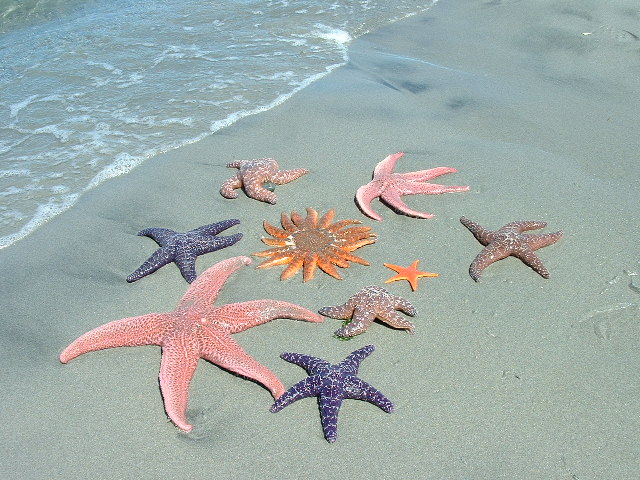
A man was walking along a beach where thousands of starfish had been washed up by the tide. The starfish were slowly dying, drying out in the hot, tropical sun. Then the man saw a small boy on the beach. The boy was stooping down and picking up one starfish at a time and then throwing them back into the ocean. The man walked up to the boy and said, “What are you doing? There’s no way you can make a difference to these starfish.” The boy picked up another starfish, tossed it into the waves, and replied, “I made a difference to that one.”

I realize that I can’t save the world. But I do believe I can make a difference, one patient, one person, at a time. Going into medicine, I have to believe that.

Something To Look Forward To: A Nigerian Medical Conference

In my current situation, it helps to have things to look forward to. They can be little things, like going out for gelato with my mom after cleaning out junk from my old house yesterday, or bigger things.

This Thursday through Saturday, I have something a bit bigger to look forward to – I’m going to a Nigerian medical conference. It’s the annual conference of the Association of Nigerian Physicians in the Americas (ANPA), and luckily for me, it’s being held in a swanky Chicago hotel this year.

In case you’re scratching your head, wondering how in the world I got invited to a Nigerian physicians conference … no, I am obviously not Nigerian. But I have a dear friend who is. In fact, I met her at the 2010 OldPreMeds Conference. (OldPreMeds is an organization that hosts an online forum for non-traditional pre-medical and medical students, and I have been involved with the group since last year. Click here to visit the Web site.) My friend was living in Washington D.C. at the time, but she moved to Chicago in January to complete her pre-med classes at one of the universities here. She registered for the ANPA conference, gets to bring a guest, and voila – my invitation.

I’m really excited about the conference – some of the seminars are focused on Nigeria, which should be very interesting. Others are more global in nature. My minor in college was International Studies, so those global issues have always fascinated me.

The conference is organized into themes: Women’s Health, Children’s Health, Health Care and the Foreign Corrupt Practices Act, Responsible Conduct of Research, and Medical and Dental Education in Nigeria.

Among the seminars I will be attending are:
– Women and Bleeding Disorders
– Infertility in Women
– Cancers in Women: Innovations in Therapy
– Female Circumcision: Controversies
– Overview of the Foreign Corrupt Practices Act
– What Does Professionalism Mean in the New Age?
– Conflict of Interest in Research and Academia
– Teaching Biomedical Sciences in Technologically-limited Medical Schools: A Nigerian Experience

The speakers are from across the United States and the world, and the attendees will be as well. So not only will it be a great opportunity to learn, it will be a chance to network with people I might never meet otherwise.

I will definitely post more post-conference to let you all know what I thought, and some of what I learned.

Health In The Headlines: Telemedicine

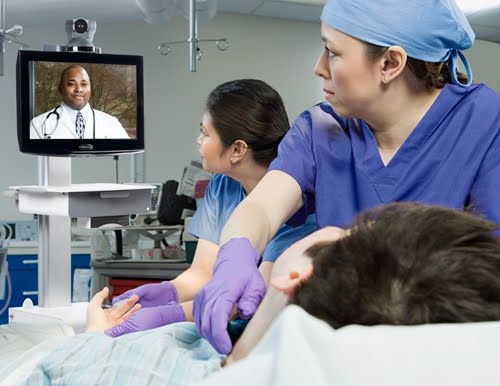
Is this – telemedicine – the future of health care? “Visits” with the doctor via video conferencing?
No, I don’t think so. We all have plenty of in-person appointments with our doctors to look forward to, so not to worry. But I do think telemedicine may be part of the future of health care. And for some people, it already is. People like Deanna Ventura, who live too far away from the medical specialists they need. Ventura, who has Parkinson’s, was recently featured in a story about telemedicine on National Public Radio (click here for the online version of the story). She has been seeing a movement disorders specialist at Johns Hopkins – 343 miles from her house in upstate New York – for the last four years via video conference calls, according to the NPR story. From my impression, she seemed very happy with the arrangement.
That NPR story piqued my interest, so I decided to do a little digging into the issue myself. Here is some of what I found – and what I think about it.
First of all, what exactly is telemedicine? How is it defined? According to a report by the Institute of Medicine (Telemedicine: A Guide To Assessing Telecommunications For Health Care), telemedicine is:
“… the use of electronic information and communications technologies to provide and support health care when distance separates the participants” (44).
But what does that mean? This definition includes video conferences, sure, but also telephone calls, e-mail messages, the sending/receiving of still images (such as X-rays), and the computer-based processing of other medically related data. This committee’s definition also includes consultation, administrative, and educational uses of telecommunications (but I won’t really go in that direction).
And in reality, a lot of what falls under this definition is already going on in health care today. We have all talked with our doctors on the phone; some of us may have exchanged e-mails with physicians as well. And if you have a test done at one facility, your doctor (who is at another facility) often gets the results or images electronically – that is all telemedicine, technically. 
The use of video, though, is what tends to get people’s attention. That seems like something new. But while it may be new to most of us, it’s actually not a novel idea. According to one article I read,* the first use of telemedicine in this context took place in 1959, in the form of a two-way, closed-circuit microwave television system used between the Nebraska Psychiatric Institute and Norfolk State Hospital (also in Nebraska). 
Since then, though, telemedicine hasn’t exactly caught on. There are several reasons for this. One reason is licensing. Doctors are licensed in the state in which they practice, which makes them unable to practice across state lines, thus limiting telemedicine’s reach. The Institute of Medicine report referenced the possibility of creating a national telemedicine license. But that is a long ways off, if indeed it ever comes into being. Another reason is that health insurance companies usually will not cover telemedicine “visits.” So people are either left to pay for them out of pocket, or, in the case of Deanna Ventura (of the NPR story), rely on external fundraising to foot the bill. In addition, there has been little evaluation of telemedicine, in terms of quality of care or cost. This, according to the Institute of Medicine report, leaves people leery of adopting the technology. And finally, there is the issue of technology itself. As we all know, technology changes almost daily. Finding the appropriate, compatible technologies to use for telemedicine is incredibly difficult, especially when you must take patient privacy and confidentiality into account. 
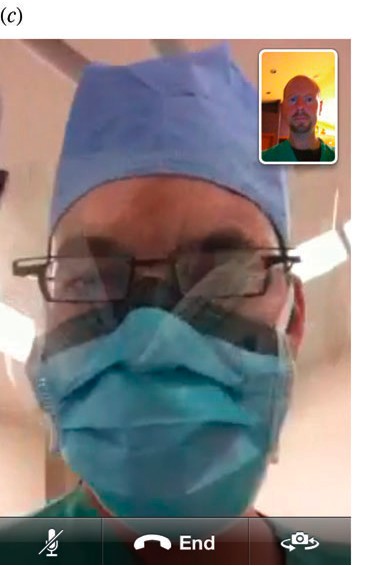
That said, medical practitioners are finding interesting, novel ways to use existing (and commonplace) technology. Millions of people across the globe use the iPhone (including myself). One article** I found on PubMed described how physicians used the iPhone 4 FaceTime software to videochat with each other and share images of a patient’s foot that had a limb-threatening infection, and needed emergency surgery. Here is a section of the article explaining what was done:
“A patient with a limb-threatening infection was taken on an urgent basis to the operating room. With no prior planning except for text messaging, the surgeon consulted with 2 surgical colleagues to discuss incision planning, requirements for resection, and subsequent surgical staging (Figs 2a–2d). The “FaceTime” application was managed by an operating room technician under the direction of the operating surgeon” (215).
And here are the images captured on the iPhone 4 (warning: these are a bit graphic).
If I had been that diabetic patient who needed emergency foot surgery, I would have been quite willing to have my surgeon consult with another surgeon via iPhone. If I were Deanna Ventura, didn’t drive, and lived too far to see the specialist I needed, I would be happy to see the physician over video conferencing. But if I could, I would still prefer to see a doctor in a face-to-face visit. That’s just me – I like the personal contact. There are times, though, when that’s just not possible. And that’s where telemedicine extends medicine’s reach. 
*Breen, G., and Matusitz, J. (2010). An evolutionary examination of telemedicine: a health and computer-mediated communication perspective. Soc Work Public Health 25, 59-71.
**Armstrong, D.G., Giovinco, N., Mills, J.L., and Rogers, L.C. (2011). FaceTime for Physicians: Using Real Time Mobile Phone-Based Videoconferencing to Augment Diagnosis and Care in Telemedicine. Eplasty 11, e23-e23.

Gen Chem Comes To Life

While working in the lab last week, one of my tasks was to isolate DNA and RNA using TRIzol. It was a long protocol involving lots of pipetting, mixing, and centrifugation. And of course, lots of waiting in between steps.

But the protocol isn’t what I want to talk about in this post. It’s the preparation I did in advance of starting the RNA and DNA isolation. To do this isolation, you need to make a number of solutions and dilutions. So as we were prepping for the procedure, my lab supervisor handed me several bottles of concentrated solutions and a powder and basically told me to go at it.

Hm. Right. For about 5 seconds, I stared blankly at my composition notebook and calculator. Then I realized that this was exactly what we had learned to do in General Chemistry last year. We had never actually made the solutions – merely done the word problems from the book – but the concepts were the same.

So I took the bottle of sodium citrate that I was supposed to use to make a 0.1 molar solution in 10% ethanol, wrote down the molar mass off the bottle, and calculated how many grams I would need to make 10 mL of the solution (remembering that molarity is moles per liter). Then I took the 100% ethanol bottle and diluted it 1:10 (making 10 mL) in a 15 mL plastic tube. After that, it was simply a matter of mixing the powder in the 10% ethanol. Easy, right? Yep, easy – if you paid attention in Gen Chem – which I did.

By the time I finished with the sodium citrate solution, my confidence had shot up. So diluting the 1 molar sodium hydroxide to 8 millimolar was a cinch.

But the proof is in the pudding, right? So after I finished isolating the DNA, I went to the NanoDrop – this awesome machine that measures the concentration of nucleic acids based on a teeny tiny drop (1 – 1.5 microliters) of the solution – and checked the concentration. More than 900 nanograms per microliter! That sounds like nothing, but for a DNA concentration, it’s quite a lot. And it’s more than enough to run the future reactions we want to do.

When I actually use something I learned in class, it reminds me that yes – these classes truly serve a purpose. And that is a good feeling.

Microbiology In Action

I voluteered yesterday morning and had a new experience there, which was pretty interesting: the convergence of microbiology and clinical work. A woman came in having been treated the previous week for a urinary tract infection (UTI), but her symptoms had returned. The nurse practitioner I was working with thought based on the symptoms that it sounded more like a yeast infection than a UTI. (I had to look up the word for “yeast” in Spanish – levadura.)

So the nurse practitioner decided to take a vaginal swab and prepare a slide to look at under the clinic’s lab microscope. I had no idea the clinic’s lab even had a microscope … I suppose it’s an obvious thing, but I never thought about it, since I don’t really go in there. The nurse practitioner prepared the slide with two specimen samples, and a drop of saline on one of the samples and a drop of potassium hydroxide on the other. I, of course, asked whether I could go with her to look at the slides in the lab. She’s one of my favorite practitioners at the clinic, and I work with her a lot, so she was quite willing.

We slipped the slide under the microscope, and lo and behold, yeast cells. Of course, I spent lots of time in Biology I and II last year looking at slides under the microscope, but obviously never in the clinical context. So it was really neat to be able to actually diagnose something using the same scientific tool we had used in class. Very rewarding.

ADCOM Q&A (favorite non-science class)

When I was an undergraduate, I took a little of everything: anthropology, sociology, comparative literature, history, philosophy, film, Spanish, biology. And, of course, my major: journalism. I liked some classes better than others, sure, but I’m of the opinion that you usually get out of a class what you put into it. And I generally put a good deal of effort into my courses. In other words, I got a high-quality, well-rounded education at the University of Illinois.

So if an admissions committee member put the following question to me – What was your favorite non-science class? – I would have a lot to choose from.

But “favorite” implies one. So I would have to go with J380. “J” standing for “journalism.” This was the advanced-level reporting class for journalism majors, usually taken by seniors. I took it as a junior so I could study abroad my senior year. I don’t remember the formal title of the class, but we students usually referred to it as “beat reporting.” Because that’s really what it was. For those of you outside the J-world, beat reporting is covering a particular issue, community, or other specific subject. In this class, we had to choose one such topic in the Champaign-Urbana area and write about it throughout the whole semester. We were to write several smaller stories in the beginning of the semester. Then the class culminated in a three-part series of at least 25 pages, which was equivalent to our senior thesis.

I still remember our first discussion section, when we chose our beats. Professor Bob Reid wrote a list of potential beats on the blackboard and we took turns picking from the list. I immediately knew which one I wanted – international issues – and crossed my fingers that no one would take it. I got my wish. International relations, and how they affected the local community, fascinated me. I really wanted to explore the subject. (I should also note that I minored in International Studies and had taken several related classes at UIUC.)

I will be honest: I did not exactly enjoy this class at first. In fact, a couple weeks in, I panicked (especially about having to write that 25-page series) and wanted to drop the course. I even thought about changing my major, since J380 was a journalism graduation requirement. But my advisor told me to stick it out, and I’m glad I did.

Why? Because I really came into my own in that class, in so many ways. As a reporter and writer, sure. But also as a young adult trying to find her way in the world.

For starters, Professor Reid had this thing about Curious George. (Yes, the little monkey who is always eating bananas and getting into trouble.) He said we should all be more like Curious George – wondering about everything we see and hear, touch and smell. And also seeking out new adventures. That is what makes a good reporter, he told us. I really took that to heart. So I didn’t sit around in my little apartment waiting for stories to come to me (that never works anyway). I went out and looked for them. And I mean really looked.

For example: I knew that one of the big international issues in the community was the increasing supply of crops from South America, and its effect on local crop prices. I figured the best people to talk to about that would be some farmers. I found out from an agricultural professor that a group of them met every Saturday morning for coffee in a little cafe a few miles outside Champaign-Urbana. So I made plans to meet them out there. Which doesn’t sound like a big deal, except that I didn’t have a car. So I rode my bike. More than 10 miles, round trip. On the highway. With semis rushing past me as I pedaled by on the shoulder. Not the safest thing I’ve ever done, but I felt it had to be done. I was curious, and wanted some answers to my questions. I learned that pounding the pavement – literally – is the way you get those answers.

One of Professor Reid’s pet peeves was that students rarely thought about accountability. He wanted us to call our local, state, and national representatives, heck, the PRESIDENT, and find out what they thought about what was going on in Champaign-Urbana regarding what we were writing about. You didn’t get an A on a story unless you did that. He didn’t think you deserved an A unless you had gotten that angle. And I came to agree: our government does need to be held accountable (to an extent) for what is happening in our community. So I would sit in the journalism department’s phone room (which was basically a little closet in the basement of Gregory Hall, with two landline phones – this was in the day before most people had cell phones) and call government offices to get their comments.

This was more of a reporting class, but I also learned a great deal about storytelling from Professor Reid. Because if you don’t tell your story well, there’s a good chance people won’t read it. So I gradually became better at weaving in relevant sights, sounds, and smells, as well as dialogue.

And when the time came around to write my 25-page series – which had me practically paralyzed at the start of the semester – I wrote, wrote, and wrote until I realized I had crafted a work of more than 50 pages. And it was not fluff, either. It was journalism. It was then I realized: I was a journalist.

While I discovered, after several years in the publishing field, that journalism is not where I want to spend the rest of my working days, I took valuable lessons from J380. That’s why I count it as my favorite class: it’s stuck with me. In the end, isn’t that what the best classes do?
Better Things Lie Ahead

As I may have mentioned before, I haven’t lived alone in more than 7 years. And back then, I was in a serious relationship (with my husband). So it didn’t feel like I lived by myself.

Now I really live alone – and I’m finding it to be somthing of an adjustment. It’s not that I mind doing things on my own. When I lived with my husband, we were often doing our separate things, but it was in the same house, and we both knew there was another person around. Or another person you could call just to say “hello,” or “I love you.”

Waking up alone is another odd thing. I’m accustomed to having my morning coffee with another person, not even necessarily talking about much, just another person being there, sitting next to me on the couch. Coming home from the lab to an empty apartment, having dinner by myself … they’re all reminders of what has happened. I don’t feel sad all the time or anything. Sometimes I feel a little lost, though, in these altered circumstances. I think that’s normal, but it’s bewildering nonetheless.

I know how important it is, especially now, to socialize with my friends and family. And I do. I have dinners out, dinners in, coffee, etc. And lots of phone conversations. It’s just those weird times when I’m used to another person being around that get me.

Everyone asks me how I’m doing. I tend to say that given the circumstances, I’m coping well. And that is the honest truth. But that doesn’t mean this isn’t hard, or that little things like seeing couples kissing or holding hands don’t send shockwaves of memories through my mind.

A dear friend of mine recently got married (it was both the bride’s and groom’s second marriage). I helped out with planning the wedding. Which I thought might be really difficult for me, but was actually a lot of fun. A few days later, I was over at their house, and my friend’s new husband pulled me aside. He had gone through a very nasty divorce before meeting my friend, and told me that while he obviously didn’t enjoy that situation, he is much happier in his current relationship than he was in his first marriage. So it worked out for the best. He encouraged me that there are positive things ahead in my future, too, and to focus on that as much as I can.

This is a message I have gotten from several friends who have been divorced: that good things, better things, lie ahead. I’m trying to hold on to that as much as I can. Thank you to everyone who is helping me do that.

The Funny Papers

I have fond memories of lazy Sunday afternoons during my adolescence, post-late-afternoon-pot-roast, sitting on the couch and reading the comics section. (That was back in the day when people actually subscribed to newspapers … but I won’t get in to that.) These days, my exposure to cartoons comes from my mom, who saves medically-related “Close To Home” cartoons from her daily flip-calendar and brings them over when we have dinner together at my apartment. A few days ago, she brought one that really made me laugh. I found it online, and thought I’d share it:

 
John McPherson has some pretty funny ones, let me tell you – and I found quite a few that tie into medicine. I’ll post them periodically, because I believe that we all need to laugh a little more.

My Birthday Wishlist: A Histological Study

Smooth Muscle Isolated Fibers

My 30th birthday is in three months and nine days. And let me tell you, I’m counting down every one of those days. Not because I’m particularly eager to be 30 – though it doesn’t bother me at all that I’m about to hit the three-decade mark – but because I’ve discovered what I want for my birthday. All of the Etsy.com science items I recently posted go on my wish list, of course (although I want the colored pencil chemistry labels, rather than the crayon ones I listed – I don’t own crayons anymore). But today I found something else: microbiology posters.

Neurons: Human Brain
Cognition Synapse

No, I’m not joking. And so to answer the question burning in your mind: Yes, the nerdiness continues. I love it.

Ever since last summer, when I started at the research lab, I have been fascinated with stained slides. One of my tasks last summer was to count cell nuclei (which were stained blue, by the way) for Olga. It was pretty tedious, whish one of the reasons she asked me to do it (she admitted as much), but I didn’t mind. I knew I was contributing something. And honestly, the images were just gorgeous.

Blood Clot Formation:
Showing Trapped Red Blood Cells
(Erythrocytes) in Fibrin

So today, after I posted that image of the pancreatic cells, I got to thinking: I wonder whether there are posters of such images that one can purchase? I assumed it must be so, in this day and age of Internet shopping. I tried a bunch of keywords on Google, and finally came across Allposters.com. It took me a little while to find the site’s microbiology subsection, but when I did, I knew I had hit the jackpot. I ended up e-mailing myself more than 20 fantastic posters of green-, red-, and blue-stained neurons; a blood clot formation; red- and teal-stained muscle cells; a purple-, pink-, and blue-stained neuromuscular synapse; and so much more.

The Neuromuscular Synapse:
The Junction Between a
Nerve Fiber and a Muscle Fiber

My living room decor is set, as is that of my bedroom. But the walls in my office / music studio are glaringly blank. In the taupe-y sense. They are just begging for me to hang framed prints of erythrocyes and collagen protein on them. I figure I’ve got space for five or so prints, frames included. It would be so perfect: to study biology, genetics, and chemistry amid such poignant, beautiful, and educational imagery. And what conversational pieces they would be!

Fact or Artifact?

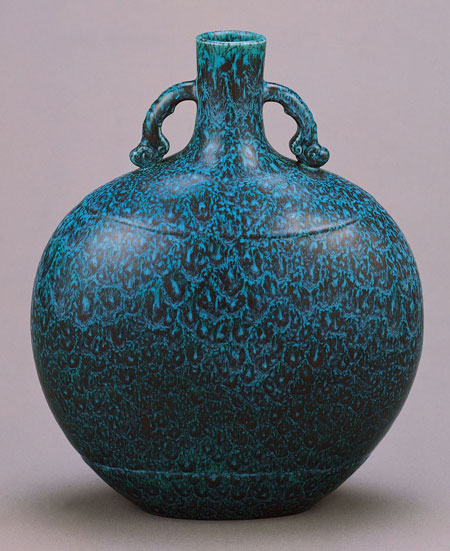
Prior to last week, my only exposure to “artifacts” was something like this:

This artifact is an ancient Chinese pot, the kind of piece you would see at Chicago’s Field Museum, or in a similar collection.

But last week at the lab, Vasily, my research supervisor Olga’s husband, told me about biological artifacts. Here is a definition from Biology Online:

Artifact. Any visible result of a procedure which is caused by the procedure itself and not by the entity being analyzed. Common examples include histological structures introduced by tissue processing, radiographic images of structures that are not naturally present in living tissue, and products of chemical reactions that occur during analysis.

Vasily told me that the researcher has to be very careful to distinguish between what might seem like fantastically interesting results and an artifact. I was intrigued. So I looked up some articles on PubMed about these so-called artifacts. Here are some of my findings, along with some pretty cool images that illustrate the concept.

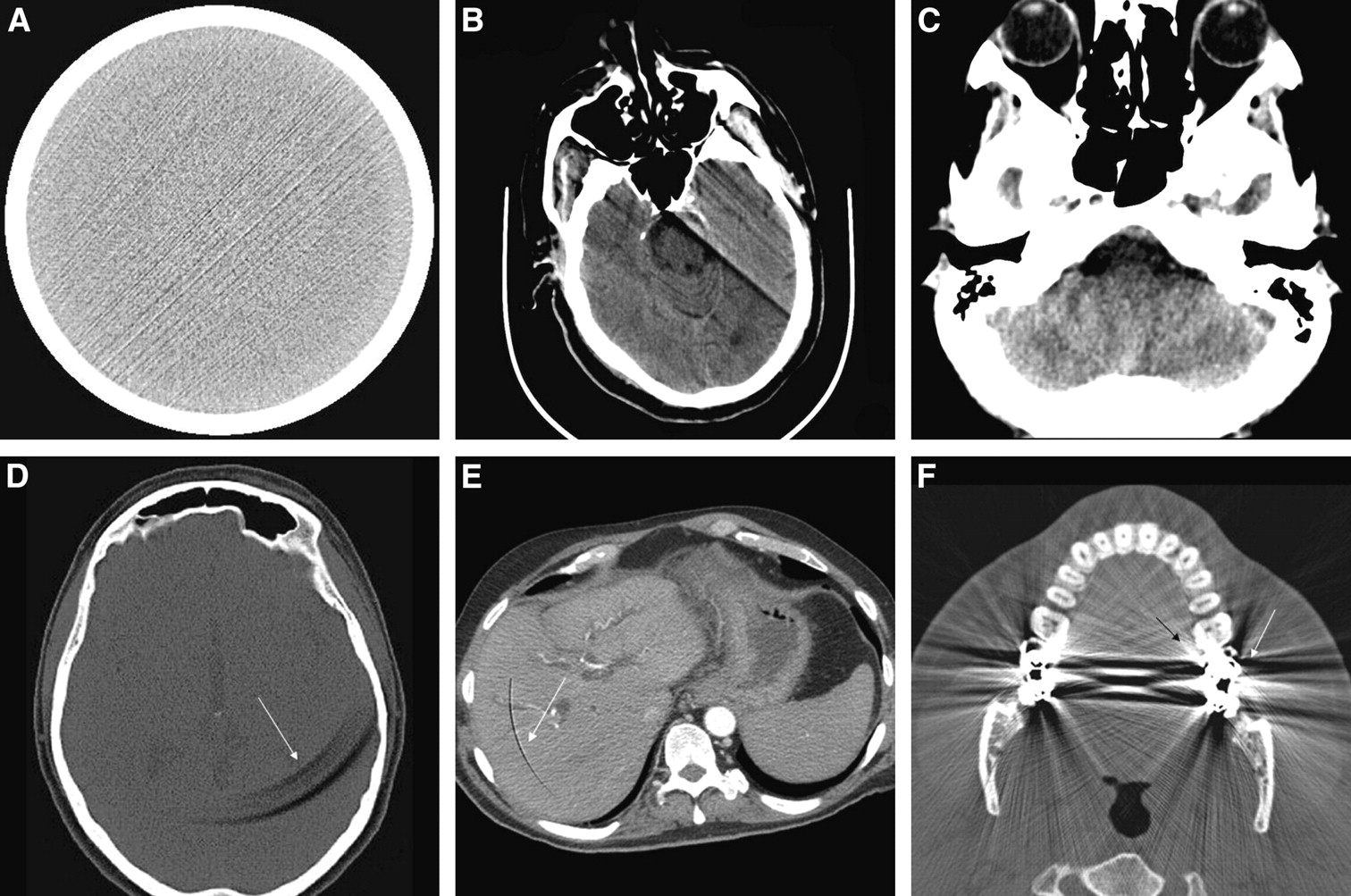
One type of article that kept coming up was about radiological artifacts. Basically, the idea is that the quality of a CT scan or MRI can be compromised, leading to “image artifacts” that can result in the improper diagnosis of a disease. For example, according to one paper I read*, there are several categories of radiological artifacts. The artifact type that I understood the best (the others had to do with rather sophisticaed nuclear technology) results from motion. If there is either involuntary (i.e., sneezing, heart beating) or voluntary (i.e., swallowing) movement, there could be distortions or shadowing on the film. Above is an example of a artifacts pictured in the paper.

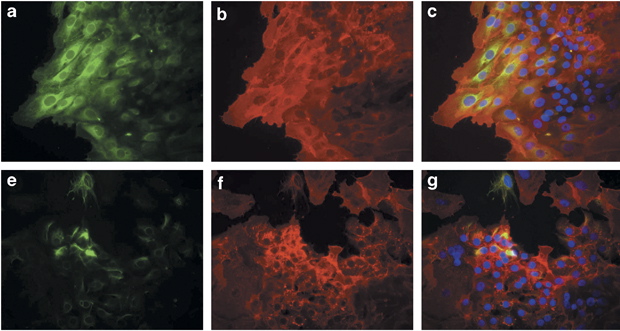
On a subject that I understand a bit better (and that results in prettier pictures), there are artifacts on the biological side of research as well. Another article I found** was about a very specific aspect of pancreatic epithelial cells. Its authors reported that a type of cell transition that had been observed in their laboratory was likely an artifact. They hypothesized that their cell isolation procedure might have introduced some type of genetic changes in the cells that caused the artifactual result. Below is an image from this paper, representing the artifact that they observed: the coexpression of MSC antigens CD29 and vimentin in a two-day cultured pancreatic digest. (Don’t worry if that’s Greek to you. But I know some of you out there are research folks, so I figured I would mention a few details.)

So what’s the point, other than looking at cool cell stainings (which is fun on it’s own, in my opinion)? The point is that as a scientist, and as a clinician, you have to be cognizant of what is normal. And then when results come back that are abnormal, you take a close look to make sure that there is not an alternate explanation other than true abnormality (or perhaps an amazing discovery, in the case of research). It’s always about questioning things. That’s the nature of science, isn’t it? I think so, at least.

* Popilock, R., Sandrasagaren, K., Harris, L., and Kaser, K.A. (2008). CT artifact recognition for the nuclear technologist. J. Nucl. Med. Technol. 36, 79-81.

**Seeberger, K.L., Eshpeter, A., Rajotte, R.V., and Korbutt, G.S. (2009). Epithelial cells within the human pancreas do not coexpress mesenchymal antigens: epithelial-mesenchymal transition is an artifact of cell culture. Lab. Invest. 89, 110-121.