doc w/ Pen

journalist + medical student + artist

Category: Medical School: Year 2

A sound strategy for stress relief

Medical school is stressful. I don’t think anyone — whether looking from the inside or the outside — would deny that. So part of surviving the experience is about finding strategies to mitigate that stress. A healthy diet and regular exercise go a long way. Spending time with other people, doing non-medical-school things, is key too. Something else I’ve recently discovered is listening to the calming sounds of nature while studying. It helps put me in a peaceful frame of mind even if the material at hand is complex, and potentially frustrating. You can buy this sort of thing of course, but it’s also available for free — a plus for broke medical students — on YouTube. My favorite YouTube channel in this vein is Relaxing White Noise, which has 10-hour tracks ranging from “Bird Happy Hour at the Mountain Creek” to “Rain on Tent” to “Forest Night Nature Sounds.” There are also non-nature sounds, like a fan, but living in the concrete jungle of New York City I want to be reminded of green places and things. (I also want to drown out the perennial construction.) Here’s a sample of one track I like, “Forest Rain Sounds”:

Once a copy editor, always a copy editor

You know you’re a still copy editor at heart when

… You’re reading a neuroanatomy textbook, trying to learn about the vestibular system, and come across an antibiotic spelled in two different ways on the same page. Not only do you notice this, but you feel the need to investigate: gentamicin vs. gentamycin? The former is the correct spelling (with the “i”), according to multiple online sources including the Mayo Clinic. But this isn’t enough. You now need to grasp the roots of this mistake. So you dig deeper, and discover that the misspelling is somewhat understandable given that other antibiotics — streptomycin, neomycin, and tobramycin — spell that syllable with a “y” rather than an “i.” And actually, gentamicin (with an “i”) is sold under the brand name Garamycin (with a “y”). After all this, you are mostly satisfied, except that you have no power to correct the error.

Following such a lengthy digression, this is your final, perplexed thought: “Now what was I reading again?”

When life gives you lemons, build a couch

When I moved into my new apartment in August, the couch I’d bought off another student simply didn’t fit through the narrow hallway of this ancient New York City building. That was frustrating. So I found an online company, Home Reserve, that sells couches (and other furniture) you assemble on your own. Furniture assembly is always an adventure. You never know what the instructions will be like, or whether the parts will be banged up. But I didn’t have much choice. The company’s website emphasizes that the UPS boxes containing the couch parts will fit through narrow spaces, and the videos they posted made the process seem pretty self-explanatory. So I hoped for the best.

The two boxes, each weighing about 60 pounds, were delivered last night. My kind next door neighbor helped me lug them up the stairs. This morning, I put everything together. In less than three hours, I went from two big boxes of flat wooden pieces to a fully finished, upholstered couch. Pretty amazing. My apartment finally feels like a home — a home where I have somewhere to sit other than my bed. That’s a good feeling.

Note: Click on any photo for an enlarged slideshow.

Cookie, anyone?

Cookie time

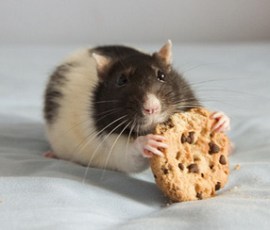
“No rat will ever turn down a wet chocolate chip cookie. And I can actually testify to that from personal experience.”

Watching lecture after lecture can get tiresome, no matter how interesting the material. So I definitely appreciate when a speaker injects a bit of humor, including the above gem from today’s presentation on the hypothalamus. Our professor was explaining the role of the hypothalamus in regulating eating behavior. I’m still struggling to understand everything the hypothalamus does (it does a lot!). But what an unforgettable image …

Repurposing old rules for a new test

Words to live by -- and take a test by.

Words to live by — and take a test by.

Becoming a physician tests you. Your intellect, patience, determination, resolve, and inner strength. Your humanity. This testing happens every day — in the classroom, in the clinic, in the hospital. Part of this process also occurs during actual multiple-choice tests.

More than three years ago, on May 23, 2013, I took the MCAT — the gate-keeper exam for entering medical school. A little over four months from now, on Feb. 10, 2017, I take the next exam in this sequence toward earning my M.D. — the USMLE Step 1 board exam. It’s an 8-hour test, with more than 250 questions probing “whether you understand and can apply important concepts of the sciences basic to the practice of medicine, with special emphasis on principles and mechanisms underlying health, disease, and modes of therapy,” according to the official United States Medical Licensing Examination website.

The stakes are high — I have to pass this exam to move forward. But focusing my thoughts and energy on how high those stakes are is a sure path to test anxiety. After classes end on Dec. 16, I have until my exam date to prepare (minus a trip to Chicago to see my family for Christmas). That’s plenty of time to review and solidify my understanding. It’s a matter of perspective, and directive. Which is why I think it’s time to repurpose the “rules” I developed for the MCAT. They apply here too.

Lorien’s USMLE Step 1 rules:

1. Take a breath.
2. Trust your gut.
3. Take this seriously.
4. Focus.
5. Maintain tempo.
6. Think NOW – not ahead, and not behind.
7. Read every word carefully: passages, questions, and answer choices.
8. Eliminate wrong answers.
9. Estimate.
10. Guess and move on after the allotted time.
11. Keep calm and carry on.
12. Think positive, not negative thoughts.
13. Channel confidence, not fear or doubt.

Uganda: two months and already nostalgic

It’s hard to believe that exactly two months ago, I was on a safari in Uganda. My second year of medical school has started, which means I spend more time looking at pictures of brain anatomy than pictures of any vacation destination. But this rainy, September day is a perfect time to flip through some of my safari photos, and to remember what a magical trip it was.

(Click on any photo to see an enlarged slideshow.)

Lions: clawing their way to the top (of a tree)

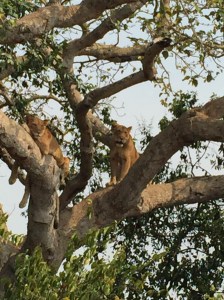
The collared female lion, Harriet, sitting up and watching US.

The collared female lion, Harriet, sitting up and watching US.

Locking eyes with a wild lion and living to tell about it — that’s something few people can say they’ve done. But it was a privilege I had while on my safari in Uganda’s Queen Elizabeth National Park.

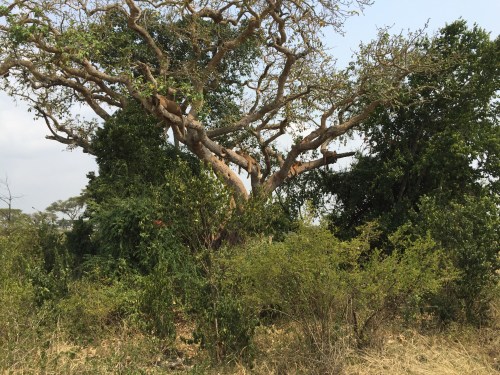
The park’s Ishasha region is known for its tree-climbing lions. Lions don’t normally climbs trees as far as I know, but these do — to escape the buzzing flies hovering low to the ground, and to gain shade from the beating equatorial sun, according to my guide.

One of the things that is so exciting about a safari is that you’re not guaranteed to see the animals. That might sound paradoxical, because you’ve gone on safari to see the animals. But their rarity, and hidden nature, reminded me that these are truly wild animals. This is not a theme park or a zoo.

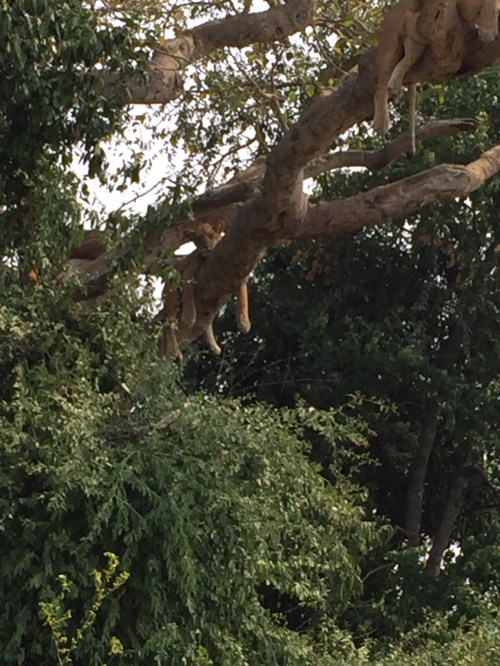
We encountered the Ishasha lions mid-afternoon, after several hours of driving. Four of them lazily reclined on the horizontal branches of a fig tree, seemingly oblivious to our rumbling van and mumbling voices. My guide, Joseph, identified the larger, collared female lion as Harriet. (Joseph later told me that on one of his other safaris, Harriet decided she was tired of being watched, and had come up to the van and started ramming its side. I appreciate that he told me this story after my lion experience. It was probably better that way.) As we watched the four lions, Harriet stretched and sat up. She yawned, displaying her razor teeth. Between that and seeing the lions’ dangling paws — and hence claws — I had no trouble keeping my distance and following my dad’s joking mandate of “Don’t pet the animals.”

Four Ishasha tree-climbing lions resting in a fig tree.

Four Ishasha tree-climbing lions resting in a fig tree.


From this vantage point you can see the lion's dangling paws -- and imagine its claws.

From this vantage point you can see the lion’s dangling paws — and imagine its claws.

Awwwwwww …

Do you like children?

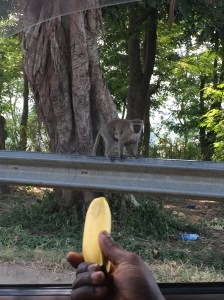
A momma velvet monkey, with her baby clinging to her chest, came down out of a tree when Joseph proffered a tempting banana.

A momma velvet monkey, with her baby clinging to her chest, came down out of a tree when Joseph proffered a tempting banana.

My safari guide, Joseph, asked me this question (I’m paraphrasing) during our six-hour drive from Kampala to Queen Elizabeth National Park. It’s a fair question. I’m almost 35 years old, and I don’t have any kids. I am not in a position to have kids right now, or anytime soon — maybe ever. I’m fine with that.

I told Joseph quite emphatically that I do like children. At this point in my life though, I enjoy playing with them, and then returning them to their parents. Joseph said he would make a prayer for me to have a baby. His prayers were answered over the next several days, though not in the way he anticipated. During my four-day safari, I saw dozens of baby animals: elephants, hippos, pumbas (warthogs), kob (antelope), velvet monkeys, baboons, and chimpanzees. Seeing all of these little ones — well, some of them were quite big — was one of the highlights of my safari adventure.

Funny how a several hundred pound baby elephant can be considered “cute.” But I’ve always loved miniatures. I even collected tiny figurines as a kid. And I guess a baby elephant is a miniature compared to its parents.

Here are a few photos of the baby animals I encountered. They were all adorable. But I reeeeaaaallllly wanted to take one of the baby monkeys home with me. Just look at those faces!

A baby elephant nursing! I saw this amazing sight while on a boat cruise.

A baby elephant nursing! I saw this amazing sight while on a boat cruise.


A baby baboon riding on its mother's back.

A baby baboon riding on its mother’s back, little bare rump exposed.


A baby hippopotamus next to its mother.

A baby hippopotamus next to its mother (to the right).

The importance of cultural exchange — and of cows

You are no longer a woman. You are a bushwoman.

Driving into the Ugandan bush during my safari. During a safari, you spend hours in the car, going from one animal sighting spot to another. I had a wonderful guide, so the time on the road -- and our many conversations -- became part of the whole experience.

Driving into the Ugandan bush during my safari. During a safari, you spend hours in the car, going from one animal sighting spot to another. I had a wonderful guide, so the time on the road — and our many conversations — became part of the whole experience.

That’s what my guide, Joseph, jokingly told me as we drove into the African bush on the first day of my safari. I didn’t know it at the time, but during those four days, I would learn so much about Uganda — and he about the United States.

It started shortly after Joseph and I hit the road. At one point, he and some boda-boda (motorcycle taxi) drivers were joking in Luganda, the local language. One thing I really appreciated about Joseph was that he would translate these conversations for me. So he promptly told me that I had been the subject of that conversation.

“That’s a beautiful woman you have,” one of the drivers had laughingly said to Joseph. “How many cows do you want for her?”

This launched us into a discussion about marriage customs in Uganda, customs that to me as an independent America woman were hard to wrap my head around. Apparently, the bridegroom often gives a gift to the bride’s family — in the form of cows, if you’re from a certain part of the country. Joseph emphasized that culturally, this is not seen as actually paying for the bride. It’s more a gift of appreciation. But before that happens, the man has to have an “introduction” — kind of like an engagement party, where the future groom buys the whole village a bunch of food both to celebrate and to prove that he’s a good guy. This introduction, Joseph said, is actually more important than the wedding itself. Then to get engaged in the church, you need a letter from the parents, granting approval. So for a man, between the introduction and the dowry, getting married can be an expensive proposition.

I continued to learn about Uganda throughout the trip, things you might not read about in guidebooks. As we drove through one particular town for example, Joseph commented that HIV was an especially big problem there. It’s a stopover place for truckers coming from both Kenya and Tanzania, he said — and some of the truckers look to hire prostitutes during their time there.

Our conversations, though, were well balanced between heavy and light topics. Toward the end of the trip, I asked Joseph about the hand motions I’d seen him make time and time again out his driver’s side window. He explained that it was a sort of sign language oncoming drivers used to query about road conditions up ahead. The oncoming driver would blink his lights. There were three possible responses, Joseph told me. If things are fine, you stick your hand out the window, palm parallel to the road, and wave your hand left to right and back again. If there is a problem immediately up ahead for the oncoming driver, with your hand out the window and your index finger pointed down to the road, you move your hand up and down. If things are bad — but not for some distance — you make a sine-wave motion with your hand. And then after the wave motion, you point your index finger down toward the road several times. I told Joseph I fully support adopting this system in the United States.

Another view from the road, this time of a grassland savannah. During a safari, you spend hours in the car, going from one animal sighting spot to another. I had a wonderful guide, so the time on the road -- and our many conversations -- became part of the whole experience.

Another view from the road, this time of a grassland savannah.

During our many hours in the car, I made a number of important contributions to Joseph’s understanding of America and Americans too. I did my best to explain some of our inexplicable vernacular expressions, including the old-fashioned phrase “knock on wood.” He understandably thought that was silly. I don’t blame him.

Perhaps the most significant knowledge I imparted relates to my hometown, Chicago. I told Joseph that I live in New York City now, but that previously I was in Chicago. When he heard that, this was his first question: “Do they raise cows there?” You can imagine my confusion. I quickly realized, though, that Joseph’s question made total sense when you think about one of Chicago’s favorite sons, Michael Jordan of the Chicago Bulls. Why would they use “bulls” for the team’s mascot if they don’t have cows in Chicago? Joseph wondered. Good question. I still don’t have a good answer.

There was plenty that surprised me about Uganda, and Joseph about the United States. Some of it was confusing, and some of it was beautiful. But learning about another culture, the differences and similarities, regardless of whether they make sense or not — that’s part of why I travel. I’m so grateful that my guide, Joseph, felt the same way. It made for a wonderful four-day trip.

One who listens

In addition to this blog, I also write a monthly column called Bio-Lingual for the online magazine The American In Italia. I don’t usually cross-post. But the piece that was just published there is about my time in Uganda so I wanted to share it here, with those who are following my experiences. Here is the link:

One who listens

A brief preview, in case you’re deciding whether to click on the link: In the essay, I explore the kind of doctor I want to be. Being in Uganda for two weeks helped me better understand how I want to treat patients.