doc w/ Pen

journalist + medical student + artist

Tag: study habits

Medical School: Expectations and Flexibility

It’s day 3 of medical school. Some things have been as I expected, like the fact that there is far more reading assigned than is humanly possible to finish—and certainly more than a person can ingest and understand. I was even prepared for meeting my cadaver yesterday in anatomy, and did not shy away (though the smell was more potent than I thought it would be).
 Oddly enough, these would become Cornell's colors in about 2 months

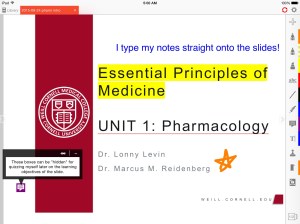
Examples of the types of annotations you can do in iAnnotate, an app for the iPad.

But life is all about flexibility. And one thing I’ve had to adjust is my note taking style. In a previous post, I said I would try using the Cornell note taking method. On the first day of class, I was prepared to do just that—with a clipboard and college-rule paper. During orientation though, each student in my class was given an iPad. I brought mine to class, expecting to use it to follow along with the slide presentations (which we have access to ahead of time) and then to take notes on paper. It was difficult to go from screen to paper though, and keep track of which notes went with which slides. So to my surprise, I’ve been annotating directly on the slides. It’s easy to type, highlight, underline, and draw with the stylus or your finger. In the app we use (iAnnotate, which I have actually been using for the last several years on my own iPad) you also have the ability to make little notes that you can “hide.” When a lecturer includes a list of learning objectives in the slide show, part of my review includes creating hidden notes with the key information on those learning objectives. My plan is to quiz myself later by trying to recall the information, then revealing the notes if I have difficulty.

We have our first quiz on Monday, so we’ll see …

Study Habits for Medical School, New and Old

This is medical school.

This is medical school.

Trying to absorb the vast quantity of information presented during medical school has been compared to drinking from a firehose. There’s simply no way to swallow it all. This means that I’ll have to prioritize information, and to maximize my time with excellent study skills. I’ve always been a good student. So I’ll be carrying over some old study habits that worked well in college and my post-bac. But I’ll also try some new methods that sound promising. It’s all based on knowing my personal learning style. Here’s my lineup:

During organic chemistry, writing out complex reactions on my dry erase board helped me understand the concepts better.

During organic chemistry, writing out complex reactions on my dry erase board helped me understand the concepts better.

Dry erase board. I used this extensively during my post-bac for everything from organic chemistry (drawing out structures and color-coded synthesis reactions) to genetics (creating a flowchart of the transcription process from start to finish). For me, the kinesthetic component of learning is key – I need to DO something with the information, not just read it or hear it (although audio and visual learning is important for me too). Seeing things written extra large, and with multiple colors, helps me remember them even better.


Scapple.
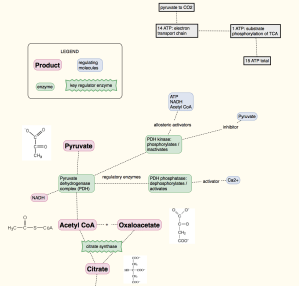
This is a new experiment. Scapple is a Mac app that allows you to make connections between ideas and concepts. I tried it out while reviewing the Krebs cycle a couple weeks ago, and really liked it (the screen shot below is part of what I created to represent the links between the different molecules, enzymes, and other players in the cycle).

The Scapple app allows you to make connections between different ideas.

Cornell note taking is a much more active process than regular note taking.

Cornell note taking is a much more active process than regular note taking.

Cornell note taking method. Another experiment, this note taking method incorporates reviewing, questioning, and summarizing into the process. It’s much more active than just scribbling down what the professor is saying. That kind of active participation helps me learn and remember, which is why I’m giving this a try.

Study groups. I’ve had mixed results with these in the past, but I’ve heard that studying in groups is really recommended in medical school. So I want to try it.

I’ve made it this far, so clearly have my share of good study habits. But with the game being stepped up in medical school, I think it’s important to experiment too. There’s always room for improvement.