doc w/ Pen

journalist + medical student + artist

Tag: science

An abstract challenge

I first saw my name in print in the fall of 1999. It was my first semester of college. I had taken a journalism class because my advisor told me not to. When I fell in love with reporting and writing, my journalism TA hooked me up at the school newspaper. My first article was a feature on cider making at the local apple orchard.

That was 17 years ago. It’s still a thrill to publish — to share my written work with the world. These days, most of that takes place via this blog or the online magazine where I write a monthly column. Most of my work consists of personal essays.

But last week, I submitted a different sort of writing — a research abstract based on my work in rural Uganda this past summer. If the American Geriatrics Society (AGS) accepts my abstract, I will present a poster at the organization’s national conference in San Antonio, Texas, in May 2017.

I do have another scientific publication — a secondary authorship on a paper from the Drosophila melanogaster (fruit fly) lab where I worked for a semester while taking my medical school prerequisites. But this would be my first time as a first author. And this would be my first foray into the world of clinical research.

Acceptance here is by no means a guarantee. And my topic is somewhat outside the typical AGS fare, so I’m not holding my breath. Even if I don’t get accepted, going through the abstract writing process was still a wonderful experience. Distilling all that work into fewer than 2,650 characters was something else. That taxed even my editorial expertise.

All that said: *fingers crossed.* I’ll find out by February.
Science Marvels #1

I dove back into science yesterday. My first medical school assignment is to complete a prematriculation assessment, and since I’ve been out of school for a few years (finished my coursework in the spring of 2012), I’m brushing up on some basic concepts along the way. In doing so, I quickly rediscovered the pure joy I find in studying science. To try and share that sense of awe and wonder, I’m going to post periodic amazing science facts or concepts on my blog. Here is today’s entry.

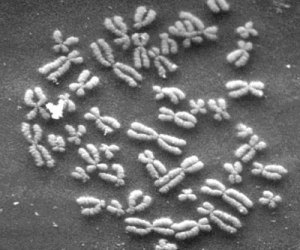
Electron micrograph of chromosomes from Berkeley.

Electron micrograph of chromosomes from Berkeley.

The Amazing Chromosome: Stretched out to its “contour” length, chromosomes range from 1.6 to 8.2 centimeters long. Yes, CENTIMETERS. This according to my medical biochemistry book. Holy cow! Question: So how do these linear segments of DNA fit in our tiny cells? Answer: They are condensed more than 8,000 fold, coiled and wrapped over and over with RNA and proteins called histones. Wow. Marvelous indeed.

Library Access: A Lab Job Perk

PubMed is a great resource. For those of you who aren’t familiar with it, PubMed is an online resource hosted by the U.S. National Library of Medicine and the NIH. It has more than 22 million citations to biomedical literature. Some of those citations have links to full text articles. But unfortunately, many of the more prestigious journals charge for their articles (often as much as $30 or $40 per article). Given my current broke status, I can’t exactly afford to buy article access.

So I recently e-mailed my PI at the UIC lab where I work asking whether I could get journal access through UIC (major universities usually provide this type of access to their students and some employees). He told me that all I needed to do was plug my laptop into the UIC network (via a network cable at the lab) and I would automatically get access to everything.

A few weeks ago, I spent a little downtime getting some of the articles I wanted. When you download an article from some of these publishers’ sites, a little window will pop up with “recommended readings” based on what you just looked up. I noticed at some point that not a journal article, but a book chapter, popped up as one of those recommended readings. I hadn’t thought about book chapters. But as I did think about it, the idea appealed to me. A book chapter would provide a great deal of background, which is what I am looking for right now. So I wondered, “Could I get the whole book?” The answer: “Yes!” Then my follow-up question: “Are there more available books on my subject?” The answer, again: “Yes!”

From home, I used the UIC library’s Web site to find available eBooks. Then while a gel was running at lab, I downloaded them, chapter by chapter (you can’t download the whole book directly). Back at home, I put them on my iPad.

Granted, I’m not going to read every single page of every single book I downloaded any time soon. But I want to be able to skim them, to decide what I want to read and not read. So getting entire books made sense.

After I had finished getting my books, I was curious – how much would all of these books have cost had I purchased them? Being the absolutely nerdy person I am, I made an Excel spreadsheet to calculate the cost of buying the hardback book directly from the publisher, the eBook from the publisher, the hardback from Amazon.com, and the eBook from Amazon.com (yes, I actually did this). I was amazed – the hardback books from the publishers would have cost more than $2,000 (eBooks and Amazon.com hardback prices were somewhat less). One more reason to be affiliated with a major research institution, and to be grateful for my lab job!

Here is my lovely spreadsheet:

library savings

Building A Scientific Cathedral

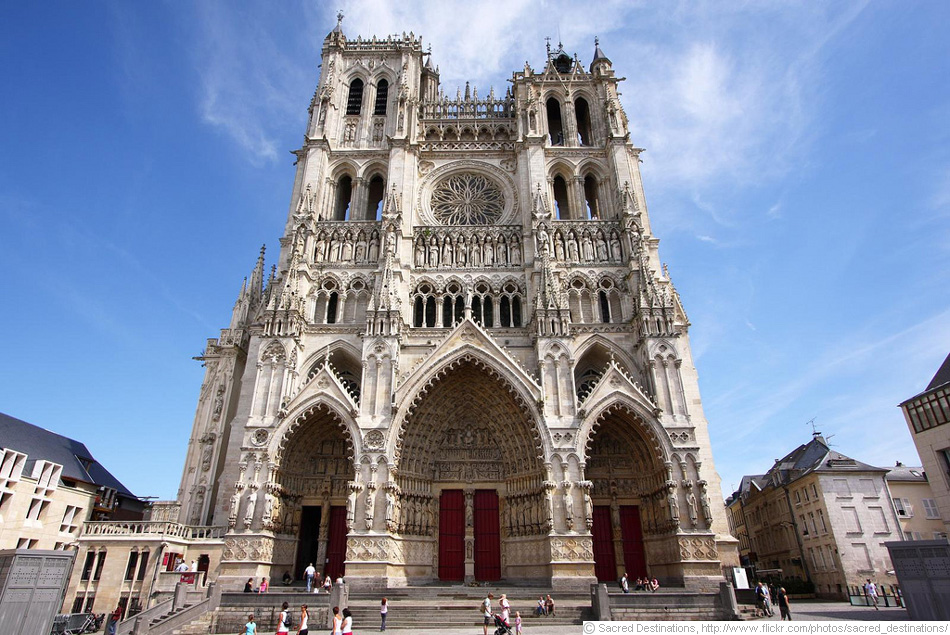
cathedralA woman came across three men working at a construction site. She asked the first man what he was doing. He replied, “I’m making bricks.” She then asked the second man the same question. His reply was, “I’m making a wall.” When she came to the third man and repeated her question, he said, “I’m building a cathedral.”

Clearly, all three of these men were doing the same thing. But they had different attitudes, different visions, and a different sense of pride, about their work.

stone wallSo why am I telling this story? I think that there is a parallel to basic science work here (and I’m not talking about the chemical reactions involved in solidifying bricks and mortar). Like bricklaying, basic science involves a great deal of “manual” labor, which is sometimes repetitive and tedious. If that’s all you see about science, though, you’re not going to be very satisfied doing it – much like that first bricklayer. If you can make some connections, put the work in context, see it as the second bricklayer did – that you’re creating a wall – then it will be somewhat more fulfilling. But if you can continue to do your work while maintaining the sense that you are a part of something greater, that every discovery is built upon the work of so many other people, that you are constructing a “cathedral” of sorts along with other scientists, then the discipline becomes so much more.

I’m not going to lie. That repetitive work? I know that in my future as a physician-scientist, I may not always feel like doing it, or find it “fun.” But there will be a point to it, a greater goal, both within the context of my own particular research and within the larger context of science. And I find that thrilling.

Like the greatest cathedrals, our body of scientific knowledge has been built brick-by-brick. I look forward to laying a few of my own someday.