doc w/ Pen

journalist + medical student + artist

Tag: medicine

Always more to learn

What we know is less than what we don’t know.

That’s a quote from one of our infectious disease lecturers. She was talking about viruses. But her words describe so many vantage points, including my own right now.

I’m done sitting in a classroom. Not just for the semester, but for medical school. Next semester, after I take my board exam, I go straight to the hospital to start applying all I’ve learned. And to learn so much more.

It’s been a jam-packed three semesters. I absorbed more information than I thought possible when this all began. Attending medical school is compared to drinking from a fire hose. It’s an apt analogy. What we endure is intense.

Even so, what I’ve got now is book knowledge. A tangle of facts. (And even that needs a great deal of solidifying during my five weeks of studying for boards.) Having that knowledge at my fingertips, and understanding how to use it in clinical practice — those are skills I don’t yet have. And while I know the steps of a physical exam, interpreting the findings, what they mean in the context of my patient, is something I need to practice too. I also need to listen to hundreds of hearts and lungs and bowels so I can learn what normal is — and what abnormal is. Right now, it’s all a bit of a jumble.

I have learned so, so much since starting medical school in August of 2015. But I have more to learn in the next two and a half years while I’m in the hospital. Then more yet in residency. And even more once I’m an attending physician. In medicine, the learning and growing never stop. That’s intimidating sometimes, but it’s also exciting. It keeps things interesting.

Right now though, I’m ready for my two-week winter vacation. All this learning is hard work.
Building trust, one patient at a time

Sneaky.

That’s what my patient called me yesterday.

He meant it as a compliment. I took it as one.

I’ll back up, and explain the context of this clinical encounter. Yesterday was our final OSCE of the semester. OSCE stands for Objective Structured Clinical Examination. That’s a long way of saying we get videotaped interacting with a standardized patient, an actor who’s trained to play a certain role and then provide us with feedback about how we did. It’s a required part of our medical school curriculum. It’s how they assess our developing clinical skills. We’ve had several OSCEs since starting medical school, but yesterday was the culmination of our three semesters thus far. Up until this point, we’d only done bits and pieces of the standard history and physical exam. This time, we had an hour for the whole thing, from the chief complaint (why are you here?) and history to a head-to-toe physical exam.

I was nervous. In part because being filmed intrinsically makes me nervous. But also because this was a lot to remember. It matters, and I wanted to do well, to take the exercise seriously. Because in a couple of months, I’ll be doing it for real.

But once I settled in with my patient, I was fine. While taking his social history, I learned he was from Chicago. So I delved into that a little more. We talked about the differences between New York and Chicago. We joked about particularities of the Upper East Side. And then I attempted to gracefully move on to the TED questions — tobacco, ethanol (alcohol), and drugs. Sexual history was next. These two groups of questions are some of the most touchy. My feeling is that if you have the time, it’s a good idea to get to know the patient a little before asking those questions. Not only that, I simply enjoy hearing other people’s stories. What is someone else’s life like? Where have they been? How do they approach the world? It’s the curious reporter in me.

And that, my patient told me, was sneaky. In a good way. We were talking about Chicago and then all of a sudden you were smoothly on to more history questions, he said. By talking about his life, he told me, I’d developed a rapport that made him feel comfortable answering those delicate questions.

Not everything went so smoothly. I have lots of room for improvement. I need to find the right balance between spending time on those life-questions and spending time on the rest of the physical exam (which I didn’t quite finish within the hour).

But I’ll get faster. I’ll become more efficient. Those are skills I can learn, and will learn as I make my way through clerkships in the hospital. That I know how to earn someone’s trust — I think that’s more important at this stage. At least for me. The rest will come.

Practice makes better

In about two months, I take the USMLE Step 1, the first of my board examinations. Yesterday, I took an abbreviated practice exam in our main lecture hall with my classmates. This was not by choice — it was a mandated exercise. And I took it begrudgingly.

I plan to study full time for five weeks for the real exam. At this point, I haven’t studied at all. What I have done, though, is plow through three semesters of medical school. While I’m in no way ready to take Step 1 now, the practice exam didn’t have the demoralizing effect I expected. First of all, I remembered more than I thought I would. That suggests that if I do apply myself during my study period, I will be ok. The level of detail required, though, reminded me how much I do have to review. And my difficulty in sitting through even an abbreviated exam reminded me that I need to build test-taking stamina to make it through the real deal.

So as much as I griped about this, I’m glad to have taken it. I know I have my work cut out for me. But I’ll be trying to work through those five weeks of studying with a mindset of calm, not panic.

Remembering how I got here, with gratitude

Living on the Upper East Side of Manhattan, you encounter a lot of wealthy people. The zip code 10065, just blocks south of where Weill Cornell Medical College is located, made number 15 on Forbes’ “America’s Most Expensive Zip Codes 2015” with a median sale price of $4.4 million. As a broke medical student though, this is not a life that I’m directly exposed to. Not usually. But recently, I was invited to dinner at a private social club. I was to meet the person who funded my summer research, including my trip to Uganda.

Having grown up writing thank you notes for even the smallest of gifts, I was excited to say “thank you” in person for making this life changing experience possible. But when I found out where we were meeting, I was also nervous. Former club members apparently included people like Eleanor Roosevelt, Pearl Buck, and Margaret Mead. What in the world did I have to wear to a place like that? Of course my fretting was for naught; everyone’s attire there was classy but not fancy, just like mine. Phew.

The food at the club was excellent, but much more meaningful was the company. At the dinner I was reminded of two things. First, how important it is to support and mentor a younger generation. That support might be financial, emotional, or otherwise. And second, how significant the experience is for  both parties.

The person who provided my scholarship was thrilled to hear about my trip and my experience. And I was thrilled to share it. The money provided was a drop in the bucket to her, but meant all the world to me. I couldn’t have gone without it. I hope my gratitude came across during that short time.

I’ve had so much help to get here, and it continues to pour in. I’m grateful for all those gifts, great and small. And I fully intend to pay them back someday by paying them forward.

My brush with the ‘winged scourge’


“Shit, do I have malaria?”

That was one of my first thoughts upon returning to the United States from Uganda in late July. I remember thinking that as I was waiting in the customs line at JFK airport in New York City. I’d spent my 12-hour connecting flight from Doha, Qatar, huddled under a thin fleece blanket, shivering, my head and whole body aching. My stomach hurt. I had diarrhea. Potential signs of malaria, I knew.

This was reinforced in our parasitology presentation yesterday, the lecturer saying:

Fever + travel = malaria … until proven otherwise.

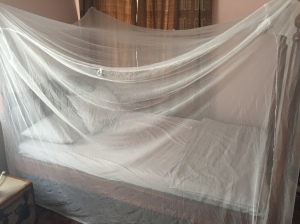
Sleeping under a mosquito net every night was part of my malaria prevention in Uganda.

Sleeping under a mosquito net every night was part of my malaria prevention in Uganda.

While in Uganda, I had spent every night under a mosquito net. I’d religiously taken my Malarone (malaria prophylaxis) as directed. But … my mosquito repellant application had been less than diligent. The bugs weren’t really about during the day, and I was already applying a sticky layer of sunscreen. So I decided to spray myself only in the evening. Problem was, I’d be sitting out on the back porch, drinking Ugandan beer and talking with my friends, and completely forget about the DEET. So a number of mosquitoes got lucky with me. It seemed like even when I applied the spray though, it didn’t make much of a difference. But either way, I had something to fuel my paranoia. And boy, are medical school students good at being paranoid about their health.

Thankfully, I didn’t have malaria — it was probably a stomach virus. Several people I’d been traveling with got something similar. But it was scary. I plan on returning to Uganda for future research, and I certainly will be more careful with the bugs next time. Just in case. No reason to tempt fate.

I’ve always thought of malaria as mainly a travel-related illness. And these days, it is. Interestingly though, I learned in our lecture about how much of the United States was affected by malaria even into the 1940s in several Southeastern states. This was such a big deal that the U.S. government worked with Walt Disney studios to bring back the Seven Dwarves in 1943 to teach people how to knock out mosquitoes, the vectors that transmit malaria. The short film was called “The Winged Scourge,” and I found it on YouTube after hearing it briefly mentioned in our lecture. I couldn’t resist sharing the video (see the top of the page). It’s just under 10 minutes, and it’s hilarious. You’ve got the booming, ominous voice warning you of the winged villain. And then you’ve got the beloved dwarves doing their best to exterminate the critters, and of course getting into mischief along the way.

Some of the advice still holds, like eliminating standing water to get rid of places for mosquitoes to lay their eggs. Though I’d guess there are other methods to try before you lay down an oil slick on ponds to asphyxiate the larvae swimming below. Not too good for the rest of the environment.

It’s a piece of history — of public health history, and of cartoon history. As a socially conscious future physician who was raised on Disney movies, what more could you ask?


Note: If you’re curious about the history of malaria eradication in the United States, here is an interesting (and brief) explanation from the CDC.

Bugs and drugs

Talking to yourself is a sure-fire way to look crazy. I’ve discovered it’s also a sure-fire memory enhancer. When I was first learning Spanish, I would have conversations with myself, voicing my thoughts in Spanish rather than English. These days, I find myself muttering antibiotic treatment algorithms aloud. I (mostly) do this alone in my apartment, for everyone’s sake.

Identifying the bacteria causing an infection is sometimes trickier than it sounds.

Identifying the bacteria causing an infection is sometimes trickier than it sounds.

Tomorrow is our first infectious disease exam, and there is so much to memorize. Every little bump helps. I can sum up this exam in two words:

  1. bacteria
  2. antibiotics

That might not sound like such a big deal. Trust me. It’s a big deal. I can prove it. I’ve included a photo of my dry erase board, which currently sports an identification tree for both the common gram positive and gram negative bacteria. (There are other bugs to know, but these are the main ones.)

The list of antibiotics to learn is also long. The list here is a screenshot from an e-mail sent by our course director, telling us what we drugs to focus on. Antibiotics are tricky though. Each one covers a slightly different spread of bacteria. I also need to know the mechanism for each drug, possible side effects, and how various bacteria can become resistant to the drug. That’s a lot of information.

Learning all these drugs -- what they treat, how they work, side effects, and resistance mechanisms -- is a feat.

Learning all these drugs — what they treat, how they work, side effects, and resistance mechanisms — is a feat.

Thankfully, my motivation for learning these bugs and drugs is high. Antibiotic therapy is something I will definitely use on a regular basis. Seeing that clinical application helps me slog through. Silly mnemonics are also a boost. Some are my own, like this one:

  • Ceftaroline, a fifth generation cephalosporin, is one of a few drugs with activity against MRSA. Here’s how I remember that: Ceftaroline‘s got a line on MRSA.

Here are a couple from the book I’ve been using to study, Microbiology Made Ridiculously Simple:

  • Carbapenems like Imipenem and Meropenem are broad spectrum antibiotics that cover all kinds of things — gram positives, gram negatives including Pseudomonas, and anaerobes.  To remember the coverage of Imipenem, think of this: I’m a pen, crossing out all bacteria.
  • Bactrim is another antibiotic that covers all sorts of bugs. This drug’s generic name is trimethoprim/sulfamethoxazole, or TMP/SMX. You can use four of those letters, TMP/S, to remember some of Bactrim’s capabilities:
    • T (Tree): respiratory tree. The drug covers all kinds of respiratory infections.
    • M (Mouth): gastrointestinal tract. The drug covers many gram negative bugs that cause diarrhea.
    • P (Pee): genitourinary tract. Bactrim covers UTIs and other nearby infections.
    • S (Syndrome): The drug covers a devastating disease called Pneumocystis carinii pneumonia (PCP), which affects people with AIDS who have low T-cell counts.

These are stupid, but they stick. And that’s what matters. It matters for my test tomorrow, but more importantly when it comes to treating a patient who presents with one of these infections. If it takes me mumbling these mnemonics to myself and looking like an idiot to get there, I’m ok with that.

An abstract challenge

I first saw my name in print in the fall of 1999. It was my first semester of college. I had taken a journalism class because my advisor told me not to. When I fell in love with reporting and writing, my journalism TA hooked me up at the school newspaper. My first article was a feature on cider making at the local apple orchard.

That was 17 years ago. It’s still a thrill to publish — to share my written work with the world. These days, most of that takes place via this blog or the online magazine where I write a monthly column. Most of my work consists of personal essays.

But last week, I submitted a different sort of writing — a research abstract based on my work in rural Uganda this past summer. If the American Geriatrics Society (AGS) accepts my abstract, I will present a poster at the organization’s national conference in San Antonio, Texas, in May 2017.

I do have another scientific publication — a secondary authorship on a paper from the Drosophila melanogaster (fruit fly) lab where I worked for a semester while taking my medical school prerequisites. But this would be my first time as a first author. And this would be my first foray into the world of clinical research.

Acceptance here is by no means a guarantee. And my topic is somewhat outside the typical AGS fare, so I’m not holding my breath. Even if I don’t get accepted, going through the abstract writing process was still a wonderful experience. Distilling all that work into fewer than 2,650 characters was something else. That taxed even my editorial expertise.

All that said: *fingers crossed.* I’ll find out by February.

End-of-life ethics

Medical school definitely has its drudgery. Thankfully there are also moments of beauty — interactions and experiences that remind me why I’m here. Moments that remind me that I am in the right place, doing the right thing. This week I had one of those moments.

It was after a morning small group ethics discussion. We’d been talking about end-of-life issues: palliative care, terminal sedation, physician-assisted death, and euthanasia. Following the session, a classmate from my group stopped me in the hall. She’s someone I think highly of, but don’t know well on a personal level. We travel in different social circles. So I was curious why she wanted to talk to me. I’ll paraphrase part of our conversation. She told me:

If any of my loved ones ever needs palliative care, I’m going to look you up and find out where you’re practicing. I want you to be their doctor. I can tell you have a heart for this.

Her words touched me profoundly. The fact that my passion for palliative care emerged — at least to this particular classmate — even in our rather contentious 50-minute discussion made my day.

It was a contentious discussion, though. Fervent, ethical arguments for and against physician involvement in the death of suffering patients dominated our debate. I do have strong opinions on this hot-button end-of-life issue, and others. Midway through the hour though, I brought up a perspective I believed was missing from the dialogue. Long before you arrive at a conversation about physician-assisted death, you do everything you can to help your terminally ill patient find meaning in the last days, weeks, or months of life. You strive to relieve both physical and emotional pain and suffering with an interdisciplinary approach. You do that through the cooperation of doctors, nurses, social workers, psychologists, chaplains, art therapists, massage therapists, music therapists, and other medical professionals, each of whom works a little different magic. You involve the family in this process too.

It is natural for a patient and their family to feel sad when faced with a life-limiting illness. But they don’t have to feel hopeless, or depressed. There is meaning and purpose to be found at the end of life. I’ve seen it, both here at the hospital in New York City, and during the home visits I did in rural Uganda. And that’s where you go first — in search of comfort and purpose (perhaps a redefined purpose). When those efforts fail, only then do I think it’s appropriate to have a conversation about physician-assisted death or terminal sedation.

I do believe in a patient’s right to physician-assisted death — with proper safeguards and regulations to prevent misuse and abuse. I do belive that terminally ill patients who have capacity deserve the autonomy to leave the world on their own terms. But I also do believe that is an option of last resort, when the suffering has become intractable and untreatable.

I have a long way to go before I’m a practicing physician. Whether I actually pursue palliative care, who knows. Whatever specialty I enter though, I will work with patients who are in pain, and who are dying. Belief in the power of hope and palliation will serve me and my patients well regardless of what specialty I choose. That these core beliefs of mine are evident to others — this tells me I’m on the right track to becoming the kind of doctor I want to be.

Caution: sharp objects ahead

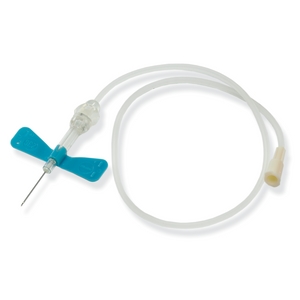
When you call it a "butterfly needle," it sounds so innocent and cute ...

When you call it a “butterfly needle,” it sounds so innocent and cute …

One step closer.

That’s what I tell myself with each new medical school milestone. This week, there were two big ones. Both involved sharp objects. But with the exception of some minor bruising, everyone came out just fine in the end.

Monday, I took my first stab at drawing blood (that pun was so intended). I’ve done delicate surgical procedures on mice, including injecting medication into the inferior vena cava. But survival was not a goal of those procedures. Phlebotomy is obviously much different. This first time, we medical students practiced on each other. With some guidance, my classmate stuck me on her first try. I had a little more trouble. Three pokes later, I managed to see the coveted red flash of blood. I patted myself on the back until I saw my friend the next day. When asked, she showed me her arm — a purple bruise where I’d poked.

I’ll get better. It takes practice, just like everything else.

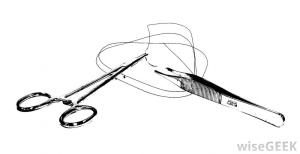
Suture kit

With suturing, you use metal tools to hold the needle and the skin.

Though it was technically my first time with this too, Tuesday’s activity — suturing — actually felt less foreign in some ways. I learned basic sewing when I was in elementary school. I feel comfortable with the general act of guiding a needle and thread. With sewing though, you use your hands to hold the fabric and the needle. With suturing, you use metal tools to hold the skin and the needle. That took a little adjusting.

Another adjustment: it took me a moment (and a comment from a surgery resident on my crazy stitches) to realize that while sewing and suturing share many features and movements, the basic suture technique I was practicing differed from sewing in one very important way. With sewing, you create contiguous stitches to keep the fabric together. You tie a knot and cut the thread only when you’re done, or when you’ve run out of thread. With the basic suturing technique I practiced Tuesday (called the “simple interrupted suture”), you create distinct stitches that are separate from each other. Stitch, knot, cut. Repeat.

This makes sense. Fabric needs that continuity to stay together. With skin, you’re holding things tight temporarily, just until the skin gets its act together and heals itself. Then you don’t need the stitches anymore. The simple interrupted sutures are actually a lot like straight pins in sewing. When you hem a dress, you pin it up first to keep everything straight and tidy. Then you run it through the sewing machine. Once you have that strong hem sewn, you remove the pins. Likewise with the simple interrupted suture I learned: you put temporary, individual sutures in until the skin is healed. Then you pull out the sutures, just like you did with the pins of your dress hem.

It makes sense to me now, but my practice foam block (full of contiguous sutures) must have looked like a complete train wreck to that surgery resident. Well, now I know. And more importantly, I understand.

Knowing, understanding, practicing: this means I’m headed in the right direction. Even if I did leave a little bruise.

Some little bug is gonna find you …

Bacteria are everywhere.

I’m reminded of this fact as I enter my last class-based unit of medical school, infectious disease. With this in mind, I’m also reminded of a song that my family listened to during my childhood. This was back in the day when people made “mixed tapes” with cassettes, not with an iTunes playlist. A friend of my dad’s made us this particular tape in the mid-1980s. It was a favorite on cross-country road trips to visit my grandparents in Colorado and Kansas. The tape was full of folksy songs about trains, whales, Star Trek, and … gut bugs.

“Some Little Bug” apparently dates back to the early 1900s. This particular version, which I’ve uploaded to YouTube and shared here, was digitized from that old cassette tape. You’ll find the lyrics below the YouTube link.

Enjoy. But not while eating.

“Some Little Bug”

In these days of indigestion it is oftentimes a question
As to what to eat and what to leave alone.
Every microbe and bacillus has a different way to kill us
And in time they all will claim us for their own.
There are germs of every kind in every food that you can find
In the market or upon the bill of fare.
Drinking water’s just as risky as the so-called “deadly” whiskey
And it’s often a mistake to breathe the air.

Some little bug is gonna to find you someday.
Some little bug will creep behind you someday.
Then he’ll send for his bug friends
And all your troubles they will end,
For some little bug is gonna find you someday.

The luscious green cucumber, it’s most everybody’s number
While sweetcorn has a system of its own.
And, that radish seems nutritious, but its behavior is quite vicious
And a doctor will be coming to your home.
Eating lobster, cooked or plain, is only flirting with ptomaine,
While an oyster often has a lot to say.
And those clams we eat in chowder make the angels sing the louder
For they know that they’ll be with us right away.

Some little bug is gonna to find you someday.
Some little bug will creep behind you someday.
Eat that juicy sliced pineapple,
And the sexton dusts the chapel
Oh, yes, some little bug is gonna find you someday.

When cold storage vaults I visit, I can only say, “What is it
Makes poor mortals fill their systems with such stuff?”
Now, at breakfast prunes are dandy if a stomach pump is handy
And a doctor can be called quite soon enough.
Eat a plate of fine pig’s knuckles and the headstone cutter chuckles
While the gravedigger makes a mark upon his cuff.
And eat that lovely red bologna and you’ll wear a wood kimona
As your relatives start packing up your stuff.

Those crazy foods they fix, they’ll float us ‘cross the River Styx
Or start us climbing up the Milky Way.
And those meals they serve in courses mean a hearse and two black horses
So before meals, some people always pray.
Luscious grapes breed appendicitis, while their juice leads to gastritis
So there’s only death to greet us either way.
Fried liver’s nice, but mind you, friends will follow close behind you
And the papers, they will have nice things to say.

Some little bug is gonna to find you someday.
Some little bug will creep behind you someday.
Eat that spicy bowl of chili and on your breast we’ll plant a lily
Oh yes some little bug is gonna find you someday.