doc w/ Pen

journalist + medical student + artist

Tag: medical student

The anatomy of a heart, and a water bottle

As I explained in my last post, medical descriptions are sometimes a little … strange. Some of them, as I learned yesterday, are also generation-dependent.

I was sitting at my desk after a long day in the hospital, studying for my medicine shelf exam (aka final exam). While doing cardiology review questions on my laptop, I came across a scenario in which a woman had a pericardial effusion. Essentially, this is a collection of fluid surrounding the heart. The chest x-ray was described as showing a “‘water bottle’ heart shape.”

Below is an image I found online that’s similar to the one from my practice question. Think about your conception of a water bottle, then look at the image.

This is the chest x-ray of a patient with a pericardial effusion.

Staring at my laptop screen, I thought to myself, “This doesn’t look like any water bottle I’ve ever seen.” I tried to think creatively, how one might fit a Fiji, Evian, or Aquafina bottle into that globular shape. Try as I might, I failed.

So I Google-image-searched this phrase: “pericardial effusion water bottle silhouette.” Most of the images that came up looked just like the one above. That didn’t help me. But when I found this image on Radiopaedia, an online collection of radiology cases, (see below) the analogy suddenly made sense. Whoever first compared the heart silhouette in a pericardial effusion to a water bottle probably never saw a plastic, disposable water bottle, like the ones we use today. His (and it was most likely a “he” since most doctors were men back then) conception of a water bottle was very different from mine. As Radiopaedia explains, “The fluid-filled pericardial sac casts a cardiac silhouette that resembles an old-fashioned leather water bottle.”

The “water bottle-shaped heart” in pericardial effusion explained, with a visual aid. From Radiopaedia.com.

I initially felt satisfied with my investigation, but the journalist in me cried out for confirmation from a second source. So I went back to Google images, digging a little deeper. And I found these:

This interpretation of “water bottle” was quite different. I don’t really consider these glass bottles “water bottles” in the same way I do both the plastic bottles of today and the old-fashioned leather bottle in the Radiopaedia image. But then again, what do I know? Maybe around the time x-rays were first being used clinically, in the late 1890s, the vessels above were considered “water bottles.” I’m a little skeptical of this, but the image with the greenish x-ray and the clear glass bottle comes from a well-respected medical journal, BMJ Heart. So it’s hard to discount this comparison completely.

To try and come up with a little more information, I Googled the same phrase “pericardial effusion water bottle silhouette” to look at text results too. The seventh result was a 2016 article from an international emergency medicine journal. The article is called “Message in a bottle: The use of chest radiography for diagnosis of pericardial effusion.” I didn’t read the entire article (I was studying for a test, remember?) but I did skim it, looking for “water bottle” references. The whole article is about using the “water bottle sign” to clue you into the presence of a pericardial effusion, and to help you decide whether to perform advanced imaging. The article actually refers to the water bottle sign 12 times. But not once does the article explain how this image looks like a water bottle, only that it does.

I am still studying for my test (I’ve got 48 hours left to master the field of internal medicine). So I must stop my descent into the rabbit hole of this question. Perhaps someone, somewhere in the world, still uses a water bottle that resembles the globe-shaped heart seen in a pericardial effusion x-ray. Perhaps that person would understand this arcane medical reference. But for the most part, at least to those of us in medicine who are using this reference today, it is outdated. It lives on, though, because as much as medicine is about progress, it is also about history.


Only in medical school … (#3)

… will you come across the description “steamy cornea” and actually take it seriously.

I read said description this morning as I was doing UWorld practice questions in preparation for my medicine shelf exam. The description was in reference to the eye exam seen in angle closure glaucoma, which is also associated with a red eye and a nonreactive, moderately dilated pupil (see the photo below).

Just in case you were wondering.

What the eye looks like in angle closure glaucoma, a medical emergency that can lead to vision loss if not immediately treated.


Running the mental gantlet

This essay was first published in the online magazine The American. You can see the original version here.


Learning about a patient is like digging into a demanding novel: plot and characters need fleshing out.

Running the mental gantlet

Some people compare starting a new clinical rotation in medical school – something you do every six or eight weeks for an entire year – to starting a new job. A job you’ve never done, and one you feel wholly unprepared for. I liken the experience to being dropped into the middle of a novel. Dialogue explodes around you. But the speech lacks context and you struggle to make any sense of the words. Characters fall in love, have sex, shoot each other, but you can’t always tell the good guys and bad guys apart. For heaven’s sake, you don’t even know where you are. Russia? Iowa? The moon?

That’s how I felt when I started my inpatient psychiatry rotation on a summer Monday last year. I arrived promptly on the unit at 8:20 a.m. as I’d been instructed. I knew the names of the attending, resident, and medical student I would be working with, but not their appearance or where I was expected to meet them. I sheepishly hung out with a kind, chatty nurse until the 8:30 a.m. team meeting – a meeting I had no idea I was supposed to attend until the friendly nurse told me. A dozen or so of us entered a room and sat or stood around a big table to discuss general issues – safety concerns, upcoming discharges, new admissions, staff absences, special activities.

After this combined meeting, we had another meeting just with my team to discuss more specific updates on our own patients. Since I was new, those present introduced themselves. Overwhelmed by it all, I promptly forgot most of their names and their roles.

I got slight comfort in telling myself I’d pick up the details after everything settled down.

I noticed that the woman running the meeting had two binders. One bore the name of my attending psychiatrist, the other the name of a different attending. Not all the patients were covered by my team, which made me wonder where exactly they wanted my focus.

As the meeting progressed, with notes and updates on specific patients, I noticed that my medical school colleague, who was sitting next to me, occasionally scribbled a few notes. “Should I be taking notes?” I wondered.

I didn’t want to be perceived as not paying attention, but I had no idea who these patients were, which ones (if any) were my responsibility, and which updates mattered.

One of these updates might consist of something like this: “On Saturday, Jane Doe took her medications. She spent most of the day with her family. She expressed her needs appropriately. She slept well.”

That sounds bland, but perhaps this was the first day Ms. Doe had agreed to take her medications. Perhaps sleeping well was a major improvement for her. I just didn’t know.

With patient names and behaviors swirling in my head, I did my best to keep the confusion at bay, reminding myself that this was my first day, my first hour. I couldn’t be expected to keep things straight. Not yet.

Then the team resident, my classmate, and I talked individually with patients in one of the unit’s small, private meeting rooms. The resident immediately launched into questions. Sleep? Appetite? Mood? Hallucinations or delusions? Medication side effects? Thoughts of hurting yourself or others?

Between patients, my classmate tried to give me a brief synopsis of the next patient: diagnosis, treatment plan.

With only that to go on, I struggled to make sense of the encounters. The journalist in me cried out for each patient’s fuller story. Understanding the past would help me understand their present, and their prognosis.

As the patients answered the resident’s questions, in my own mind the replies only provoked more questions. One patient made a vague reference to a brutal childhood trauma. Another hinted at magical powers. How could I not want to know more?

Making matters even more complicated I had little understanding of what my supervisors (the psychiatry resident and attending) expected of me for the next four weeks. The medical student told me what he’d been doing – interviewing two of our five patients one-on-one daily, and writing a progress note on each. But more concrete information was hard to find.

I finally went to the source, asking the resident what her expectations were. She told me to do essentially what my classmate was doing — pick a patient or two, spend some extra time with them, and write my own notes. I had figured as much, but now it was official.

I selected my patients and dug into their medical records, combing through the notes in each person’s electronic chart. I was back to reading the novel, starting at the beginning and working my way forward. I began with each patient’s presentation to the psychiatric emergency department. That gave me a sense of how they were when they first came to the hospital compared to how they were now. I then moved to the initial evaluation note from the psychiatric unit (where I was now working). These two comprehensive notes helped me understand each patient’s present psychiatric illness, as well as past psychiatric history, medical history, family situation, and other life factors. I also read what are called “collateral” notes. These are conversations between a medical practitioner (often a medical student) and someone else in the patient’s life — a spouse, friend, psychiatrist, therapist, or caseworker, for example. They provide an outsider perspective on how the patient’s current condition compares to their norm. Last, I read daily progress notes, finishing with the one written that morning. These brief and focused progress notes told the story of the patient’s day-by-day existence on the inpatient psychiatric unit. How they were eating, sleeping, behaving, and overall living while in the hospital. These daily updates clued me into whether someone’s delusions or insomnia had improved, for example, or whether they were tolerating an increased dose of a medication.

At the end of that first day, I was still in the middle of the novel, on page 200 or so. But I’d gone back and at least skimmed the first 199 pages. And with that background, I was now ready to move on to the next chapter: the next day.

Be my doctor

Like it or not, medical school is full of tests. Some are useful. Others seem pointless. In a recent clinical assessment, I received important feedback that let me know that when it comes to patient care, I’m on the right track. I tell the story in this essay, which was originally published in the online magazine The American. You can see the original version here.

Be my doctor

On every medical school rotation, we have at least one OSCE, the clunky acronym for Objective Structured Clinical Examination. If I had my way, “structured” would be replaced by “stressful,” because that’s what it really is.

You’re asked to interview and examine a standardized patient (aka actor) while being both videotaped and watched live by real doctors, usually the people in charge of your clerkship, and your final grade. The observers work from a checklist (that’s where the “objective” comes from, I think) to measure your performance. Your “patient” has a different checklist.

I confess that being watched, videotaped, and assessed against a detailed to-do list makes me nervous, which makes me more likely to forget things that I otherwise wouldn’t.

Two weeks into my eight-week internal medicine rotation, I endured a particularly stressful OSCE. You had 20 minutes to conduct a focused history and a physical exam. (In an encounter with a patient, “focused” means tailoring your questions and physical exam to respond to the person’s “chief complaint.”) You’re given five minutes to discuss your diagnostic impression and develop a plan. On the spot, you needed to figure out what was wrong and what to do about it. After which you left the exam room, had five more minutes to organize your thoughts, before explaining your findings, assessment, and plan to the observing “attending” in a three-minute presentation, morning rounds-style.

Unlike most OSCEs, you didn’t know what was on the checklist ahead of time. As with most OSCEs, you had to make good on a certain number of items to pass. If you didn’t pass, you had to repeat the exercise.

Anxiety is built into this territory. But once I get going, I’m fine. Early nerves give way to clinical instincts.

This OSCE was no different. About 10 minutes before we each met our patient, we received a clinical scenario along with some lab values and vital signs. After reading up and thinking through what I’d ask and do, I met with and assessed the patient to synthesize her signs, symptoms, and story with what I’d read. I asked my questions, examined her, and quickly thought through my differential diagnosis. I then presented her with the most likely diagnosis, along with my proposed treatment. As a medical student, I informed her I would discuss everything with my team before proceeding.

I asked if she had any questions. Though she’d been hospitalized with pneumonia, she was most anxious about her breast cancer, which had been diagnosed earlier. She told me she wanted her family involved in understanding what was happening. I was impressed with her acting skills – tears seemed to well up in her eyes as she lay supine on the examining table. I put my hand on her shoulder and reassured her we would bring her family in, and together discuss everyone’s questions.

I was about to continue comforting her when a loudspeaker announcement abruptly informed me the encounter was over. I should leave the room immediately. I felt myself flush with frustration. My patient was in distress, on the verge of tears, and I had to abandon her — something I’d never do to a real patient.

I followed protocol: I left, thought through my findings, and returned to present them before my attending and the patient. Then came the feedback. The physician asked how I thought I’d done. I said I thought my physical exam skills were rusty since I hadn’t been practicing them much since an earlier rotation several months before. The “patient,” who apparently has been performing this same OSCE for years, emphatically disagreed. She said I’d just performed one of the most thorough physical exams she’d experienced in this OSCE go-round. More significantly, at least to me, the patient told me she wanted me as her doctor. “What kind of medicine are you going into?” she asked me. “Are you going to be practicing in New York?”

Yes, the patient was an actor, but I got the feeling she was only half joking. She said she felt genuine empathy and compassion from me, things she doesn’t sense from everyone. When she was distressed, I stood closer to her (but not too close) and actually touched her. I offered to bring in her family to answer their questions. She described me as confident but not arrogant. For example, while I was sure of myself in explaining my diagnostic impression and treatment plan, I also emphasized my role as a medical student, and how I’d first confirm everything with my team. She said I had a sense of humor – I’d made an impromptu joke about hospitals based on something she said, and I’d gotten her to laugh. She told me I was a good listener, explained things well, and made her feel comfortable.

Her compliments disarmed me. All I could say was “thank you.” Both patient and preceptor also offered constructive criticism, which is essential so I can improve.

But when it comes to improvement, compliments can be just as important as criticism. My patient’s invigorating observations reminded me that I was on the right track and needed to stay on it.

The experience was a boost on a number of levels. Maybe it’ll help calm my nerves before the next OSCE. Maybe it’ll help bolster my confidence when I finally treat real-life patients on my own. Though I haven’t even graduated from medical school yet, I now know there’s at least one person who wants me as her doctor.

A message of solidarity and encouragement in times of struggle

Medical school is hard. Life is hard. However you identify yourself — student, employee, patient, mom, dad, child, sister, brother, grandma, grandpa, the list goes on — we all have to scramble, strive, scuffle, and struggle sometimes. Sometimes, it feels like most of the time.

That’s how I’ve felt lately. I’m guessing some of you have felt that way recently, too.

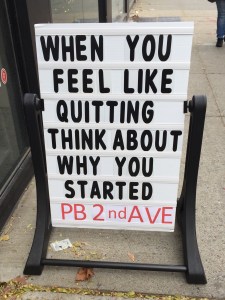
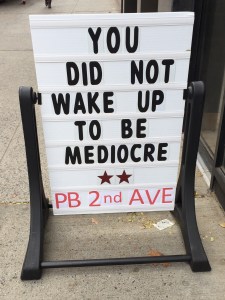
I was out walking on 2nd Avenue the other day, running a quick errand, when I saw a sandwich board sign in front of a fitness studio called Pure Barre that stopped me in my tracks. In New York City, with so much weirdness and activity all around, which you just come to accept as normal, it takes a lot to stop me on the sidewalk. But it was like this sign was talking directly to me. So I paused, and allowed myself to fall into the category of “annoying person stopping on the sidewalk taking a picture with their phone.” This wasn’t a stupid selfie though. This was important self-talk aimed at self-soothing and self-preservation.

So I took a picture of the sign, and walked to look at the other side. Lo and behold, it had a personal message for me too. So I snapped a photo of it as well.

I share these pictures here for multiple reasons. So many of my posts are uplifting and positive. That’s not me faking anything. But I want my readers to know that I’m human, and I tussle with human emotions, trials, and tribulations. I also want to let other people know — other people who may be struggling themselves — that they’re not alone. And last but not least, I want to offer a public message of encouragement to all of us, myself included.

So whether you’re grappling with a difficult boss, a difficult patient, a difficult family member, a difficult illness, or something else, know that you’re not alone. And hard as it is, for you and for me both, we will get through it, like we always do.

The order: An important first

As many of you know, I write a monthly column for the online magazine The American. Here is my latest piece, describing an important first of my medical career. You can read the original article here.


“The order”

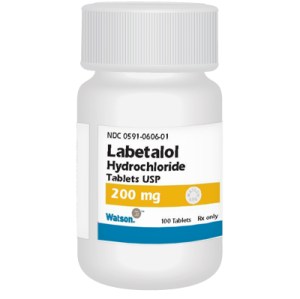
I placed my first medication order yesterday. Nothing exotic. It was a one-time dose of the drug Labetalol for a patient, my patient, whose blood pressures had been elevated. As I typed in my password to sign the order, I took a deep breath.

“By signing this,” I thought to myself, “I’m telling people that I think my patient needs this exact medication at this exact dose at this exact time.”

Suddenly, caring for this patient was no longer abstract or hypothetical. It was as real as the prescription I was about to issue. I wasn’t just writing out my daily plan for her care in my morning progress note. I was putting it into action.

As a medical student, any orders I place require a physician cosigner, either my resident or attending. The safety net exists for obvious reasons. Still, learning how to issue orders for my patients — whether it’s for laboratory tests or medications or fluids — and then doing so is part of assuming greater clinical responsibility. It’s also part of progressing from student to doctor.

But from a logistical perspective, just entering these orders is far from easy. Take the blood pressure medication. It is normally dosed twice a day, morning and night. It was about 1 p.m. at the time. If we ordered it twice a day to begin immediately, the patient would get it at 1 p.m. and 1 a.m. — not ideal if you’re the patient. You’d have to be awakened in the middle of the night to take a pill.

So I placed a one-time order for the medication to be given by the nurse immediately. I then placed another order for the same medication, same dose, this time twice a day, but starting that night. Going forward, the patient would be getting her pill at 9 a.m. and 9 p.m.

Making small things happen in the electronic medical record system is another thing entirely. It requires selecting or unselecting many checkboxes and highlighting the appropriate fields in various drop-down menus. I’m sure once you do it repeatedly it becomes second nature. But as a medication order novice, I needed someone to show me around the system. Thankfully, my kind resident took the time to walk me through the process step by step. Attention is paramount. If you don’t click (or unclick) one of the required boxes, you get an error message that reroutes you back to the order screen to fix your mistake. And if you don’t click (or unclick) some other box that’s important for your particular instructions but not technically required for the order to go through, your order may inadvertently tell the nurse to do something else altogether.

The “how” of these orders is the easy part. It’s the “what” and the “why” that require the real thinking. Why is the patient’s blood pressure elevated? Does she need a medication? If so, which one? At what dose and frequency? How long will you assess her blood pressure levels to determine if this medication is effective before either increasing its dose or adding another drug? And this is only her blood pressure. We haven’t gotten started on her antibiotic regimen.

It’s an iterative process that goes on throughout any given day. Sometimes you’re doing the investigating. Sometimes it comes in response to changes in vital signs or laboratory results (or urine output or an MRI). This means you’re monitoring all these details — vital signs, lab tests, urine output, and imaging, among others — over the course of a day to see if you need to change your handling of the patient.

To a third-year medical student just introduced to the world of inpatient internal medicine, it’s dizzying. But it’s also deeply exciting for obvious reasons. The more clinical responsibility I assume, the more I learn, and the more tangible the “live” practice of medicine becomes. And the more I am prepared for the time when I’ll be the one signing the orders on my own.

Much-needed encouragement

I’ve finished the first two weeks of my internal medicine clerkship, with six to go. On this clerkship, more than any other, it’s easy to feel clueless, since medicine deals in the entire body — every single organ system. As a medical student, I get asked questions many times every day to probe my knowledge and get me thinking about this field that is both fascinating and overwhelming. It feels like my most frequent answer is “I don’t know.” But I was recently reminded that while I have much to learn, I’ve come a lot farther than I realize.

About a week ago, a second-year medical student shadowed me during my morning pre-rounds routine. Together, we reviewed the charts of my patients, looking at their vital signs, labs, imaging, urine output, and other notable events that had occurred since I left the previous day. I’ve become pretty familiar with the electronic medical record (EMR) system now, but every action I took — selecting the correct tab to show the vital signs for example, or figuring out when the last dose of a medication was given — required a tutorial.

I showed him how to use templates in the EMR that automatically pull data like vital signs and lab results from the patient’s chart directly into your note. I started to show him how to write my daily “SOAP” note using one of these templates. And he asked, “Can you go over what a SOAP note is, exactly?” I was glad to, of course. (For those of you who are curious, here is what SOAP stands for. S = Subjective information from your patient about how they are feeling, such as pain. O = Objective data such as vital signs from the chart. A = Assessment of the patient’s condition. P = Plan for the day in terms of treatment, diagnostic studies, etc.)

Without thinking about it, I then described one of my patients as “being on PD.” I saw the look of confusion in his face, and realized I took for granted knowing that “PD” stands for “peritoneal dialysis.” So the next time I came to some medical abbreviation, I made sure to clarify its meaning.

There were lots of things I explained about treating patients too. Like how we put most patients on a bowel regimen in the hospital to make sure they have regular bowel movements. Or that when a person who has diabetes is hospitalized, we take them off their oral diabetes medications and put them on sliding scale insulin because they’re likely not eating the same way as they do at home.

We also saw my patients together, and I showed him how to do a brief, focused physical exam targeting potential findings related to each patient’s condition, and also assessing basic things like heart and lung function.

Having second-year students shadow us third-year students is a new part of the curriculum. It’s aimed at helping the second-years transition more smoothly into starting their own clerkships, which they will do in January or February. I hope all my explanations were helpful to my shadow. I know they would have helped me when I was a second-year student. As I was talking with him, I thought back nearly 9 months to mid-February when I started my first clerkship, OB-GYN, to when I knew none of these things either. To when I didn’t know how to write a SOAP note, or how to find things in the electronic medical record, or how to do a focused physical exam. I realized that I’ve come a long way in the last 9 months, much farther than I give myself credit for.

This encouragement couldn’t have come at a better time. Medicine is still overwhelming. But a little less so. And I have a newfound confidence in my ability to make significant strides in the remaining six weeks.

Working in the psych ED

As many of you know, I write a monthly column for the online magazine The American. Here is my latest piece, describing my reactions to working in the psychiatric emergency department. You can see the original piece here.


“Repairing the mind”

Bless you,” one of our lecturers told me when she heard I’d asked to spend part of my six-week psychiatry rotation in the psychiatric emergency department (ED). I understand all too well why the psych ED is a place many people might want to avoid. Many patients in this locked unit are acutely and severely ill. One patient might come in talking about hanging himself, another of how how voices are commanding her to kill people. An ambulance might bring in someone found found running down the street in undergarments. A handful of these patients can turn aggressive or violent, yelling and threatening to harm the physicians and other staff.

Most can usually be talked down but some require sedation via an intramuscular injection — and in a few cases physical restraints. Safe to say there are few dull moments.

Before I discuss my own response to the psych ED, I want to talk about a tension that generally speaking exists in medicine. I’ll use hypotheticals to illustrate my point. Imagine a doctor sees a hospitalized patient afflicted with a rare, potentially fatal disease.

“Wow, what an interesting case,” the doctor tells a colleague when the patient is out of earshot. The colleague replies, “No kidding, I’ve never seen a case of that before. Let me know what the outcome is.”

This fascination with a rare, possibly incurable disease might seem cold-blooded to a non-medical observer. What kind of person would say something like that? But medicine is all about compartments. Doctors have compassion for their patients. They care for them to the best of their ability — applying empathy and professionalism. At the same time, they’re possessed with intellectual curiosity about the underlying processes of diseases. Probing pathophysiologic principles is part of the scientific method they’re trained in.

Though compassion and curiosity coexist quite peacefully, all this might sound callous to a casual observer uninterested in these medical compartments.

My years as a medical student have taught me that patients and their families are sensitive to remarks made in passing. Medical curiosity can seem unfeeling. As a result, I’m careful as to when and how I express it.

That preface in mind, let me move on to the psych ED, an assignment I found both medically and professionally exciting. The unvarnished truth is that patients need the service and the service needs a staff. The psych ED is a high-impact place with plenty of patients ill enough to pose an immediate threat either to themselves or others, or both. For a doctor, it’s a high wire act whose reward comes in the form of helping prevent a suicide or bringing someone down from a dangerous manic episode. Plenty of patients admittedly don’t want to be in the unit. Some refuse medication and protest their hospitalization. But even in such precarious situations, you’re still providing patients with short-term safety.

The psych ED encouraged me to use both my journalistic and my medical training. Skepticism is essential in any kind of psychiatric work. Some patients will lie and behave manipulatively. They’ll do whatever they can to get out of the hospital, or remain inside. Others will try to lie their way out of medication, or into it. Part of the history-taking process includes gathering what’s called “collateral information,” which involves calling around — psychiatrists, therapists, social workers, and internists — to verify a patient’s details. With permission, we’re also allowed to get in touch with family and friends to get the fullest possible portrait of the person, assess his condition and safety, and create the best treatment plan. The number of phone calls and the tracking process can revive old investigative journalist training. You doggedly hunt down clues, refusing to back down when one lead dries up. Persistence comes in handy.

As a medical student, I’ve spent a significant amount of time with patients themselves. Once a patient is safe and secure, students are often tasked with conducting the initial psychiatric evaluation. They then present their findings, assessment, and a proposed plan to the resident and attending, afterwards writing up a note about the encounter.

This sense of teamwork, of contributing to hourly and daily goals, is uplifting. In other clinical environments, my work was duplicated — often in front of me. I’m a student. Obviously, some of my moves require double-checking for safety reasons. That’s normal. But the duplication often left me feeling redundant.

In the psych ED, when I called the patient’s psychiatrist, I wrote a note about the conversation and then presented my findings. If I missed key information, I called the doctor back. My work wasn’t repeated. I felt more trusted, more competent. Having spent a decade working in publishing, I’ve missed both the trust and the sense of competence.

There have been many challenges. The psychiatric patient interview differs from a standard medical evaluation. In the case of suicidal patients, for example, it’s essential to ask whether they have access to a gun at home. That’s not a typical question in other disciplines.

It’s a delightful combination — to feel both challenged and effective on a daily basis. Most important, I feel like I’m making a difference in someone’s life.

Weird surgery perks

Beneath my white coat, you can see the maroon OR scrubs that I wore every day while on my trauma surgery rotation. Wearing these scrubs every day provided an unforeseen benefit: less laundry to do.

My enjoyment of this surgery rotation thus far has been a pleasant surprise. Besides learning about, well, surgery, I have encountered important life lessons. But I have also accrued some unforeseen benefits. I think that understanding these perks will provide additional insight into what life is like on the surgery rotation.

Chore relief. On trauma surgery, you wear scrubs all day every day, with the exception of Monday morning’s Morbidity & Mortality conference. That meant I had less laundry to do. Given that I have to lug my dirty clothes up and down several flights of stairs and down the block (I’m in a walk-up apartment, and the laundry room is in the basement of a different building), that’s no small thing.

Budget boost. When I was working with the trauma surgery team, I would leave my apartment at 5 a.m. and get home somewhere between 6 and 8 p.m. That’s a long day, by any standards. I noticed that over four weeks of that schedule, I bought significantly less toilet paper. Actually, my grocery bill was lower overall. I was so busy that I simply ate less. In part because the workday on surgery was so hectic, and in part because when I got home at night I was too exhausted to do more than shove some food in my mouth and collapse into bed.

Free medical supplies. Yesterday, while I was cooking a batch of chili, I managed to slice open my thumb on a can of diced tomatoes. I ran to the bathroom, thrust my thumb under a stream of running water, and scrubbed the cut with soap. Before reaching for the box of Band-Aids in my medicine cabinet, I turned to grab a Kleenex to dry my finger. Then I remembered that I had something much better — sterile gauze! A packet from the hospital had made its way home in my white coat pocket. Hm. Maybe I should grab some more?

I wouldn’t consider these reasons to do a surgery rotation, exactly. But since surgery is a medical school requirement, I certainly won’t turn down the random fringe benefits.

Good hospital food?

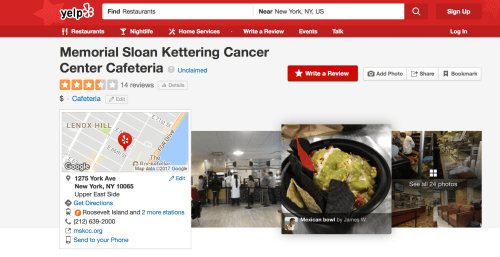
On Tuesday, I was scrolling through Yelp listings, looking for a place to dine that was located near my apartment on New York’s Upper East Side (UES). I saw the standard fare, as expected — Italian, Indian, Japanese, Thai, and so on. And then I saw this:

I did a double take. I expect Yelp to be comprehensive, but Memorial Sloan Cancer Center’s hospital cafeteria? I wasn’t expecting that.

I’d actually just been to this cafeteria the day before, the morning I started a four-week rotation on colorectal surgery. (This is the second four-week block of my eight-week surgery rotation.) I didn’t buy anything at the cafeteria, just peeked in. But after reading some of the reviews, I have high hopes. As usual, there were complaints. But there was a positive theme to the reviews, as evidence by this pointed comment:

It really is the best when it comes to hospital cafeteria food. Crab cakes, paninis, chicken pot pies, macadamian crusted fish. Enough said.

I’m not sure if the same could be said about the Garden Cafe at Cornell.

The Garden Cafe, for those not familiar with the UES hospital scene, is the cafeteria at New York Presbyterian Hospital. This is the main hospital affiliated with Weill Cornell Medical College, and where I do most of my clinical rotations. I agree wholeheartedly with this reviewer that the food there is nothing to write home about.

Even though it takes extra time and effort in the morning, I usually bring my own lunch — both to save money and because it’s healthier. But one of these days, I’ll have to try the cafeteria food at Memorial Sloan Kettering. See what all the fuss is about.