doc w/ Pen

journalist + medical student + artist

Tag: medical school

End-of-life ethics

Medical school definitely has its drudgery. Thankfully there are also moments of beauty — interactions and experiences that remind me why I’m here. Moments that remind me that I am in the right place, doing the right thing. This week I had one of those moments.

It was after a morning small group ethics discussion. We’d been talking about end-of-life issues: palliative care, terminal sedation, physician-assisted death, and euthanasia. Following the session, a classmate from my group stopped me in the hall. She’s someone I think highly of, but don’t know well on a personal level. We travel in different social circles. So I was curious why she wanted to talk to me. I’ll paraphrase part of our conversation. She told me:

If any of my loved ones ever needs palliative care, I’m going to look you up and find out where you’re practicing. I want you to be their doctor. I can tell you have a heart for this.

Her words touched me profoundly. The fact that my passion for palliative care emerged — at least to this particular classmate — even in our rather contentious 50-minute discussion made my day.

It was a contentious discussion, though. Fervent, ethical arguments for and against physician involvement in the death of suffering patients dominated our debate. I do have strong opinions on this hot-button end-of-life issue, and others. Midway through the hour though, I brought up a perspective I believed was missing from the dialogue. Long before you arrive at a conversation about physician-assisted death, you do everything you can to help your terminally ill patient find meaning in the last days, weeks, or months of life. You strive to relieve both physical and emotional pain and suffering with an interdisciplinary approach. You do that through the cooperation of doctors, nurses, social workers, psychologists, chaplains, art therapists, massage therapists, music therapists, and other medical professionals, each of whom works a little different magic. You involve the family in this process too.

It is natural for a patient and their family to feel sad when faced with a life-limiting illness. But they don’t have to feel hopeless, or depressed. There is meaning and purpose to be found at the end of life. I’ve seen it, both here at the hospital in New York City, and during the home visits I did in rural Uganda. And that’s where you go first — in search of comfort and purpose (perhaps a redefined purpose). When those efforts fail, only then do I think it’s appropriate to have a conversation about physician-assisted death or terminal sedation.

I do believe in a patient’s right to physician-assisted death — with proper safeguards and regulations to prevent misuse and abuse. I do belive that terminally ill patients who have capacity deserve the autonomy to leave the world on their own terms. But I also do believe that is an option of last resort, when the suffering has become intractable and untreatable.

I have a long way to go before I’m a practicing physician. Whether I actually pursue palliative care, who knows. Whatever specialty I enter though, I will work with patients who are in pain, and who are dying. Belief in the power of hope and palliation will serve me and my patients well regardless of what specialty I choose. That these core beliefs of mine are evident to others — this tells me I’m on the right track to becoming the kind of doctor I want to be.
Caution: sharp objects ahead

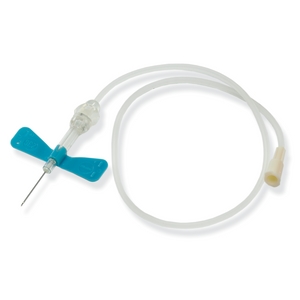
When you call it a "butterfly needle," it sounds so innocent and cute ...

When you call it a “butterfly needle,” it sounds so innocent and cute …

One step closer.

That’s what I tell myself with each new medical school milestone. This week, there were two big ones. Both involved sharp objects. But with the exception of some minor bruising, everyone came out just fine in the end.

Monday, I took my first stab at drawing blood (that pun was so intended). I’ve done delicate surgical procedures on mice, including injecting medication into the inferior vena cava. But survival was not a goal of those procedures. Phlebotomy is obviously much different. This first time, we medical students practiced on each other. With some guidance, my classmate stuck me on her first try. I had a little more trouble. Three pokes later, I managed to see the coveted red flash of blood. I patted myself on the back until I saw my friend the next day. When asked, she showed me her arm — a purple bruise where I’d poked.

I’ll get better. It takes practice, just like everything else.

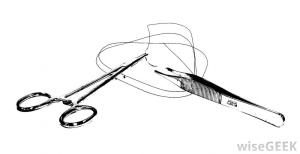
Suture kit

With suturing, you use metal tools to hold the needle and the skin.

Though it was technically my first time with this too, Tuesday’s activity — suturing — actually felt less foreign in some ways. I learned basic sewing when I was in elementary school. I feel comfortable with the general act of guiding a needle and thread. With sewing though, you use your hands to hold the fabric and the needle. With suturing, you use metal tools to hold the skin and the needle. That took a little adjusting.

Another adjustment: it took me a moment (and a comment from a surgery resident on my crazy stitches) to realize that while sewing and suturing share many features and movements, the basic suture technique I was practicing differed from sewing in one very important way. With sewing, you create contiguous stitches to keep the fabric together. You tie a knot and cut the thread only when you’re done, or when you’ve run out of thread. With the basic suturing technique I practiced Tuesday (called the “simple interrupted suture”), you create distinct stitches that are separate from each other. Stitch, knot, cut. Repeat.

This makes sense. Fabric needs that continuity to stay together. With skin, you’re holding things tight temporarily, just until the skin gets its act together and heals itself. Then you don’t need the stitches anymore. The simple interrupted sutures are actually a lot like straight pins in sewing. When you hem a dress, you pin it up first to keep everything straight and tidy. Then you run it through the sewing machine. Once you have that strong hem sewn, you remove the pins. Likewise with the simple interrupted suture I learned: you put temporary, individual sutures in until the skin is healed. Then you pull out the sutures, just like you did with the pins of your dress hem.

It makes sense to me now, but my practice foam block (full of contiguous sutures) must have looked like a complete train wreck to that surgery resident. Well, now I know. And more importantly, I understand.

Knowing, understanding, practicing: this means I’m headed in the right direction. Even if I did leave a little bruise.

Some little bug is gonna find you …

Bacteria are everywhere.

I’m reminded of this fact as I enter my last class-based unit of medical school, infectious disease. With this in mind, I’m also reminded of a song that my family listened to during my childhood. This was back in the day when people made “mixed tapes” with cassettes, not with an iTunes playlist. A friend of my dad’s made us this particular tape in the mid-1980s. It was a favorite on cross-country road trips to visit my grandparents in Colorado and Kansas. The tape was full of folksy songs about trains, whales, Star Trek, and … gut bugs.

“Some Little Bug” apparently dates back to the early 1900s. This particular version, which I’ve uploaded to YouTube and shared here, was digitized from that old cassette tape. You’ll find the lyrics below the YouTube link.

Enjoy. But not while eating.

“Some Little Bug”

In these days of indigestion it is oftentimes a question
As to what to eat and what to leave alone.
Every microbe and bacillus has a different way to kill us
And in time they all will claim us for their own.
There are germs of every kind in every food that you can find
In the market or upon the bill of fare.
Drinking water’s just as risky as the so-called “deadly” whiskey
And it’s often a mistake to breathe the air.

Some little bug is gonna to find you someday.
Some little bug will creep behind you someday.
Then he’ll send for his bug friends
And all your troubles they will end,
For some little bug is gonna find you someday.

The luscious green cucumber, it’s most everybody’s number
While sweetcorn has a system of its own.
And, that radish seems nutritious, but its behavior is quite vicious
And a doctor will be coming to your home.
Eating lobster, cooked or plain, is only flirting with ptomaine,
While an oyster often has a lot to say.
And those clams we eat in chowder make the angels sing the louder
For they know that they’ll be with us right away.

Some little bug is gonna to find you someday.
Some little bug will creep behind you someday.
Eat that juicy sliced pineapple,
And the sexton dusts the chapel
Oh, yes, some little bug is gonna find you someday.

When cold storage vaults I visit, I can only say, “What is it
Makes poor mortals fill their systems with such stuff?”
Now, at breakfast prunes are dandy if a stomach pump is handy
And a doctor can be called quite soon enough.
Eat a plate of fine pig’s knuckles and the headstone cutter chuckles
While the gravedigger makes a mark upon his cuff.
And eat that lovely red bologna and you’ll wear a wood kimona
As your relatives start packing up your stuff.

Those crazy foods they fix, they’ll float us ‘cross the River Styx
Or start us climbing up the Milky Way.
And those meals they serve in courses mean a hearse and two black horses
So before meals, some people always pray.
Luscious grapes breed appendicitis, while their juice leads to gastritis
So there’s only death to greet us either way.
Fried liver’s nice, but mind you, friends will follow close behind you
And the papers, they will have nice things to say.

Some little bug is gonna to find you someday.
Some little bug will creep behind you someday.
Eat that spicy bowl of chili and on your breast we’ll plant a lily
Oh yes some little bug is gonna find you someday.

Making a difference in dermatology and beyond

Dermatology: another unit in the medical school history books. During the course, more than one dermatologist-lecturer tried to convince us that derm is about more than eczema and acne. That it’s more than pimple-popping. That it’s … interesting. These lecturers tried to woo us with thrilling cases where the dermatologist saves the day. And yes, that must be exciting.

Personally though, what I found most moving about dermatology wasn’t the rare, life-threatening rashes. It was the “boring” bread-butter-cases.

Like psoriasis. Psoriasis never makes the headlines. It’s not at all exciting, from a medical perspective. But it affects people’s lives. According to some researchers, psoriasis can affect a person’s quality of life just as much as heart disease, cancer, diabetes, depression, or arthritis.*

That might be hard to picture. After all, what’s so bad about some scaly skin? But when you hear it from a patient who has lived with this, you understand. The psoriasis patient who talked to our class was a business executive. He talked about how embarrassing it was to see clients when the floor surrounding his desk chair was covered with flakes of dead skin, for example. Thankfully, this patient’s story had a happy ending — he got relief from one of the incredible new treatments now available.

UstekinumabThese treatments are amazing. They don’t work for everyone, but when they do they’re like magic. Here is a before-and-after image, from our psoriasis lecture, showing what one of these new therapies can accomplish in just a few months.

As far as diseases go, psoriasis may not be exciting or exotic. What’s exciting to me, though, is the incredible effect a dermatologist can have on a patient’s life by treating their severe psoriasis. That, to me, is a major appeal of dermatology. And at the heart of it, what I find appealing about medicine in general: making a positive impact on someone’s quality of life.


*Rapp SR, Feldman SR, Exum ML, Fleischer AB Jr, Reboussin DM. Psoriasis causes as much disability as other major medical diseases. J Am Acad Dermatol. 1999 Sep;41(3 Pt 1):401-7.

A computer lesson on pain control

Our required EMR training includes a 10-minute lesson on how to order PCAs.

Our required EMR training includes a 10-minute lesson on how to order PCAs.

$560 – $635 billion.

That’s the estimated annual cost of pain, according to a 2011 Institute of Medicine study called Relieving Pain in America.

Having spent this past summer immersed in the world of palliative care, I’ve seen how pain carries a heavy personal cost too. I’ve also seen the remarkable difference it makes in a person’s life when that pain is diminished or eliminated.

So as I continued to work on my mandated electronic medical records training last night, I was pleased to see a 10-minute module on how to order patient-controlled analgesia (PCA). PCA involves a computerized pump connected to the patient’s IV line. With PCA, it’s the patient who controls the amount of pain medication they receive (with a limit established by the prescribing physician). PCA is not appropriate in all situations, but it’s one more option in the doctor’s pain management armamentarium.

I don’t imagine PCA ordering is something medical students actually deal with, but I’m glad the module was there — if only to remind us all how important pain management is.

No regrets

I started college as a biology major, pre-med. I changed my major to journalism after taking an introductory writing class — a course that changed the course of my life. Over the last few years, since coming full circle and deciding to pursue medicine after all, I’ve been asked many times whether I wish I’d stuck with pre-med in college. After all, if I had, I’d be a full-fledged physician by now rather than a lowly medical student.

“No.”

That’s my unwavering answer.

I changed my major back in 2000 in part because I fell in love with writing, and in part because I wasn’t committed to the idea of four years of medical school followed by another three or four of residency. And don’t forget the major debt — a scary prospect for a 19-year-old.

It took me some 15 years to make my way to medical school. But that was the right timeline for me, for me to fully realize that this is what I want in my life, for me to be ready. I wouldn’t change any of it because I wasn’t ready back then. And those 15 years brought all kinds of adventures of their own — all of which provide me with a rich set of life experiences to draw upon as I make my way in my new career. In unexpected moments, those events, and the lessons I learned from them, brighten the path in front of me.

One of those moments occurred during our last unit, where we learned about rheumatology and the musculoskeletal system. Part of the curriculum involved learning various physical exam maneuvers to test for musculoskeletal problems. We had lectures, then brief, proctored practice sessions to learn how to test for rotator cuff tears, for example, or carpal tunnel syndrome. Some maneuvers were easier than others. And while they all made sense while I was sitting in the room surrounded by our orthopaedist-teachers, when I got home, the details of the trickier exams (especially for ACL and meniscus problems in the knee) had faded.

You never know when the past will come back to help you.

You never know when the past will come back to help you.

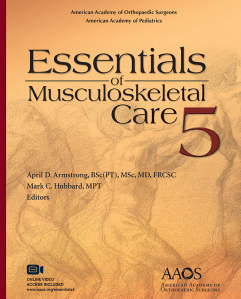
My past life in publishing, though, offered an answer. The year before I started medical school, I worked for the American Academy of Orthopaedic Surgeons (AAOS). AAOS is the medical society for orthopaedic surgeons, and also publishes orthopaedic books. When I left, I was graciously given a copy of Essentials of Musculoskeletal Care 5, a book on general musculoskeletal problems actually directed at non-surgeons — primary care physicians, nurse practitioners, physical therapists, residents, medical students, and others. Aside from hunderds of pages of expertly written text, the book includes more than 200 video demonstrations of exam maneuvers and procedures. So rather than turn to YouTube for  videos of unknown origin, I had a trustworthy source. And when I practiced the manuevers with my classmates, the videos were something I could share with them, too.

Sure, I could have bought the book. But I’m a broke medical student, and it’s really not in my budget right now. It’s part of the package of my past life, a past life that informs and enhances my current one. And while it might have taken me longer to get here, that time certainly wasn’t wasted.

Parlez-vous français?

Trying to learn about thrombosis in French is pointless for someone (like me) who doesn't speak French. But for the writer and word-nerd in me, the foreign phrases are fun to look at anyway.

Trying to learn about thrombosis in French is pointless for someone who doesn’t speak French (like me). But for the writer and word-nerd (also me), the foreign phrases are fun to look at anyway.

The answer to the question posed in this blog title — whether I speak French — is a resounding “no.” The little I do know about French is that it is a beautiful language, one gentle on the ears, eyes, and tongue. When I hear it spoken or see it written, I have little idea what the words mean. But to me they are lovely words nonetheless.

This love of French words extends, I learned this week, to medical texts. Yesterday our class received an e-mail with this subject line: “Dr. Erkan’s Printed Material – The English Version is Now Posted on Canvas.” (“Canvas” being our online education portal.) I was immediately intrigued. This implied that at some point, a non-English version was available (clearly an accident), but had since been removed. A kind classmate who’d inadvertantly downloaded the foreign language version — in French! — forwarded me the PDF. I had already watched the lecture in English, and had read the English slides. So as I skimmed through the French materials, I had a vague idea of what I was reading. My fluency in Spanish helped a little, as both are Romance languages, with some similarities. This was not at all a productive use of my precious time. I had a test to study for. Looking at the French version obviously would not help. This was pure linguistic voyeurism.

My first childhood crush was on Jaromir Jagr, a Czech hockey player. More than anything, I was enthralled with his last name, which according to English grammar rules was mysteriously missing a vowel between the two terminal consonants.

My first childhood crush was on Jaromir Jagr, a Czech hockey player. More than anything, I was enthralled with his last name, which according to English grammar rules was mysteriously missing a vowel between the two terminal consonants.

I guess I shouldn’t be surprised at this fascination with a foreign tongue. The signs were there at an early age, when I started watching National Hockey League games with my dad. It’s a fast-paced, exciting game, which helped hold my attention. But just as fascinating were the players’ names — especially the Eastern European ones. My first childhood crush was on Jaromir Jagr, a Czech who played then for the Penguins. I didn’t even really know what he looked like, as he was covered in protective padding and a helmet all the time. My true attraction was to his last name, which was seductively missing a vowel between the “g” and the terminal “r.” “How was this possible?!” the young grammarian in me wondered. It was my introduction to foreign languages, to rules so different from the familiar English ones that they took on a magical, mystical quality. I had to learn more.

But life puts time constraints on you. Fluency takes years of dedicated practice — you must choose a language to focus on. So I chose Spanish, and I’m glad I did. It, too, is a lovely language with curious and detailed rules whose application can make me giddy. Spanish is also highly practical in the United States, especially in urban areas like my former home, Chicago, and my current one, New York City. If I could choose another language to learn, disregarding practicality and difficulty, it would be Russian. It hearkens back to the genesis of my linguistic interests, which started with those Eastern European tongues.

I’m in medical school now though, learning a foreign language of another kind: doctor-speak. Fluency here is by fire and immersion. No time for nation-languages. So I must be content, at least in this season of my life, with things like browsing medical texts in French. And dreaming about how someday, I might have time for more.

Learning EMR: an important attitude adjustment

Learning how to use the hospital's electronic medical record system via a series of videos and short practice sessions is not my idea of fun. But changing my attitude about the experience helped me see it differently.

Learning how to use the hospital’s electronic medical records system via a series of videos and short practice sessions is not my idea of fun. But changing my attitude about the experience helped me see it differently.

Yesterday, I spent a good hour and a half staring at my computer screen, watching modules on how to use the hospital’s electronic medical records system. I don’t think I’m even halfway done. And after the modules, I have a classroom session to attend too. This was tedious and aggravating, as you can imagine. Not to mention overwhelming — so many menu bars, buttons, and icons.

As I watched one of the early videos, I thought to myself: “I won’t learn the system by watching videos. I’ll learn it by doing it.” And then it hit me. As grating as this task is, what it represents — my transition from classroom to hospital — is something to celebrate. Soon I will be using this system to write notes and enter orders. How far I’ve come in such a short time!

That thought didn’t make the videos any more interesting, per se. But it altered my attitude. And that made a world of difference. While the short practice exercises I was doing alongside the videos wouldn’t be my definitive learning experience, I began to see them as an important first introduction to a foreign system.

Always a good reminder: attitude matters. In everything.

Cerebral humor

The brain is complex. Studying it is fascinating — and also frustrating. Thankfully, I have people in my life who help me keep my sense of humor about this amazing organ, and the two months spent studying it during medical school.

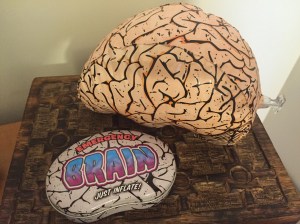
"Just inflate!"

“Just inflate!”

First, there’s the Emergency Brain, with the tag line “Just inflate!” If only it were that easy, right? It’s a nice thought though, and one that makes me laugh.

Second, there’s The Handy Brain Model. This is a brain model like you’ve never seen, a mitten of sorts that you put on your hand to simulate the lobes of the cortex as well other structures like the amygdala and the hippocampus. It’s both funny and practical. Who could ask for more?

Thanks, guys. Laughter really is the best medicine.

A sound strategy for stress relief

Medical school is stressful. I don’t think anyone — whether looking from the inside or the outside — would deny that. So part of surviving the experience is about finding strategies to mitigate that stress. A healthy diet and regular exercise go a long way. Spending time with other people, doing non-medical-school things, is key too. Something else I’ve recently discovered is listening to the calming sounds of nature while studying. It helps put me in a peaceful frame of mind even if the material at hand is complex, and potentially frustrating. You can buy this sort of thing of course, but it’s also available for free — a plus for broke medical students — on YouTube. My favorite YouTube channel in this vein is Relaxing White Noise, which has 10-hour tracks ranging from “Bird Happy Hour at the Mountain Creek” to “Rain on Tent” to “Forest Night Nature Sounds.” There are also non-nature sounds, like a fan, but living in the concrete jungle of New York City I want to be reminded of green places and things. (I also want to drown out the perennial construction.) Here’s a sample of one track I like, “Forest Rain Sounds”: