doc w/ Pen

journalist + medical student + artist

Tag: clinicals

Surgery, day #1: attitude adjustment
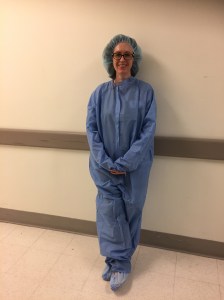
We weren’t wearing the appropriate maroon scrubs when we went to the OR to practice how to scrub in for surgeries. So we had to don the infamous blue “bunny suit.” These disposable, zip-up onesies are only stocked in XL, so most of us looked completely ludicrous. I felt it was important to capture the ridiculosity of the moment. My friend, who had kept her iPhone handy, was kind enough to oblige.

Around the country, the medical school surgery rotation has a reputation for being one of the toughest and most grueling. The hours are long, the breaks are few, and the expectations are high.

So it was with more than a little trepidation that I approached the first day of my surgery clerkship yesterday. But after yesterday, I find myself with a changed attitude. The hours won’t be any shorter, but our day of orientation got me excited about what I’ll be seeing and learning over the next 8 weeks.

Our orientation included the obligatory lecture sessions about clerkship logistics, leadership, grading, safety, all that. But after those things were out of the way, we got to do stuff. Fun stuff.

Our orientation was held in Weill Cornell’s Skills Acquisition and Innovation Laboratory (SAIL for short). It’s a suite of rooms in the hospital designed to help surgeons, surgical residents, and medical students practice their surgical skills. And while as medical students, we obviously won’t be performing the operations, we will be assisting in some ways. Depending on the trust earned with our residents and attendings, we may be asked to do things such as insert the foley catheter (for urine), retract, hold the camera during laparoscopy, suture, and tie knots. Retracting is pretty self-explanatory, but everything else requires some knowledge.

So yesterday, we practiced. We used actual foley catheter kits (the same kind that we will see in the operating room) on both male and female mannequins. Urine passage is obviously pretty different depending on the gender, and getting a tube up there is also a little different. While inserting the foley, we worked to maintain sterile technique to reduce the risk of infection. There were also workshops on knot tying (so many knots to learn!) and suturing (so many ways to suture!). The most high-tech workshop was for laparoscopy, also known as minimally invasive surgery. That’s where they make tiny incisions and insert a camera and other instruments rather than open up the abdomen (or other part of the body) with a long incision. There were several stations to practice our hand-eye coordination. It was a lot like playing a video game. At each station, you looked up at a screen (same as you’d do during a laparoscopic procedure) while holding the camera and/or instruments with your hands. Then you had to manipulate objects with your instruments, passing tiny blocks from one hand to the other, dropping beans into a tiny hole, or untangling rope (to simulate loops of bowel), for example. These stations actually replicate an exam that surgical residents have to pass in order to graduate. After doing a few stations, I have a new respect for this kind of surgery. I did notice improvement after a few go-rounds though, so I see how these practice stations are a huge help to surgeons.

Late afternoon, we headed to the OR for a brief tutorial on scrubbing, gowning, and gloving. Since I completed my ob/gyn rotation, I’d already learned these skills, though it was a good refresher.

At the end of the day, I’d recalibrated my attitude. And I’d formulated my goals for the clerkship. I want to perform well, of course — that goes without saying. That overarching goal encompasses lots of little goals, including studying for the shelf exam, reading up on patients, being a helpful student, working hard on my patient presentations, and so on. But I also want to leave surgery with a better grasp on some of these surgical skills, particularly suturing and knot tying. We were told yesterday that it takes (literally) thousands of hours to really learn how to suture and tie knots. I don’t have thousands of hours to practice. But I also don’t need to perfect my skills to the level of a surgeon. I do, however, want to feel more comfortable doing those things, because they’re useful across the practice of medicine. So I talked at length with the doctor who runs SAIL, which is open 24/7 for us to come in and practice. I’ve now got some sutures, gloves, and other paraphernalia at home to practice with. And he told me to come back in a week or so to show him my progress. He’ll help me if I’m struggling with anything or if I’m doing something incorrectly — both of which are very likely. I know that this kind of hands-on tutoring is invaluable when learning a new skill. I’m so grateful for the help.

Along with being a writer and medical student, I’m also an artist and former pianist. I love using my hands, and know the importance of building muscle memory. So I see this as a fun (and practical) challenge.

I love a good challenge. I’m in medical school, after all.
Getting back up

In addition to sharing my experiences here on this blog, I write a monthly column for the online magazine The American In Italia. This month’s piece, published yesterday, is about how humbling medicine is — in more ways than I expected. Here’s the link: Getting back up.

Nocturnal on demand

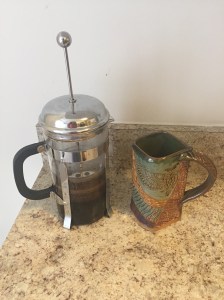
I’m hoping a pot of strong coffee will help prepare me for my first night shift on labor and delivery.

I can count the number of all-nighters I’ve pulled on one hand. All were in college. Tonight I will add to that number. Tonight, I start working nights on labor and delivery (L&D). It’s only for four shifts. But it will definitely be a growing experience.

I’m simply not a night person — morning is when I shine. Some people will stay up late to finish their work, then crash when they’re done. Not me. Back when I was in journalism, with a newspaper deadline looming, I would go to bed at 10 p.m., sleep for a few hours, then wake up at 2 or 3 a.m. to finish writing my stories.

But babies are born around the clock. So being a medical student on L&D means both learning what goes into a delivery and developing the stamina to work these long and sometimes awkward hours. The same principle is true for many other specialties too.

There doesn’t seem to be any good way to shift your schedule from days to nights. I got up as usual this morning, and then after lunch took a 2-hour nap. I made a pot of French press coffee around 4 p.m., which I’m drinking now. I’ve got lunch (if you can call your midnight meal that) and snacks packed, and more caffeine if needed.

Here goes …

Observations from ob/gyn

I’ve almost finished my fourth week (out of six) on ob/gyn. What a refreshing change from sitting in a lecture hall. I keep meaning to sit down and write about what I’m seeing and learning, but I’m always … So. Tired. Many of the days are long. Regardless of the number of hours, I come home exhausted. That’s not a complaint, it’s merely a statement of fact. And it’s exactly what I expected. I’m gradually adjusting. Some moments are stressful (like the few seconds before I launch into presenting a patient’s case to my resident); others are absolutely thrilling (like watching a baby being born, and then helping deliver the placenta). But it’s a roller coaster I’m glad to be on.

So far I’ve had two weeks on gynecology (mainly observing surgeries), a week of maternal fetal medicine (high-risk obstetrics), and four days of labor and delivery (assisting with births and covering “triage,” which is essentially the emergency room for pregnant women).

In brief, before I dash off, here are a few observations of my time so far.

I really like talking to patients. That might sound silly, like it should be obvious. I’ve gone into medicine, of course I should like talking to patients. But I really do. When I was on the gynecology service, rounds — when the doctors and students go see each patient first thing in the morning — were usually between 6:30 and 7 a.m. As medical students, it was our job to “pre-round” — to go see each patient before rounds, to see how they were doing, what happened overnight, to do a brief physical exam. Then we presented each patient to the residents. The first morning I went to pre-round, as I stood outside the patient’s door, I was terrified. But once I walked in the room and started talking to her, it felt so right. I felt at home asking, listening, answering, and examining. I quickly discovered that if you’re wearing a white coat, people think you know things, and so they ask you questions in return. And I do know a few things. But I’m careful to always acknowledge my limitations as a student.

Medicine is a humbling profession. During these few weeks, I’ve shared some of people’s happiest — and most tragic — moments. Watching a baby escape the uterus during a C-section, and then seeing the parents hold their new child for the first time … I felt a slice of their joy. While on my maternal fetal medicine elective, I also saw the other end of the spectrum. Several times, I stood beside the physician as she told a couple that their pregnancy was not viable. In those instances, I felt a sliver of their pain. It’s a privilege to share these moments with people, to celebrate with them in their happiness, or to stand in solidarity with them in their sorrow: “Rejoice with those who rejoice, weep with those who weep.”

Clinicals are a real bonding time for us medical students. On both gynecology and labor and delivery, I’ve spent hours upon hours with fellow students I barely knew at the onset of the rotation. That quickly changed. We’d share bits of information we’d gathered — how to find the template for writing notes in the convoluted electronic medical records system, for example. Or even simpler things — where the closest bathroom is, where to find surgical gowns in the supply room. In moments of doubt, we’d huddle and confer, united in our uncertainty. These people were near-strangers to me initially. But I witnessed so many times when someone bent over backwards for a classmate. I’ve heard that it can go the other way, that some people will throw you under the bus. But I’ve never seen anything like that. More than ever, I deeply respect my classmates, and feel honored to be working with them.