doc w/ Pen

journalist + medical student + artist

The Laws of Motion (and my thoughts)

To paraphrase Newton (and my physics book):

An object at rest remains at rest as long as no net force acts on it. An object in motion (with constant velocity) remains in motion, with the same speed and in the same direction, as long as no net force acts upon it.

My question:

Does Newtonian Dymanics apply to one’s thoughts?

My thoughts, you see, seem to be traveling a million meters per second. Without an opposing force, they show no signs of slowing down. And physics is the culprit, the force that put my thoughts in motion in the first place.

Well, maybe not physics itself. My fear of physics. Even more precisely, my fear of not doing well in physics.

I realize that this is a rather irrational fear, one not based on any evidence. So far, I am doing quite well in physics — I believe I am near the top of my class, in fact. A’s on my homework, labs, quizzes, even my first exam.

I have an A in the class. So why am I afraid of it?

I’m not sure. Perhaps because physics doesn’t come to me quite as naturally as chemistry or biology do. I really have to wrestle with the material in physics, sometimes on a problem-by-problem basis. It’s tough and taxing. Or maybe I’m scared because I have seen people work really hard in other subjects and NOT get the result (i.e., the grade) they wanted, and I see the possibility of that happening to me in physics. They don’t give out A’s for effort, after all. Or maybe I’m letting the pressure get to me a bit, all the talk about needing to keep your grades up, to do well in your post-bac courses … and I’m afraid that if I don’t ace physics this semester and next, I won’t achieve my end goal: getting into medical school.

Regardless of the reason for why physics produces a sinking feeling in my stomach, I need to deal with it as best I can. I don’t think I’m going to transform my viewpoint and suddenly *poof* love physics (although I do find it interesting). No, I don’t expect magic.

But I do need to exert a force on my thoughts to slow them down. Because according to Newton’s laws, they’ll just keep going unless I do something.

So here’s my plan: surround my physics experience with positivity. That doesn’t mean light scented candles or sing happy songs while I do my physics homework problems (too distracting, not to mention just plain weird). No, what this strategy means to me is that when I wrestle with a problem (or maybe more like five or ten of them), I reward myself in some way. I call or e-mail a friend, write a short blog post, or read (a non-school book) for 15 minutes. Do something positive after physics problems so that I associate the two. Ergo, physics doesn’t seem so scary.

Will it work? Will the force I exert through my “positive associations” be enough to slow my racing thoughts? I don’t know. There’s only one way to find out. So here goes.

(Note: Giving myself the time to write this blog post was a “reward” for doing more than a dozen physics problems today in preparation for an upcoming test. And let me tell you, I feel pretty good about things at the moment …)

Medicine: East and West

In mid-September, I attended a lecture on traditional Chinese medicine at Dominican University. I wrote this essay as an extra credit assignment for my biology class, but thought I would share it here as well.

When I think of the field of medicine, I think of procedures, treatments, and methods based on years (sometimes decades, or more) of rigorous research and scientific inquiry. With a father in medicine and a mother in nursing, that’s simply how I grew up. But my parents – and my liberal arts education – also taught me to approach new information with an open mind.

At Tuesday night’s lecture on Traditional Chinese Medicine by visiting Fullbright scholar Chia-Feng Chang, that was sometimes a challenge for me. Not because I went in with a closed mind, but because the core beliefs and philosophies of Chinese medicine are, in some respects, simply so very different from those of Western medicine. That said, I did take away from the lecture that there is more than one way to conceive of “medicine.” And I believe that each tradition deserves respect, regardless of one’s personal beliefs.

As a pre-medicine student, my plan is to focus the next several years of my life on studying the “hard” sciences – introductory classes such as biology and chemistry, and upper-level courses such as anatomy and immunology. So I had to keep my jaw from dropping when Dr. Chang said, “Anatomy is not essential to Chinese medicine.” Rather, she went on to say, practitioners of Chinese medicine see the body as an integrated whole rather than an assortment of parts. My immediate reaction to that was that, “Well, don’t you need to understand the parts to understand how the whole works?” I had a hard time wrapping my brain around Dr. Chang’s perspective, at a very basic level.

Another component of Traditional Chinese Medicine that was difficult for me to understand is in the field of pediatrics. According to Dr. Chang, Traditional Chinese Medicine physicians would examine the three middle fingers of a baby or young child and make diagnoses based on characteristics observed only from those fingers.

I think I found these aspects of Traditional Chinese Medicine difficult to comprehend because at its roots, Chinese Medicine is based not on scientific experimentation, but on the structural similarity of the human body to water, nature, and the heavens. In seeing these similarities, Chinese Medicine practitioners developed a theory that blood and Qi (energy) flow through a series of of  “circulation channels.” They then believe that all illness is due to congestion or blockage of Qi and blood. To cure an illness, the blockage must be relieved and flow and harmony restored to the body.

While the mystical aspects of Traditional Chinese Medicine do not appeal to me, they do to many people. And I personally know people who have benefitted from Chinese medical practices such as acupuncture and herbal remedies. So while I lean more toward Western medicine myself, I know it is not the only path. I respect the other paths; they are just not my own.

Caritas et Veritas: Love and Truth

On September 28, I attended a symposium at Dominican University about our school’s motto: Caritas et Veritas, “Love and Truth.” I wrote this essay as an extra credit assignment for my biology class. I thought it important enough to share here, too.

I couldn’t have asked for a better birthday present. Exactly 29 years after I entered this world, I was sitting in the Old Pool room at Dominican University listening to a discussion about how our school motto (“Caritas et Veritas” — “Love and Truth”) plays out in science and math courses.

While not everyone’s birthday wish, perhaps, nor cause for celebration in everyone’s estimation, it was exactly what I wanted to be doing that day. Of course, the Caritas et Veritas symposium wasn’t held just for me – I’m not quite that egocentric – but I certainly took away plenty from it, on a personal level. And not necessarily what I’d expected …

I’m a post-bac pre-med student. So clearly, I’m interested in science. What not everyone knows is that I’m also interested in literature. In fact, I was a high school literature textbook editor for nearly two years, specializing in American and English lit. So when I saw the lecture title, “A Gradual Dazzling: The Nature of Truth in Literary Studies,” my heart skipped a beat.

But honestly, the first three speakers (on ancient Greek drama, Romance literature, and contemporary Irish poetry, respectively) bored me. Not because the subjects were boring, but because the speakers were boring: they simply read from their (very technical, very specific) papers. I found myself struggling to follow along.

Then Ellen McManus got up to talk about the field of Literary Studies, and trends in the field. I found myself wishing she had spoken for the entire hour. Each progression of the field, starting with the T.S. Eliot-inspired “New Criticism” (which saw literature as telling a special “slant” truth different from psychology, science, religion, etc.), to Postmodernism (truth is an artifice in ALL texts), to the influence of cultural / queer studies on literary studies (you must uncover the historical truths embedded within the context of the text) fascinated me. But the most recent development – called “Consilience” – has me rapt. Believers in this philosophy of literary study are also called “Literary Darwinists.” They draw on evolutionary science to understand literature, and believe that different kinds of knowledge (i.e., science, psychology, literature, etc.) should be linked together in a nested way. I find this philosophy, also called “vertical integration,” very interesting. I desperately want to find out more about it.

I have already contacted Dr. McManus via e-mail and gotten her recommendation on two books about Consilience that she thinks are good places to start. My Amazon.com order is supposed to arrive this coming Wednesday … and I can’t wait.

After the literature seminar, I attended “What does Caritas et Veritas Mean in Science & Math Courses?” I was interested in this lecture both because I am taking three science courses (physics, chemistry, and biology), and also because my chemistry professor, Dr. Daniela Andrei, was one of the panelists. The panelists talked about how veritas – truth – is evident in that there is usually a “correct” answer in science and math courses. Caritas – love – they said, is evident in their interactions with students. One example they gave is that they work very hard to teach critical thinking skills to their students through encouraging participating, making connections between old and new material, figuring out what type of question they are being asked, etc.

After that section of the presentation, I asked a question: whether the presenters thought they could really teach critical thinking skills to students at the age of 18 or 20, or whether students needed to enter college with those skills already learned (and primed to be perfected). It wasn’t a rhetorical question; I was really interested in the answer. But I felt the question was dodged, or perhaps misunderstood. Professor Aliza Steurer responded that she believed you could learn at any age. Which I agree with, on a certain level. However, there is plenty of research out there that shows that students who don’t learn certain basic skills by early elementary grades (i.e., reading and certain math skills) are essentially screwed for the rest of their education. Now, whether this is a product of the quality of those students’ education or the plasticity of the brain is another matter. But I really do wonder whether students need to have acquired some skill set by a particular age, and past that age (which may be somewhat dependent on the person), they just can’t. Or at least, not as well or as flexibly or with as much dexterity. Motivation figures in as well, in addition to whatever base level of intelligence a person has. And when you start talking about that base level of intelligence, you get into the nature vs. nurture debate, going back to infancy (and perhaps even the womb) … it becomes a very complex issue with perhaps too many branches to keep track of at once.

I think I’m fascinated by the whole issue because I had a very non-traditional educational upbringing, and I often wonder how that has affected me. My parents are both very well-educated (a family physician and a nurse with her master’s degree), and they worked from the beginning to create educational opportunities for my two younger sisters and me. Reading was a constant activity in our house, from day 1, for example. But the really atypical thing was that we were all homeschooled for several years (my first year of public school was sixth grade). Of course, we had textbooks. But that was only the beginning of our education. Area museums provided hands-on science, history, and art exhibits to engage us on those subjects. The local butcher had what we needed for every dissection possible. Chicago’s ethnic neighborhoods offered the chance to study microcosms of the world’s countries, up close (including a taste of each country’s cuisine). On vacations, we studied ecosystems and plant and animal life. Life meant – means – learning. How did all of that affect the way I absorb, process, and maintain information? I don’t know exactly, but I believe the effect was a positive one.

But I digress. The last session I attended was “Seeking, Detecting, and Even Deleting the Truth: How Neuroscience is Changing Our Understanding and Powers Over Truth.” I will address the last two speakers first. While I found the subjects – using brain imaging as lie detection and drugs to delete memories – to be interesting ones, I find them extremely problematic. From the evidence presented, it seems that there are serious functionality issues with the lie detection / brain imaging idea. I certainly would not want it used to test my guilt / innocence at this point in time. In terms of the memory erasure idea, while it does seem to work in rats (which is fascinating), I see some ethical considerations in using this on humans. Also, I would be concerned as to how this would affect the rest of the memory system. I found these two topics very thought-provoking, but not particularly practical.

I connected more with the first presentation, which more about the philosophy of science as related to Veritas (truth). First of all, I found Dr. Scott Kreher’s* definition of truth – “Truth is how the world really is” – to be very interesting. Not that I disagree with it, at this point in my life. In fact, I find it very appealing. However, had you asked me 15 years ago, I would have responded with a much different definition of truth – “I am the Way, the Truth and the Life. No one comes to the Father but by me.” That Biblical passage still rings in my ears more than a decade after I (very decidedly) left my conservative religious upbringing behind in favor of a more empirical approach to the world.

Dr. Kreher’s definition (or perhaps explanation) of science also intrigued me: Science is a set of processes that allows us to approach the truth. (emphasis added) If you think about it, that’s so obvious. Scientists so often replace old facts, hypotheses, even established theories with new ones, based on newly discovered evidence. Practicing science requires a certain level of humility. Yet so many people look at scientific discoveries as unalterable FACTS. They don’t question them, or think critically about them. I think part of the fault there lies with the media (of which I used to be a member). A scientific paper or study will come out, and the evening news will report it in a skewed way, for maximum shock value, as a truth (or nearly so). When really, as Dr. Kreher said, “We’re always just approaching the truth.”

As I said, the Caritas et Veritas Symposium was like a gift. At each lecture, I received something to ponder, to take with me. Not merely because I went to the lectures. That’s not enough. But because I brought myself, open and vulnerable, and willing to refine my own definition and understanding of Caritas et Veritas, both in relation to my education and to my life in general.

*My biology professor
Lost & found in translation

It’s allergy season — especially for those sensitive to ragweed, like Maria Juarez.* She came in to see the nurse practitioner at a local free clinic reporting a runny nose, itchy throat, sneezing, and wheezing — all of which had lasted for weeks. She used to take an inhaler, but had run out. Over-the-counter allergy medications made her sleepy. Maria wanted to know if there were any better ways of controlling her symptoms.

Sounds like an easy enough clinical encounter, right? Except that Maria spoke only Spanish, while the nurse spoke only English. That’s where Mark* and I, Spanish medical translators at that free clinic, came in. Our job was to translate everything that was said from one person to the other to make sure the appointment went smoothly.

For people who live outside their native countries and who aren’t fluent in the second language, this happens all the time. But for those of us born and raised within the same borders, it’s something we rarely, if ever, have to think about. But while you read this blog post, it’s something I want you to actively consider.

It’s so easy to take verbal communication for granted: understanding, being understood. That is, until you can’t understand, or be understood. I know from experience that this position — especially in the medical context — feels like one of powerlessness, of vulerability. And it is. You feel at the mercy of those around you because you can no longer fend for yourself. Nor defend yourself, for that matter. You must take others at their word. What other choice do you have?

I had no other choice. I was 15, in a foreign country. And we’re not talking on the other side of the border here. We’re talking across the ocean, across continents. In China. Beijing, to be more precise. I had a fever, sore throat, reduced appetite, and was generally miserable. Was it an infection? Some rare disease? My high school chaperone thought not, but took me to a doctor to be on the safe side.

While many of the young students we encountered in Beijing spoke English, this doctor evidently did not. Gestures and body language will only get you so far. Fortunately, there was someone to translate the Mandarin to English. This was more than a dozen years ago, so I don’t remember whether the translator was a member of the doctor’s staff or had come with my chaperone and me, but no matter. She was able to make the situation clear: I had a throat infection, and should take antibiotics for a week or so. I remember the doctor handing me a bottle with lots of Chinese characters printed on it, which was a little frightening (not being able to read for myself what was in the bottle). But again, the translator came to the rescue and explained the dosing instructions and contents. We thanked the doctor and made our way back to our hotel, much relieved.

Looking back on the situation, I completely took that translator for granted. Very Eurocentric of me, expecting there to be someone who could speak English (although I can hardly hold that against myself at 15). But what if there had been no translator? I doubt very much that the Chinese doctor’s message would have gotten through, and I certainly would not have taken any of that medication without knowing exactly what it was and when (and how often) I was supposed to take it.

And now I find myself in the translator’s role. A human cultural-linguistic bridge. I am helping to transform that feeling of powerlessness into one of power, into ownership of one’s health care. And that feels like a job very much worth doing.

*Names have been changed to protect people’s privacy.

There’s always room for JELL-O

Any halfway decent cook knows that you can’t put certain fresh fruits — kiwi, pineapple, and papaya, to be exact — into gelatin (commonly known as JELL-O). Well, you can … but the gelatin won’t set. Which rather defeats the purpose of making JELL-O, doesn’t it?

Any halfway decent scientist knows why. And after Monday’s biology lab, all of the students in Dominican University’s Biology class (including myself) do too.

I will explain. But to do so, we must zoom in to what’s called the “particulate” world, the world we can’t see with our own eyes …

The failure of the gelatin to set has to do with a type of enzyme (protein) called “gelatinase” found in those tropical fruits. (In case you were wondering: Yes, these fruits do contain protein.) If active, gelatinase breaks down the gelatin protein found in your typical packet of JELL-O, preventing the JELL-O from setting.

How does this work? Understanding this phenomenon requires a bit of biology and a bit of chemistry. (But don’t be scared! It’s actually really cool how this works.) Proteins, such as the gelatinase found in the tropical fruit mentioned, are organic molecules that have very important roles in the function of living cells (including our own cells). One role that many proteins have is that of an enzyme, or biological catalyst. These catalysts basically facilitate chemical reactions in living cells by reducing the amount of energy required for those reactions to take place. Without these chemical reactions, life would cease. So proteins (as enzymes) are pretty important to us, and to other living things.

Enzymes function as a result of a very specific three-dimensional structure. This structure is determined by the DNA that “spells out” the instructions for making the enzyme. Each enzyme, then, has its own unique structure. Because of this individualized three-dimensional structure, each enzyme usually fits, in the same manner as a lock and key, with only one other molecule (called a “substrate”) and catalyzes a reaction there. So each enzyme does one specific job. The enzyme will not function (act as a catalyst) if a different molecule is present. This property is called “enzyme specificity” or “substrate specificity.”

However, proteins are very sensitive. If they get too warm, or the solution around them changes in pH (how acidic/basic the solution is), then the protein can lose its three-dimensional structure. And when that happens, the protein can no longer bind with its substrate — the key doesn’t fit into the lock anymore. This is called “denaturing” of a protein.

Now let’s return to the “macroscopic” world, the world we can see unaided by microscopes and chemical models. The world of the lovely, green, sweet-and-sour kiwi …

Like all good scientists, once we learned the principles of how enzymes work, we tested them out. Using (yes) kiwis and (yes) gelatin. Raspberry gelatin, actually. The experiment was simple, yet elegant, explanatory, and enlightening. Here is my data chart. I will explain it below.

Assay of Gelatinase From Fresh Kiwi Fruit
Tube No. Contents of Tube Gelatin set? Active Enzyme present? Is the tube a control or test sample?
1 gelatin + water Y negative control
2 gelatin + water Y negative control
3 gelatin + known gelatinase N X positive control
4 gelatin + known gelatinase N X positive control
5 gelatin + fresh kiwi extract N X test sample
6 gelatin + fresh kiwi extract N X test sample
7 gelatin + boiled kiwi extract Y negative control
8 gelatin + boiled kiwi extract Y negative control
9 agar + fresh kiwi extract Y test sample
10 agar + fresh kiwi extract Y test sample

We tested 10 tubes of solutions (five different mixtures, each mixture done twice to see if we got the same result). After mixing the solutions, we set them all in an ice bath to find out whether they would set into hard gelatin, or remain as liquids.

Tubes 1 and 2 had only gelatin + water (no gelatinase). These tubes were what is called a “negative control” — they had a known negative test in an experiment (no enzyme activity). Tubes 3 and 4 had gelatin + a “known gelatinase” — an enzyme from a pineapple prepared by our lab professor. So as predicted, they did NOT set because there was active enzyme present. These tubes were “positive controls”– a known positive test (enzyme acting on the gelatin). Tubes 5 and 6 were test samples — tubes we were interested in the results of. And they behaved as predicted — the gelatinase from the kiwi extract did interact with the gelatin and prevent the gelatin from setting! Contrast this with tubes 7 and 8, which contained gelatin and boiled kiwi extract. Remember that heat will “denature,” or unfold, an enzyme. That’s exactly what happened — boiling the kiwi rendered the gelatinase ineffective, so tubes 7 and 8 did set (more negative controls). Tubes 9 and 10 were filled with agar, another jello-y substance, and fresh kiwi extract. This time, we were testing the “enzyme specificity” concept — would the kiwi’s gelatinase also work on agar, as well as the gelatin? The answer, we found, was “no.” The gelatinase is specific to the gelatin, and would not work on a different substrate (agar).

As I said, simple yet elegant, and very hands-on. My kind of learning.

An end to the silence

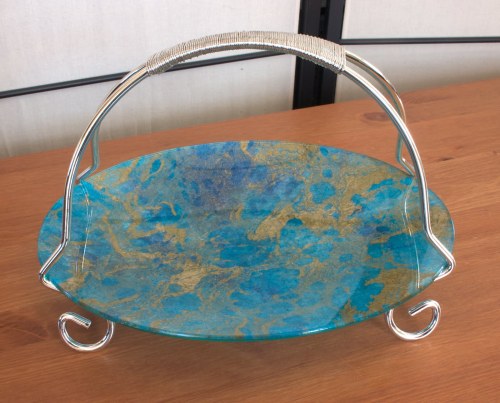
I didn’t post here on my blog last month because I was busy with school, and with other things, such as the decoupage serving tray pictured above.

The few of you following my blog (thank you, by the way) will have noticed that I did not post at all during August. Or if you did not notice that fact specifically, you probably did observe that a good while went by without so much as a whisper from me. No worries, nothing is wrong. I’m not sick, I’m not dying, and as you saw from my two recent posts, I have not changed my mind about becoming a doctor.

So why the silence?

Reason #1: busyness.

August was the-month-to-get-everything-done-before-school. And when you have a family, a house, a husband, and other such life elements, figuring out how to manage them on a totally different schedule takes some time, juggling, and preparation.

Reason #2: business.

Yes, I have my own business, called The Artful Diner. As with most artists, I won’t be able to retire off my income from it, but the extra money helps, and I enjoy it. As the name implies, my work has to do with dining. And indeed, I make decoupaged dishware and beaded / wire-wrapped utensils to sell online and at art shows. At the end of July, I heard about a local art fair that I really wanted to participate in. I signed up, paid my fee … and then realized I needed more inventory. So I spent the next several weeks in full production mode. (My dining room — aka my “studio” — still looks like a hurricane swept through it, much to my husband’s delight.) Here is a link to my Etsy.com storefront, and a few photos of my recent work.

My Etsy storefront link: The Artful Diner

Here are some coaster sets I have painted and decoupaged with marbled paper (this is a new thing I am doing now):

Another new item for my online store this season is pillar candle stands. These are flat pieces of glass, with paper (and often vintage ephemera) decoupaged on the underside, on which you can put a tall pillar candle. The wax drips onto the flat, glass surface, and you just scrape it off. Here are a couple photos of those:

A set of six small decoupaged bowls:

So rest assured: I have not been idle with my time. Between the life busyness and my business, posting on my blog fell between the cracks. But I missed writing during that time, and especially writing about science and medicine, so you may also rest assured that I will not let that happen again.

The genetics of synthesis

“Synthesize.” When I worked as a textbook editor at McGraw-Hill, we used that word all the time in our literature textbooks. (Usually in the context of asking — rather, telling — students to synthesize a number of elements.)

And now here I am, a student myself. And yes, I am synthesizing, too. But I will get to that shortly.

First, what is synthesizing and synthesis? It is, according to Merriam-Webster’s online dictionary, “the combining of often diverse conceptions into a coherent whole.” In other words, taking different pieces of evidence, material, readings, experiences, and so on and making sense of them when put together. It is an incredibly complex cognitive process, far beyond mere comprehension, even above analysis.

At the university level, it is rather taken for granted that students are capable of synthesis. Homework, quizzes, and exams require it. So to do well, it is necessary. But what is really exciting is the synthesis that happens independently of all of that required work. It may not boost your grade, but it should boost your confidence that you are understanding — and connecting with — the material.

At least, that’s what it does for me. It also encourages me that I am on the right track with what I am doing. Because making these kinds of connections (when it’s not required by a professor, that is) requires not only knowledge, but interest. And a little passion doesn’t hurt, either.

For me, the lightbulb flared this morning as I was reading my biology textbook. I will be honest — reading that monstrous (read: insanely heavy) book was not what I felt like doing at 7:30 a.m. But I wanted to be prepared for my morning lecture, so read I did. While the whole selection — relating the evolution of mammals — was fascinating, the true reward lay in a nugget on the very final page: a one-paragraph blurb on a gene called FOXP2, thought to play an important role in human language. (And since language is one thing that sets us apart from our ape cousins, this gene is also thought to play a role in the evolution of Homo sapiens).

“FOXP2 … FOXP2 … FOXP2 … where do I know that from?” I asked myself as I finished reading. I knit my brow, cocked my head, and pursed my lips as I searched my brain for a possible link. Because I knew I knew that gene from somewhere. And then it dawned on me: my summer research. Olga had been looking for evidence of FOXP2 expression in her lung cell samples. Because while FOXP2 is involved in language development, it is also involved in cell proliferation (growth) in the lungs, and hence could signal the presence of stem cells.

My eyes lit up and I laughed out loud. Synthesis indeed.

As I write this, I realize that maybe it sounds strange to get all warm and fuzzy about genetics and research. But I just can’t seem to help myself.

Of course, I had to tell someone who would really appreciate this “discovery.” (Telling my husband, Geoff, didn’t quite do it — merely the letters “D – N – A” make his eyes glaze over). So I headed to my bio professor’s office hours after my last class and told him I’d had an “interesting encounter with our biology textbook.” That sure got his attention. We had a nice talk. He knows me a little better, and vice versa. One of the best parts of my undergrad education was getting to know my professors well and being mentored by a handful of them. I hope for that same kind of experience this time around as well.

The honeymoon will soon end … but that’s ok

I am officially a pre-med student.

Correction: I have been for just over a week now. But it hasn’t really sunk in yet, because this is still the honeymoon stage. All love songs, hugs, and kisses — no slammed doors, curse words, or broken dishes (yet).

Everybody is still in friend-making mode; there are few cliques or ways to feel excluded, if you make an effort to be social. Everything comes easily at the moment: I still remember all that we have “learned” so far, even though I’ve barely touched a biology, chemisty, or physics textbook in more than a decade. Every grade is an A right now — we haven’t had any assignments, exams, or quizzes on which to lose points. The sun is shining, the future is bright, and everyone still has a chance to get in to medical school.

Soon that honeymoon will end. There will be late nights up studying before exams. And then the actual exams. Weekends lost to lab reports after hours spent in the lab during the week. The anxiety of eventually applying to medical school. The dread of not getting in.

So why do it? Is the destination worth it?

Hell no.

Don’t get me wrong — I can’t wait to be a doctor. I think I’ll be a pretty good one, and I have a feeling I’ll enjoy it. But getting there is a long road. Years, literally, of your life. Anyone who thinks they can just push through without having any appreciation for the journey there will be incredibly miserable for an incredibly long time. And, I think, become bitter and angry about it. Yeah, that bodes real well for a person’s bedside manner, doesn’t it?

I’m one of those crazy people who actually likes school. When I’m interested in something, learning about it is a pleasure (most of the time — ask me at 3 a.m. and I might tell you a different story). I’m excited about where I’m going, but I’m also excited about what I’ll be doing along the way. And to do this, you have to be.

That’s why it’s OK that the honeymoon will soon end. Because when it does, that signals the beginning of a deeper, richer relationship with the subject matter. (For this school year: biology, chemistry, and physics.)  Sure, it will be harder. And sure, I may complain about that sometimes. I may struggle. I may even use four-letter words (*gasp*). But I wouldn’t trade places with anyone.

Stay tuned.

ADCOM Q&A (learning from your mistakes)

Everyone makes mistakes. Even pre-medical students. And one trend I’ve noticed in the medical school interview questions I’ve looked at (this applies to job interview questions as well) is that the interviewers quite often will bluntly ask you about those mistakes or other shortcomings. For example, there is the infamous “What is your greatest strength and weakness?” question, which I have been asked in multiple job interviews. A similar medical school question I found online literally begins with these words: “What has been your biggest failure … ?”

Clearly, though, if an applicant goes on for 10 minutes about how badly he did in organic chemistry, that’s not going to go over well. That’s why the question about your “biggest failure” ends with these words: “… and how did you handle it?”

So if an applicant did poorly in organic chemistry, explaining why he didn’t do well — such as that he didn’t have good study skills — and then what he gained from the experience — such as that he developed better study skills as a result of his failure– would be a much better answer.

ADCOMS want to hear us pre-meds admit that we’re not perfect, and then talk about what we have learned from our mistakes, shortcomings, failures, weaknesses, and other “problem areas.” Because failing is part of life (as much as I hate to admit that). It’s what you do after you fail that sets you apart from other people.

The reality is, everyone falls down sometime. The question is: Do you get back up?

My answer is: YES. And here’s an example from my childhood.

(Let me preface this example by saying that I was homeschooled from preschool through the end of fifth grade. So when I talk about my mom giving me a test … it’s because my mom was my one and only teacher from age 4 to age 10.)

When I was about 7 or 8, my mom gave me an impromptu spelling test. You know the kind — the ones that are supposed to gauge where you are and where you need improvement. They’re called diagnostic exams, I believe. As someone with something of a failure complex, I hated these exams because I never did well on them — you’re not SUPPOSED to do well on them. At the time, this point escaped me.

Anyway. I miserably failed this spelling test. I don’t remember the number of right and wrong, and it’s probably better that way. I was distraught at first. I had failed! What was I supposed to do? Then my mom sat me down and explained the purpose of this “diagnostic” exam. Her explanation brought some comfort. And in the end, while I was not necessarily happy that I had failed, I understood that the test pointed out some areas where I needed to improve.

And so I made it my absolute mission to become the best speller possible. I learned all the rules. I memorized the exceptions. I practiced spelling words until I was practically murmuring them to myself under my breath in the bathtub.

Then came time to take the exam again. And I aced it. All that work paid off — I had learned what I didn’t know, what I needed to work on, and I made it a point to not make the same mistakes again.

And guess what? When I attended public school a few years later, I went on to win several school spelling bees, and even a district spelling bee.

To this day I am a fantastic speller, and in my previous jobs, earned a reputation as such. All because I failed an elementary school spelling test and made up my mind that wasn’t going to happen again.

And while I still don’t like failing (although who does?!), I try to remember this example when I do. Because it proves that you can learn from your mistakes. And perhaps, that without making mistakes, we wouldn’t learn quite so much.

ADCOM Q&A (working under pressure)

Being a doctor is, quite often, about working well under pressure. If someone stops breathing, for example, you better figure out how to get them breathing again, and quick! There is no time for consulting the Internet, a textbook, or (very often) other doctors. You must act. Now. Or someone might die.

That’s why ADCOMS often ask pre-medical students a variation on this question (which I found on the Internet on a list of practice questions):

How do you work under pressure? Give an example. What, in hindsight, were you most dissatisfied with about your performance? What did you learn from your experience?

“I’m no stranger to working under pressure,” I thought when I read that question.

And that is the truth. For the year and a half that I worked at the Forest Park Review, a local weekly newspaper in the Chicago suburbs, “pressure” was my constant companion. (And this was my first job out of college, so I learned it early.)

It was especially intense, though, on Tuesday mornings. That was deadline day, when the paper was sent to the printer. I would wake up at 2 or 3 a.m. in order to write a half-dozen or so stories and an editorial by 7 or 7:30 a.m. And then I would go to the office. What for? For another three hours of deadline drama: writing headlines, creating captions, approving page layouts, and so on. It was grueling.

But through it all, I had to be at peak performance. Exhaustion was no excuse. I had to get the facts right, get the dates right, and get people’s names right. And do it all in captivating prose. Oh, right — make that captivating prose in less than 700 words per story.

But I didn’t need any excuses. In fact, I kicked things up a notch on deadline day. I was intense, driven, focused. When I have a goal, and time constraints for completing that goal, I find myself subdividing time into estimated allotments for each portion of the task I have to complete. This helps me stay on track so that I don’t spend too much time doing any one thing. On deadline day, that might mean 30 minutes for one story, and one hour for another. (I prioritized as well as subdivided.)

The process was intense, and I was intense during the process. It was hard to turn that intensity off right away. So when I’d leave the newsroom at around 11:30 a.m. or noon, snippets of stories would float through my mind. And I would question myself: Did I do X right? Did I change Y like I told myself I needed to? Maybe I should have opened that one story with another lede …

Then when I saw the newspaper the next day, I saw the in most cases, yes, I did do X right, I did change Y, and in actuality the lede I opened on that one story with was fantastic.

I gradually learned to trust myself, not to second-guess myself in those high-pressure situations. Because I knew what I was doing, I really did, I just needed to BELIEVE that I knew what I was doing, and go with that. Because it was often the second-guessing that led to the mistakes.

This is an essential skill for a physician to have. There is often no time for second-guessing. Making a second guess might mean your first act is one moment too late. So trusting yourself, your skills, and also your intuition, is something that a physician must do … is something that hopefully I will one day do.