doc w/ Pen

journalist + medical student + artist

Hospital life: From anesthesiology to zebras

I belong in the hospital.

Not because I’m deathly ill (thank goodness), but because I want to work there someday.

I’m on spring break this week, and had the opportunity to shadow two physicians: an ICU director (a pulmonologist, Dr. Saunders*) and an anesthesiologist (Dr. Matthews*). Not only am I fascinated and intrigued with what they do, but (call me crazy here) I really like the hospital environment. Of course, the ICU and the OR are very different places, but I enjoyed things about them both. In this blog post, I will describe some of what I observed and learned in both the ICU and the OR, and why I find these places so interesting and compelling. I will also attempt to impart some of the passion and compassion I witnessed both of these days.

Day 1: ICU. 

I began my day at a local community hospital ICU by going on rounds. For those of you who have never gone on rounds, it’s quite an overwhelming experience. Total information overload. Dr. Saunders, the hospitalist, pharmacist, cadre of interns, and I circled the ICU, stopping in front of each room, going over each patient’s current status. Which, for patients in the ICU, is pretty detailed: recent labs, overnight events, medications, lines, and so on. The interns were in charge of relaying all of this information and then answering questions about what it all meant. What did it mean that Mr. Smith’s potassium level was low? What did it mean that Mrs. Jones’s renal function had worsened? And more importantly, what would you do about it?

Acronyms flew like geese on a fall day, but I quickly caught on to what at least a few of them meant. “SBT” — spontaneous breathing trial — is a particularly important one in the ICU for patients who are on a ventilator. SBTs are a good predictor of whether a patient will be able to breathe on their own, off the vent. And getting the patient off a ventilator as soon as possible is key, because the longer someone is on a ventilator, the more likely they will stay on one.

I was incredibly impressed with the hospitalist, who really took the reins of rounds. He had an amazing memory for both the big picture of a patient’s prognosis (are they ready to come off the ventilator any time soon) and for the minute details (what their most recent ABG — arterial blood gas — showed). He also integrated teaching so seamlessly into the process, coaching and correcting, but not criticizing, the interns.

Toward the end of rounds, we looked at all of the patients’ chest X-rays. First of all, it’s not like it is on TV. (OK, OK, nothing is like it is on TV, I know. But bear with me.) On TV, when you see an X-ray of someone’s broken bone, it’s so obvious. There will be a huge gap there. Or if someone has a tumor, there will be a bright, white, grapefruit-size mass sitting in the midst of a black background. Again, obvious. But with these real-life chest X-rays, it was a mystery to me how the physicians could tell anything from them. They would point to a splotchy, whitish area and say it was pneumonia. And I’d think, “OK, I get it.” Then on the next one, I’d think I saw a similar splotchy area, and then the hospitalist would say, “This X-ray looks great!” The way they had trained their eyes to see such detail was just incredible.

This is what I really gleaned from those two hours of rounds: There are two levels of understanding when it comes to a patient’s condition and prognosis. And they need to be integrated. You need an understanding of both the minute details, and the big picture, as well as how those details contribute to the big picture. This requires a great deal of synthesis of clinical information and basic science. (Yes, all that basic science you learn does have a place!) The interns struggled with this, understandably; they are fledgling physicians. But for the hospitalist, I could tell this had become second nature to him. That was just amazing to watch.

One thing about working in the ICU is that while some patients get better, some of them don’t. But with current advances in medicine, they can linger for weeks, months, even years. So at some point, it’s up to the family whether to let the patient go or prolong their life artificially. I sat in on one of those family discussions. It was Dr. Saunders, an intern, a nurse, the patient’s daughter, and me, all piled into a tiny office. Dr. Saunders began the meeting by asking the patient’s daughter what her understanding was of her mother’s condition. As he explained to me later, that gave him a sense of where she was both emotionally and cognitively with the situation. Then he presented some additional facts about the patient’s condition and prognosis. Before he even had a chance to give a recommendation, though, the daughter said, “I think I know what needs to be done. I don’t want her to suffer anymore.” Dr. Saunders agreed, and encouraged her to talk with the rest of her family about the decision. It was a sobering reminder about the nature of life, and of death.

Dr. Saunders told me afterward that this meeting was one of the easier ones — people aren’t often receptive to the idea of letting go of a loved one. Even if, from a physician’s standpoint, it is the best thing for the patient.

Later, I got to see something of a “zebra.” (That’s doctor-speak for a rare condition.) Dr. Saunders and I headed to the ER to do a pulmonary consult on a woman who came in with severe chest pain and shortness of breath. The diagnosis? Catamenial pneumothorax of the left lung. A pneumothorax is a collapsed lung. A catamenial pneumothorax is a collapsed lung associated with a woman’s menstrual period, and with endometrial “implants” on the lung or pleura. No one seems to know exactly how or why this happens. But it had happened multiple times to this woman. The physicians decided to treat her with a chest tube and later VATS (video-assisted thoracic surgery) procedure. Which sounds really scary but is actually minimally invasive and allows the surgeon to repair the problem.

We also saw more patients, had another family meeting with the relatives of a man who had had a stroke (this one over the phone), and somehow managed to squeeze in lunch at the infamous hospital cafeteria (the food was actually pretty good!). Never a dull moment. And every moment something different. That’s one thing I really liked — the variety of the day, what we saw and what we (well, technically he) did.

Day 2: OR. 

The OR is a place where what seems like magic happens. The surgeon cuts a person open. The surgeon removes things, implants things, repairs things. The surgeon sews the person shut. But all of that is made possible because the person is unconscious, kept unaware of the trauma their body is undergoing. Making that happen is the anesthesiologist’s job.

Dr. Matthews, the physician I was shadowing, got pulled last-minute into some administrative duties (he is the department chair of anesthesiology at the hospital where he works). So I spent part of the day with two certified nurse anesthetists, who perform anesthesia under the supervision of a physician. Between Dr. Matthews and the nurse anesthetists, I now have a better picture of how complex anesthesia is, and how fascinating.

At first glance, anesthesia might look easy. You stick a tube down a person’s throat, pump them full of drug cocktails, and let a machine regulate their breathing. But there’s a reason they make you go to medical school to be in charge of this stuff. It involves the subjects of biology, chemistry, physiology, and pharmacology (to name just a few). It involves understanding all aspects of a patient’s history and how that history interacts with the situation at hand. It involves rapid decision-making, sometimes in crisis situations. It also involves patience, compassion, overall good bedside manner, and a sense of teamwork. (Oh, and it helps if you don’t faint at the sight of blood.)

I observed two surgeries that day: a tummy tuck and an arthroscopic shoulder surgery. And I watched two nurse anesthetists at work. One thing I noticed — which they corroborated — was that they each had their own “style” of working, and of relating to the surgeon, surgical tech, and other nurses. They both explained to me that there are different ways of accomplishing similar things (such as pain relief, for example), and that different practitioners prefer different methods. One of them told me, for example, that he prefers to avoid using certain intravenous muscle relaxants because they require you to use another drug called a “reversal” to reverse the muscle relaxant effect at the end. He said that in his experience, patients who received those drugs seemed to experience more nausea after awakening.

Something else that really stuck out to me was that at one point during the shoulder surgery, the patient’s blood pressure became a little low. Not dangerously so, but lower than the nurse anesthetist wanted to see it. He had two different drugs he could use to remedy the situation — one would raise both blood pressure and heart rate, and the other would raise blood pressure while decreasing heart rate. The problem was, we didn’t really want to mess with her heart rate at all, so what to do? He chose the second drug, based in part on the woman’s age and medical history, and how the drug would affect her based on that history. Lo and behold, a few minutes later, her pressure was back up, and her heart rate had only decreased a couple of beats per minute. It was incredible.

As with working in the ICU, life in the OR is anything but boring. Every patient is different, and requires something a little different from the anesthesiologist. Keeps you on your toes. And I like that.


*Names have been changed.

An adage a day …

William Osler (1849-1919) was a Canadian physician and one of the founding professors at Johns Hopkins. His quotes and wisdom are well known among many in medicine. Here are some of his words, and those of some others with interesting insight into medicine.

“A picture is worth a thousand words,” if you believe the common adage. Depending on the situation (and on the picture), that can be true. In the context of medicine, for example, you need pictures of human anatomy — not just words describing human anatomy — to learn about the body.

That said, another adage takes a different view: “The pen is mightier than the sword.” This speaks to the potential power of words over forceful actions, especially in diplomatic situations. (I could probably make a really bad surgical analogy here if I tried, but I’m not going to.)

In sum, pictures, actions, and words all have their respective places.

As a writer, I believe in the power of words, not only on their own, but also to shape our actions and our mental pictures of the world surrounding us. And when it comes to words, people have had plenty to say on the subject of medicine. In many cases though, what makes someone’s words memorable has less to do with what they say than with how they say it.

With that introduction, I would like to share some particularly memorable medical adages that I have collected. All of them come from a 27-page editorial that was published in 1928 (yes, you read that right) in The Bulletin of the New York Academy of Medicine. You can access the whole article online here.

Popular Chinese sayings

  • The unlucky doctor treats the beginning of an illness; the fortunate doctor the end.
  • It is easy to get a thousand prescriptions, but hard to get one single remedy.
  • Before thirty, men seek disease; after thirty, diseases seek men.

Chinese literary aphorisms

  • Men worry over the great number of diseases; doctors worry over the small number of remedies. – Pien Chiao
  • When you treat a disease, first treat the mind. – Chen Jen
  • To avoid sickness, eat less; to prolong life, worry less. – Chu Hui Weng

Quotations from the Hippocratic Canon

  • The highest duty of medicine is to get the patient well; of several effective remedies, choose the least sensational.
  • Physicians are many in title but few in reality.
  • Where the physician can do no good, let him do no harm.
  • To do nothing is sometimes a good remedy.
  • Science begets knowledge, opinion ignorance.

Herophilos (Greek physician and first anatomist; 335 – 280 BC)

  • To lose one’s health renders science null, art inglorious, strength effortless, wealth useless and eloquence powerless.
  • Medicines are nothing in themselves, if not properly used, but the very hands of the gods, if employed with reason and prudence.
  • He who can discriminate between the possible and the impossible is the wisest physician.

Aulus Cornelius Celsus (Roman encyclopedist; c. 25 BC – c. 50)

  • The art of healing has no more solid base than experience.
  • The art of medicine has almost no constant rule.
  • We should not impute the faults of the physician to his art.
  • Better an untried remedy than none at all.
  • For major ills, major remedies.

Thomas Syndenham (British physician recognized as founder of epidemiology; 1624 – 1689)

  • The art of medicine is to be properly learned only from its practice and exercise.
  • A man is as old as his arteries.

Jean-Martin Charcot (Pioneering French neurologist; 1825 – 1893)

  • Disease is from of old and nothing about it has changed. It is we who change, as we learn to recognize what was formerly imperceptible.

Abraham Jacobi (German-born physician, opened the first children’s clinic in the U.S.; 1830 – 1919)

  • Treat the man who is sick and not a Greek name.
  • Nature does not kill and does not heal. If there were consciousness in Nature, she would feel indifferent about what she is, viz., mere evolution.

Sir Thomas Clifford Allbut (British physician and inventor of the clinical thermometer; 1836 – 1925)

  • The name of a disease is not, as it is continually regarded, a thing.

William Osler (Canadian physician and one of the founding professors at Johns Hopkins; 1849 – 1919)

  • From Hippocrates to Hunter, the treatment of disease was one long traffic in hypotheses.
  • Common sense in medical matters is rare and is usually in inverse ratio to the degree of education.

Medical humor: Hospital chart bloopers

One day many years ago I was talking with my dad about his job as a family practice physician.

“Do you know what my most important tool is?” he asked.

I thought for a minute. “Your stethoscope?” It seemed a logical answer.

“No, my pen,” he responded.

Errors in medical documentation can take you into uncharted waters.

Insurance paperwork to fill out, prescriptions to write, and probably most of all, the infamous charting. Everything you do and observe as a physician is supposed to go in a patient’s chart. As I have seen at the free clinic where I work, this can take quite a while and be a very detail-oriented task, especially if there are multiple issues going on with the patient.

Here I present some examples of medical charting gone wrong, courtesy of an e-mail from my mom. I hope to post more humorous pieces like this in the future, because as the saying goes, “Laughter is the best medicine.” Enjoy!

Hospital Chart Bloopers

  1. The patient refused autopsy.
  2. The patient has no previous history of suicides.
  3. Patient has left white blood cells at another hospital.
  4. Note: patient here — recovering from forehead cut. Patient became very angry when given an enema by mistake.
  5. Patient has chest pain if she lies on her left side for over a year.
  6. On the second day the knee was better, and on the third day it disappeared.
  7. The patient is tearful and crying constantly. She also appears to be depressed.
  8. The patient has been depressed since she began seeing me in 1993.
  9. Discharge status: Alive but without permission.
  10. Healthy appearing decrepit 69-year old male, mentally alert but forgetful.
  11. Patient had waffles for breakfast and anorexia for lunch.
  12. She is numb from her toes down.
  13. While in ER, she was examined, x-rated and sent home.
  14. The skin was moist and dry.
  15. Occasional, constant infrequent headaches.
  16. Patient was alert and unresponsive.
  17. Rectal examination revealed a normal size thyroid.
  18. She stated that she had been constipated for most of her life, until she got a divorce.
  19. I saw your patient today, who is still under our car for physical therapy.
  20. Examination of genitalia reveals that he is circus sized.
  21. The lab test indicated abnormal lover function.
  22. Skin: somewhat pale but present.
  23. Patient has two teenage children, but no other abnormalities.

Flashcards: “Kingdom” Protista

The last set of flashcards for this Friday’s exam. There are some more really neat pictures here. Algae, amoebas, parasites, all that good stuff.

Study these flash cards

Sample of my flashcards from this deck.

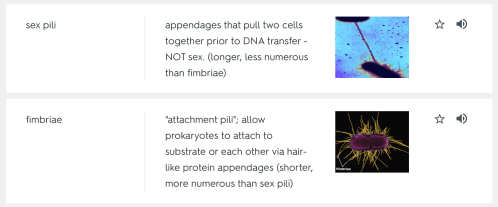
Flashcards: Prokaryotes

Another set of flashcards for this Friday’s bio exam … this one also has some cool pictures, so check it out!

Study these flash cards

A sample of my flashcards from this deck on Quizlet.com.

Flashcards: Cladistics

I’ve got a big biology exam coming up this Friday (March 4), so in preparation I’ve been making more flashcards. Here is a set on cladistics. I will also post sets on prokaryotes and protists. If any of you out there are in my class, hope this helps!

– Lorien

Study these flash cards

Sample of my flashcards from this deck on Quizlet.com.


Physic-al discomfort

Last December, I tried out a fun Facebook app called “My Top Words of 2010.” It (supposedly) went through all my status posts from the year and came up with a list of the words I used the most. My top word? PHYSICS. (I used it 11 times, in case you’re interested.)

For those of you who have been following this blog for some time, or who know me personally, this should not be a surprise. It’s not that I don’t like physics. I actually find it quite interesting. But I also find it quite difficult.

Case in point: the homework we were assigned to do a couple of weeks ago on electric fields and point charges took me at least 6 hours to do, if not more (and 2 of those hours were spent at a tutoring session). I understood it by the end, but it took a lot of work. And a lot of help. (Which, by now, I’m not afraid to ask for.)

A week and a half ago, we had our first exam of the semester. Prior to that, my professor handed out a set of 49 (that’s right, 1 fewer than 50) optional practice problems. Doing well on these physics exams is not so much about being able to solve the problems, but being able to solve them quickly. And the only way to build up speed is to practice, practice, practice. So, being the dedicated (and slightly insane) student I am, I did every one of those practice problems. All 49 of them. For several days leading up to that exam, I went to bed thinking about physics problems, and I woke up thinking about physics problems. I breathed physics problems.

Come exam day, though, I still felt unprepared. After my professor handed out the test, I looked at the first problem and blanked out. Knowing that I had no time to waste (we had 7 multiple-part problems to do in 50 minutes), I skipped it and moved on to a problem I could quickly do. I worked to the end of the exam and finally circled back to that first problem. I answered it as best I could and handed in my test at exactly the 50-minute mark. Done. Thank god.

As the adrenaline wore off, my mood plummeted. I had felt rushed the whole time and was sure my answers were riddled with stupid errors.

Well, I got the exam back Tuesday afternoon: 93%. Mine was one of four As between both physics sections (about 40 people total). The class average was in the 70s.

I talked for a few minutes with my professor about the exam, and he said he was able to tell from his post at the front of the classroom who had done the practice problems and who hadn’t. He said he could tell I was one of the few who really knew what I was doing because I worked through the problems quickly, without hesitation. (Which was a bit funny, considering I sure didn’t feel I knew what I was doing!)

It’s clearly a confidence issue for me. And one I don’t have in my other classes: biology and chemistry exams don’t fill me with the same kind of dread, nor do I leave them thinking that I flunked.

I have pondered this a great deal, and here is what I have come up with: physics is out of my “comfort zone,” if that makes sense. It’s not the kind of science that I’m used to, and it involves a very different way of thinking about the world. (Literally.) So I have this niggling doubt that perhaps, maybe, I won’t be able to “get” it. Which, of course, I’ve proven wrong to myself over and over. (I got a high A last semester, and have an A so far this semester as well).

I really see taking physics as an important learning experience for me. And I’m not talking about the material, although that is obviously necessary for doing well on the MCAT. What I’m talking about is developing a different attitude and approach toward material that perhaps isn’t my strength. Not fearing it, but embracing it as a challenge, and still retaining confidence that if I put my mind to it, I will succeed. Obviously, I haven’t quite grasped this concept yet … but I’m working on it.

I had a fantastic journalism professor in college who told us it was our job as journalists to be uncomfortable, to step out of our comfort zones and learn and experience something new. Well, I’m no longer a journalist, but that professor’s advice still holds true: you really do learn something about the world, and about yourself, when you put yourself in that kind of situation.

In short: you grow. And isn’t that what life is all about?

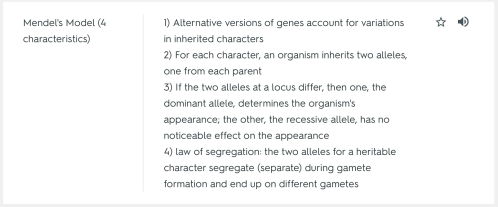
Flashcards: Mendelian genetics

In a previous post, I mentioned that I had found a great iPhone / iPad app called Flashcards++, which allows you to create digital flashcards and import them to your Apple device and study on the go. (Always a good thing for us busy students!) You can both make the flashcards directly on your iPhone / iPad, or make them on one of two Web sites (Quizlet.com or Flashcardexchange.com) and then import them. I use Quizlet.com. I discovered yesterday that I can “embed” the flashcards in my blog. So I thought that I would do that and share a bit of what I’ve been studying: Mendelian genetics. (That, among many other things!) Feel free to flip through the flashcards if you like. It’s kinda fun, in a really nerdy and geeky way. But then again, if you’re going into medicine, you have to embrace that inner nerd, right? RIGHT?! Enjoy.

Study these flash cards

A sample of my flashcards from this deck on Quizlet.com.

The art of the medical history

While translating this week at the free clinic where I volunteer, I helped out with two back-to-back intake appointments. “Intake” meaning brand new patients to the clinic, and meaning the medical practitioner had to take an entire medical and social history before getting down to what was bothering the patient that day. I had translated for intakes before, but never back-to-back ones. Working with them in such high concentration really got me thinking about the importance of taking a good medical history: how it very often provides the tools for making a more complete diagnosis and understanding what is going on physically, and psychologically, with a patient. And how without it, you would be lost.

The first patient, a middle-aged woman, came in with wrist pain. Suspecting tendonitis or carpal tunnel, the doctor asked whether the woman had ever worked in anything where she did repetitive motion. Turns out she used to work with jewelry. Turns out she also had surgery on her other wrist for carpal tunnel many years back. Bingo! The doctor then prescribed anti-inflammatory medication to try and relieve the symptoms, with the hopes that the patient wouldn’t need another surgery. Had the physician not known about the patient’s past, it would likely have taken much longer to make a diagnosis and to find something to bring the patient relief.

A nurse practitioner saw the second patient, a younger woman with rheumatoid arthritis who had been taking a high dose of steroids to relieve her arthritis pain. When it came time to do a “review of systems” — to check her health (literally) from head to toe — she responded with a “yes” when asked if she had a problem with nearly every area mentioned. Headaches, blurry vision, the list went on. It became quite clear that it was the long history of taking steroids that was likely causing all of these problems. The solution? Taper off the steroids and start another arthritis-relieving medication. Again, had the nurse practitioner not asked very detailed questions about her medication history (which he did), there is no way he would have known that her problems were a result of the steroids, and no way he would have been able to (hopefully) resolve the situation.

There are so many things you need to know about a patient, so many things that could affect their well-being. So many questions, many of which may not be pertinent to one patient, but may make the difference for another patient’s treatment. For example, if you know someone has a family history of diabetes, you can keep closer tabs on their sugar levels, and also impress on them the importance of eating right, exercising, etc. Not that you wouldn’t do that for every patient — but you could emphasize that there is added risk because of the family history. And that might help convince them to take their health more seriously.

Listening to the physician and the nurse practitioner take those medical histories gave me a better sense of what I will need to do when I become a doctor. It was good experience for me to be exposed to not only what questions to ask, but how to ask them: with compassion and sensitivity (especially the more delicate questions). Luckily, as a former journalist, I am an experienced interviewer. So I have that going for me. What I am learning is a new set of questions, and how to interpret a new set of answers.

Health in the Headlines: On forcing Americans to buy insurance

“A second federal judge ruled on Monday that it was unconstitutional for Congress to enact a health care law that required Americans to obtain commercial insurance, evening the score at 2 to 2 in the lower courts as conflicting opinions begin their path to the Supreme Court.”

– from the New York Times (click on the link for the whole article)

The provision in President Obama’s health care bill referenced in the above quotation is set to go into effect in 2014. Republican-appointed Judge Roger Vinson, who made the ruling, also found the rest of the health care bill unconstitutional. The whole matter is surely destined for the U.S. Supreme Court, as the Times article suggests.

I don’t pretend to be a constitutional scholar. So I don’t feel I can comment on the “constitutionality” of the health care bill, nor on the specific provision requiring all Americans to purchase commercial insurance. Nor do I want to get into a debate regarding party politics. Those of you who know me know where I stand politically, and this blog post is by no means a political party statement. So don’t even go there.

That said, I have an opinion on the efficacy of the health care insurance provision, based on my own experiences working in the medical field.

First of all, I believe all Americans deserve proper health care. In our convoluted health care system, that means (most likely) having insurance of some sort, be it individually-purchased insurance, or government-provided insurance. But forcing people to buy insurance on their own dime is another matter. Here is why I think that is a problem.

I work at a free clinic in Chicago where the only requirement to be a patient is that you have absolutely no insurance. That means no private insurance, no Medicare, no Medicaid. This clinic is for the people who fall through the cracks: the people who can’t afford insurance on their own and who don’t qualify for government assistance, either because they are undocumented immigrants or because they don’t meet the income “poverty” requirements the government sets forth. I don’t know exactly how many patients the clinic has, but I do know that the extensive filing system in the clinic’s office is full to bursting, and that doctors and nurse practitioners do new intake appointments every day. There is clearly a need for this type of service in the Chicago community.

But these people, who are people, let’s not forget, not numbers, nor statistics on a chart, do not come to this clinic by choice. They are there because they need this service. Because many of them can barely afford the basic necessities of daily living, such as food, electricity, the bus fare to get to work (if they are lucky enough to have a job — probably a minimum wage one — at all).

Asking them, nay forcing them to buy health insurance (or face a penalty), is forcing many of them to give up something else that they desperately need. Food, electricity, the bus fare to get to work. The list goes on.

While the government is planning to expand Medicaid eligibility (according to the same NY Times article), I doubt very much whether that supposed “safety net” will safely catch all of these people.

This provision of the health care bill is well intentioned, I understand that. It is meant to make sure that people receive health care when they need it, and don’t wind up with enormous out-of-pocket expenses when some horrible illness strikes. The formation of “health care exchanges” is also meant to drive down rates for people who have to purchase insurance on their own. Those are obviously good goals, and I support them.

But what has not been taken into account is that there are scores of people who literally cannot afford even $25 a month per person in their family for health insurance. I have met many of them. And I cannot, in good conscience, support such a provision.

Constitutional? I have no idea. Conscientious? Not according to my experience in the real world. And that, I believe, is what many politicians lack: real-world experience. Or at the least, they are so far removed from it that they have forgotten what it’s like out there in the real world. And that’s just plain sad.