doc w/ Pen

journalist + medical student + artist

Matters of Life and Death: A Day With an Oncologist

When many people think of cancer, they think two words: “death sentence.” Hence, the prospect of treating people with cancer could be summed up in one word: “depressing.” And it’s true that some of Dr. Park’s* patients were dying. There was the woman whose lung cancer had metastasized to her brain. Her whole family – husband and three children – had accompanied her to her appointment to get an update, and the news wasn’t good. They could do chemotherapy, and it could prolong her life, but chemo could not cure the cancer. And chemo would cause many toxic effects, including hair loss and nausea, Dr. Park said. You could tell the family had grabbed onto that little bit of hope and was clinging to it. Dr. Park had to bring them around to reality. He explained that without treatment, the average survival time for a person with her condition was four months. With treatment, the average was a year. And those were only averages. Chemotherapy was no silver bullet. One of the daughters was sobbing at this point. I reached to hand her a Kleenex box, but she had found some tissues in her purse. The woman with cancer, sitting on the exam table, said she thought she wanted to try the chemo and see how it went. Dr. Park agreed, and said that they could always stop if it became too much to bear. The woman, who had remained calm, collected, and still throughout the whole appointment, then spoke. Her voice broke ever so slightly, and she twisted her hands together. “I just want to go fishing,” she said softly. 
My heart broke for that family. For what they were going through, for what they would continue to go through as this woman’s disease progressed and even after she was gone, dealing with the loss of their wife and mother. 
But there were survival stories too. Like the woman who had beaten breast cancer, even though it had cost her one of her breasts. She came in laughing and joking, obviously happy to be there for a routine check-up rather than for chemotherapy treatment. For her, cancer had not been a death sentence. And she was obviously resilient, having bounced back from a major surgery that would deeply affect anyone on so many levels – physical, emotional, psychological, sexual. I honestly don’t know how I would handle such an intensely emotional situation. But here she was, offering to let me feel the difference between her reconstructed breast tissue and natural breast tissue. “Whatever you can learn from me, that’s wonderful,” she said. 
I am still in awe of that woman, and of every patient I met in Dr. Park’s downtown Nashville office earlier this month. What was I doing in a Nashville oncologist’s office, of all places? Isn’t that what everyone does on their summer vacation? In all seriousness, that is what I did on my summer vacation. In early May, I was in Nashville, Tenn. visiting a dear friend (who is also a non-traditional pre-med student). Her husband is good friends with Dr. Park, a Nashville oncologist. And Dr. Park was more than happy for the two of us to hang out with him for a day at his office. And as I have already suggested, it was an amazing day.
From the beginning, Dr. Park told us that he wanted to make the experience as educational and beneficial as possible, and that he would try to walk the line between explanations that were way over our heads and explanations that were so simple they might insult our intelligence. He found that balance perfectly and effortlessly, it seemed; he was a natural teacher. Before each patient’s appointment, he would pull up the patient’s history on the computer (their office had completely gone to electronic medical records, or EMR), explain the person’s disease, prognosis, treatment plan, and reason for that day’s visit. We would also go over the patient’s most recent labs together; these values often determined whether a cancer patient was well enough to get chemo that day, or whether a hematology patient needed an adjustment of his or her coumadin (a blood thinning medication). 
While so much of the oncology world was (obviously) new to me, I was able to make connections to what I already knew. And that is always a rewarding experience for me. Those lab results we looked at for each patient? They were the same types of results that we had gone over when I rounded with the ICU director in Chicago several weeks ago. So I was familiar with what some of the normal ranges were, and therefore also when something was amiss. One patient, who had myeloma, also had a kidney problem that had him on dialysis. Dr. Park told us that before they had started any cancer treatment, they had to make sure that he really had myeloma, not just an amyloid issue with his kidneys, because the two treatments were very different. Amyloid … the word struck a chord in my brain. “Is that in any way similar to the beta-amyloid protein accumulations that are a feature of Alzheimer’s disease?” I asked. Dr. Park looked surprised, and said yes, that they were both protein accumulations (although the histologies are very different). Another connection I made had to do with tissue structure, something we learned last fall in General Biology I. A woman came in as a new patient, having had a bilateral mastectomy (both breasts removed), and her physician wanted Dr. Park to evaluate her pathology and lab results to see whether she would benefit from any chemo treatment in addition to the surgery that had already been done. DCIS – ductal carcinoma in situ – was the type of cancer she had, meaning that it had not yet spread to the basement membrane (and this is a good thing), Dr. Park explained to my friend and me. I remembered learning about the basement membrane, and could picture exactly where it was in relation to the other types of cells in human tissue.   
But to the woman with the DCIS, it didn’t really matter so much where the basement membrane is, or even what it is; what she cared about was that her surgery had most likely gotten all of her cancer, and that chemo was not needed. “Praise Jesus,” she murmured as she listened to Dr. Park’s good news. “Hallelujah.”
That particular woman clearly had a faith that helped sustain her through her breast cancer. But another breast cancer patient we met seemed to be all alone, almost aimlessly so. Her cancer had metastasized to her bones – her skull, sternum, femurs. Yet she seemed not to be able to come to terms with the fact that she was dying; her main concern was that she had intense back pain. So Dr. Park worked out a plan with her to get her the immediate relief she needed, suggesting radiation treatment. I felt bad for the woman, because not only was she going through a torturous disease, she was doing it alone. That’s something no one should have to do.

My friend has an extensive family history of cancer, and she told me she didn’t think oncology was something she could imagine herself doing. I completely understand that. But the other day when someone asked me what type of doctor I want to be, I found myself blurting out “oncologist.” I was a little surprised at myself, honestly, but I ran with it in the context of the conversation. Clearly, I have plenty of time to make these decisions. But it doesn’t hurt to try a professional hat on (in the most basic way) and see how it feels.

Thank you, Dr. Park.

*Name changed.
Moving Out, Moving On

For the last 10 minutes, I’ve been staring at my bedroom walls with an immense sadness. The kind of sadness that grips your gut and tightens your throat so that you feel claustrophobic within your own skin. That kind of sadness. These old walls are a deep-sea turquoise, dark and rich. I painted them myself shortly after we moved into this house. It was a Chicago winter, so cold out – I was impatient; I couldn’t wait for spring – and I had to keep the windows open so I wouldn’t pass out from the paint fumes. So I wore my old gray Nike sweatshirt, the one I’d had since high school, a Christmas gift from my grandparents. Funny the things you remember.

Memories … I have made so many in this house. And almost seven years to the day after moving in with Geoff, I will be moving out. Alone.

It’s not that I’m going to live in a dump. I found a lovely little one-bedroom apartment in Forest Park, not far from school, not far from my friends and family. Decent rent, garage parking, lots of windows and natural light, newly refinished hardwood floors, not one but two closets in the bedroom (if you’ve ever seen my clothing collection, you’ll understand the importance of this amenity), the list goes on. I can see myself living there. And assuming my credit check goes through (which it should), the landlord told me it’s mine whenever I want it.

No, it’s what I’m leaving behind. And what those things represent. This house says “Lorien” all over it – I stripped wallpaper from the entire first floor, patched and sanded the walls, then primed and painted in a colorful palette of gold, sage, and raspberry. The upstairs I painted too, again in different colors. I wanted anything but white walls, and just about made it. (Only the kitchen, office, and Geoff’s music room are white.) This house is where we had family birthday parties, barbecues, sister sleepovers. But most of all, this house is where Geoff and I were together. We inhabited this place as husband and wife. That is over. But as long as I’m here, it doesn’t feel quite over. So as I sort through seven years’ accumulation of stuff; through my clothes and papers and books and art supplies and dishes and everything else that hides in the nooks and crannies of this big house; as I sort things into the “keep,” “throw away,” and “give away” piles; as I begin to pack things in cardboard boxes; the evidence of my former life is gradually fading away. Until eventually, when this house is empty and bare, the evidence of that life will have evacuated to the recesses of my mind. What do I do with that?

I need to move out, to move on, I know that. I can’t stay in this place anymore. But just because I need to do it doesn’t make it any easier.

ADCOM Q&A (working amid diversity)

The western Chicago suburb where I went to high school prides itself on being one of the first “integrated” communities in the country, and on a continued history of diversity. However, if you take a deeper look, you’ll quickly see that most of the African-American people live on one side of town, while the Caucasians live on another. And at the high school, African-American and Caucasian people rarely associate with each other. In fact, I caught nasty looks and insults for carpooling with a lovely girl originally from Nigeria (as did she). Maybe you can call this “diversity,” but I certainly don’t think you can call it “integration.”

And so, if an admissions committee member asked me something to the effect of: “What experiences have you had working with diverse populations? What have you learned from those experiences?” the first thing I would do would be to differentiate between “diversity” and “integration.” And then I would talk about the experiences I have had with integration – where diverse people really were mixed together and interacted with each other.
My first such experience came when I was a little girl. I grew up in a predominantly African-American church (and when I say predominantly, I mean there were three white families in the whole church) on Chicago’s West Side. I still remember the magic of Keystone Baptist Church’s amazing choir, how the songs those men and women sang would raise goosebumps on your skin. I remember the passion of the preacher, and the devotion with which deacons prayed. But most of all, I remember the people. We all loved each other deeply, like family, and that love overcame the boundaries of skin color. I remember my mom telling me once that for some of the people in the church, interacting with our family (and the other white families there) was the first and only positive experience they had ever had with white people. And it changed their perspective on skin color. 
My own perspective on skin color was that it was irrelevant in terms of status or value. In fact, I thought the dark skin was amazingly beautiful. My favorite babysitter at the time, Felicia, was African American. She was my heroine. One day, my mom found me, black permanent marker in hand, carefully and methodically coloring my skin. “What are you doing?!” she asked, shocked. “I want to look like Felicia,” I told her, in a complete matter-of-fact tone, like it should be obvious. My mom was careful to explain that everyone’s skin was different, and everyone’s skin was beautiful, but that my skin couldn’t be dark like Felicia’s. She then shuttled a very disappointed daughter to the bath.
What did I learn from these experiences? First, how important it is to instill a sense of respect for diversity and integration into children at a young age, when they are impressionable and willing to learn those lessons. And how important it is to expose them to integrated experiences. Because you can talk all you want, but if you never experience integration, the talk is really meaningless. Second, how important it is to be an ambassador. Because you never know who is watching, and who might take what you say and do seriously.
In addition to my experiences at Keystone with the African-American community, I have spent significant time with the Hispanic community, especially now that I am a Spanish medical translator. Of course in this context, I don’t get to know the people on a personal level. But it is an integrated experience nonetheless. Because I am right there, interacting with and speaking with these people in their native language. 
One of the most difficult things about my job at the clinic where I work is that medical vocabulary is something you don’t use in everyday conversation, so those words have been like a new language I have had to learn on my own. For example, you generally don’t talk about IUDs – dispositivos, in case you’re wondering – on a daily basis. But you do talk about them when you’re translating for a pap smear (papanicolau) appointment. 
The second most difficult thing is that the people with whom I work come from so many countries, regions, and backgrounds and hence have different colloquial words and expressions that they use. I remember one time working with a Mexican woman who had injured her shoulder. She kept using a word I had never heard before – I think it was estrellar – and I had no idea what she was saying. Finally, I asked her, “Se rompió el hombro?” – “Did you break your shoulder?” “Sí, sí, sí,” she said, smiling and obviously relieved that I had figured out her meaning. 
From these experiences, I have learned that sometimes you have to invest a significant amount of time to really be able to integrate yourself into a community and situation, but that the effort is worth it in the end, because you are able to truly make a difference. At the same time, you’re never going to get everything perfect – just like how I didn’t know what the word estrellar meant at my first go. But when you do make that effort, no matter how imperfect it is, that effort truly is appreciated. So trying is worth it, even if you only know a few words of a language, or a little bit about a culture. Because in trying, you are demonstrating respect for the other person’s world. And that makes all the difference.
I’m not trying to paint a rosy picture here. Working in situations where there is diversity (and hopefully integration) can be very difficult, full of misunderstandings, and sometimes even animosity. I only want to share my experiences, what I have learned, and what I hope to bring with me into my future as a physician. Because in that role, I will encounter all kinds of people. And all of them deserve the best of treatment, both medical and personal.

I’m Not Old, I’m ‘Refreshingly Contemporary’

Whenever my mom has to learn some new-fangled technological thing, like how to program the DVR or how to update her cell phone’s bluetooth headset on her computer, she has a great sense of humor about it. She refuses to consider herself old or out of date. “I’m refreshingly contemporary,” she always says – no matter how long it takes her to figure out the technology.

I’m not even 30, but I had my own “refreshingly contemporary” moment during finals week, one that gave my research biology class a good chuckle. (Glad you got a laugh on my behalf, guys!) Rather than have an exam, our “final” was to give a 15-minute PowerPoint presentation on our antibiotic resistance project. (I wrote about my own experiments in an earlier blog post, Caffeinated E. Coli. Click on the link to read that post.) The goal was to emulate a scientific conference, where we, as the presenters, demonstrated what we had done through slides showing our data, tables, figures, conclusions, etc. In addition, of course, we also had to explain everything to our audience in a clear, concise manner. So our grade was to be based both on our oral presentation and on our slides.

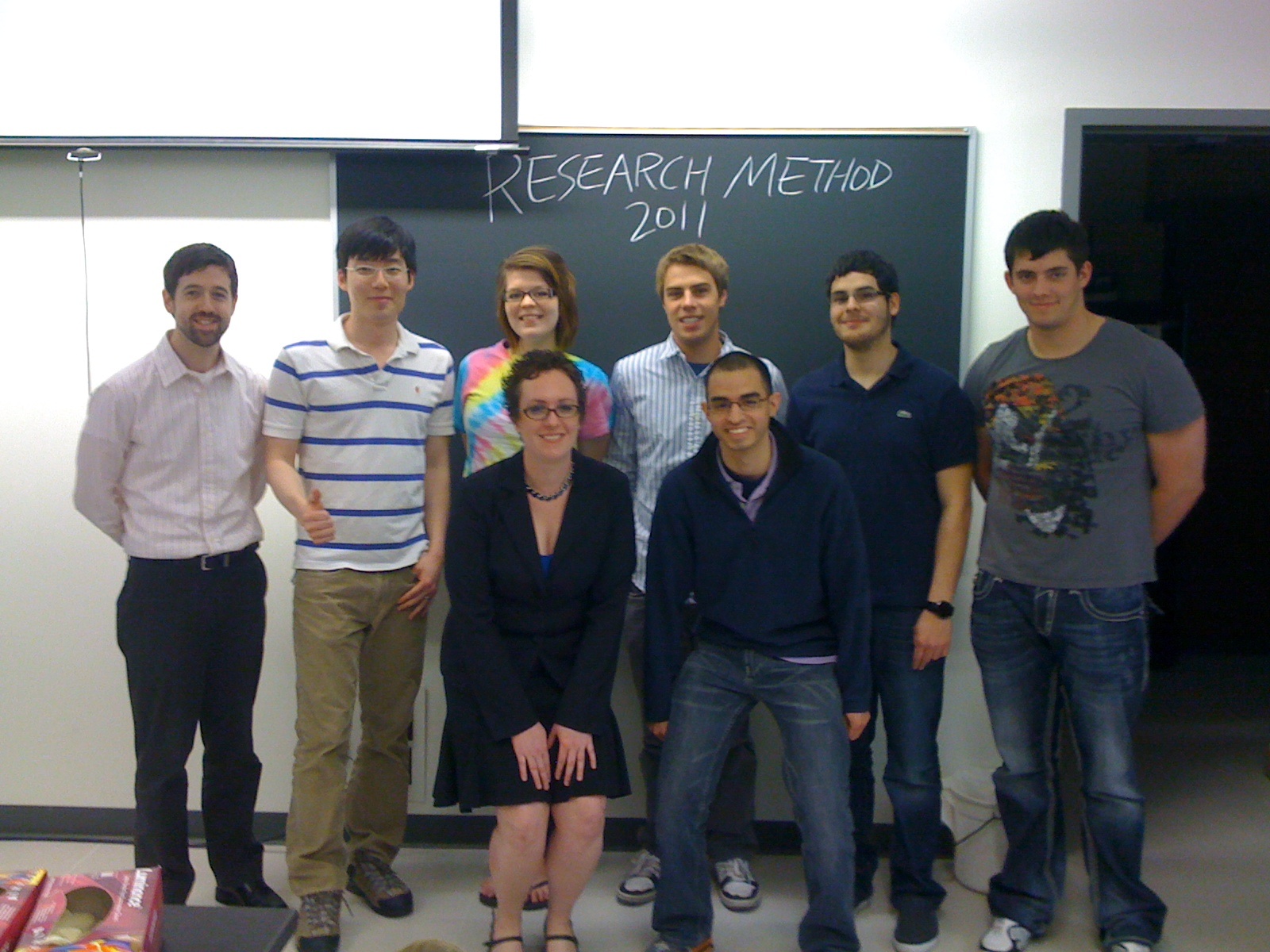
My Research Methods in Molecular Biology class,
the day we gave our PowerPoint presentations.

And now for my “refreshingly contemporary” moment: As an almost 30-year-old, I have never, I repeat never, given a PowerPoint presentation. When I told this to my class and my professor, my lack of PowerPoint experience did indeed elicit laughs. “Never?” someone asked. “What did you use for presentations?” I thought about it for a second. For starters, I realized that I hadn’t given a presentation of any sort in a long time. And in school – way back in the day – I used posters and overhead projector transparencies. Yes, I’m old. In comparison to the undergrad youngsters I was talking to, at least. And there was another thing: “Well,” I said, “as a former journalist, I’m used to being the one asking the questions, not the one doing the talking.” My professor just smiled. “I guess the tables have turned then, haven’t they?” he said.

One side note: I had used PowerPoint once, but not for an actual presentation. I had put together some graphs and text for a previous class assignment, and decided that the slide page orientation looked better than an 8.5 x 11 page. So I wasn’t completely unfamiliar with the software. But I had most definitely never made anything for the “big screen.”

I wasn’t really worried, though. PowerPoint is Microsoft software, which I’m pretty good at using. And when I had used it the previous time, I quickly realized that all the same copying, pasting, and formatting skills from Word would apply. Sure, I didn’t know how to make the presentation fancy – but I didn’t really care. I would focus on substance rather than style. Which is the main point anyway.

So I approached the presentation in the same way I would a lab report. Look at the data, decide what kinds of figures and tables are necessary, and then put those together. Then work out the analysis of the data, and the conclusions that I could make from it – analogous to the “discussion” section of a written report. And last, put together an introduction and conclusion. I found that my writing skills – both having a good understanding of sequence and how to use transitions – came in very handy in both writing the presentation and designing the slides. When I was done, I was confident in my work.

The day of the presentations, Dr. Kreher brought us bagels, coffee, and juice – “It’s not a conference without food,” he told us. I went near the end, and despite some technical difficulties (related to creating my presentations on a Mac and trying to run it on a PC … always an iffy proposition), felt really good about how things went.

The only downer of the morning was that after the last presentation, our class was officially over. My favorite class, the class that kept me going through this incredibly difficult semester. That thought saddened me. And then …

“Wait everybody, don’t leave!” shouted out one of my classmates. “I want to take a picture of the class.” So we all lined up in front of the blackboard, and smiled for his iPhone camera. “This will be fun to look look back on in 20 years,” he said.

Indeed. Fun to look back on a photo of the people with whom I truly got my feet wet in research. And fun to look back at the PowerPoint presentation I gave that same day, which, I hope, will be the first of many.

Pre-Med Year 1: Done

Well, it’s official: I have finished year 1 of my pre-med courses. It’s surreal. Two years ago, I was a laid-off textbook editor barely contemplating the road to medical school. One year ago, I was gearing up to work in a research lab and start classes in the fall, not having “done” any science since my sophomore year of college (back in 2000). And now I have a 4.0 for 29 credit hours of straight science courses. Things are looking good.

More importantly, I am loving this journey. Courses I knew I would enjoy (such as biology) have delivered. Classes I thought I would have to fight my way through (namely, physics) have piqued my interest in some way. Subjects I didn’t even know would capture my attention (I’m referring to research here) have lured me in.

I have learned so much, but everything I have learned has only made me want to learn more. Case in point: I practically drooled when I looked at the list of upper-level science classes I was eligible to register for next year; the hardest part was that I obviously have limited time and can’t take everything. With most of my requirements out of the way (physics, gen bio, and gen chem), all I have to take, in terms of pre-reqs, is organic chemistry. But since I’ll be in school, I get to take so much more: anatomy, a cadaver dissection lab, genetics, and biochemistry. I absolutely can’t wait to take what I have learned this year and add to and expand upon it. I feel like this year, I got a general outline of so many things; in the future I will be filling in a lot of the details of that outline. Being a former journalist (and still very much a writer), I understand the importance of an outline, but I also understand that the meat of a “story” lies in the details. And I am hungry for those details.

I look at some of my classmates who are so impatient to “get there” – to medical school, I guess. But I have a feeling that once they get to medical school, they will just want to, again, “get there” – to residency. And then to a fellowship, etc. If you are always focusing on the future, you miss what is in front of you. And that is the most beautiful, amazing part of life. Sure, I’m excited to go to medical school. But I am enjoying each day as I go. Because if I don’t, this journey is empty. And I won’t have absorbed all the lessons and knowledge I can gain along the way. And in many ways, that would make not only this journey empty, but my life empty as well. And in emptiness, I would certainly not be fulfilling my dream.

Lessons from the clinic

Every time I volunteer at the free clinic where I work as a Spanish medical translator, I come away with something. (So yes, volunteering is important – it’s not just something to put on your resume or med school application.) This past Thursday was no different. Two patients in particular stood out to me.

One was a very sweet middle-aged man, probably in his 50s, who was being treated for diabetes, high cholesterol, and thyroid problems (among other things). On the surface, it looked like he was incompliant with his meds – his cholesterol was still high, his A1C was still high, and in spite of 200 mcg of synthroid, his thyroid was still screwy. But as the nurse practitioner and I got further into the appointment, we came to the realization that it wasn’t that he was purposely avoiding taking the medications as intended – he probably couldn’t read. So while we did the normal routine – wrote out a new medication card, with all of the instructions written out as to which medication to take when, whether with food, etc. (I wrote them out in Spanish, of course) – we also went over the instructions with him verbally, multiple times, and had him repeat the instructions back to make sure that he understood everything. It reminded me that you really have to pay attention to the nuances of a patient visit, and treat the patient individually, because each person’s situation is so different. That seems obvious, of course. But when you’re rushing and trying to see X number of patients in a day, that can get lost. But really, it can’t – because that’s why I want to be a doctor.

The second patient who really made an impression on me was a younger woman, about my age. She had been dealing with depression for some time. The physician asked how her depression was, and how she had been doing on her Lexapro. Turns out that she had made some significant life changes on her own – had been attending therapy at the clinic and exercising regularly – and had been able to control her depression without the medication. You could tell she meant it, too. She smiled confidently as she talked about how things were going. Not a hint of the depression that had plagued her before. The young physician beamed as well. Not because he had come up with some fantastic and fancy drug cocktail for the patient, but because she had come up with her own way of coping with her situation, with his encouragement and help. It’s not always about prescribing medications or procedures, but about working with patients to find what works for them. And when you see that progress, that woman’s smile and her genuine ability to cope with her life situation, what a joy that is. That’s how I felt, at least, and I was just the translator, the observer. I can’t wait to be one of the participants in the whole process.

Caffeinated E. coli

I don’t think I’ve ever been so excited to go to school on a Monday as I was on April 11. Yes, I was actually excited about a Monday. Because at 11:30 a.m., when I walked into my research seminar class, I was going to find out whether my E. coli bacteria had mutated in the presence of caffeine and become antibiotic resistant.

OK, that might not sound like anything worth getting worked up about. So let me back up. My classmates, professor, and I were studying antibiotic resistance in bacteria. This is a poignant research topic, given the rampant rate at which antibiotic-resistant infections such as MRSA spread in hospitals. But we weren’t looking to decrease antibiotic resistance; we were looking to increase it. The goal was to learn about how mutations in DNA can allow bacteria to develop antibiotic resistance.

DNA is a sort of “language” that tells cells how to build their proteins. If that “language” is altered, even by a single letter, then the protein structure can also be altered. And that can affect an antibiotic’s ability to chemically bind to a bacteria and either destroy it or prevent it from replicating.

Mutations – changes in DNA – occur naturally, at a very low rate. So that’s what we looked at first. We grew cultures of bacteria in small glass tubes overnight in a shaking incubator, providing them with a liquid medium that would keep them happy, fed, and replicating. Using what’s called spectrophotometry, we were able to determine the concentration of bacteria cells. In essence, we used a machine to measure the amount of light that was absorbed by a sample of the cells in a small cuvette (a fancy name for a plastic tube). Then we distributed 100 microliters (a really tiny squirt) of the cells onto petri dishes which had a jelly-like medium for the cells to grow on.

Half of the petri dishes contained an antibiotic called carbenicillin, but this wouldn’t kill the bacteria, because they were engineered with a gene that gave them resistance to this specific antibiotic. These “carb” plates were our controls. They should exhibit explosive growth, but only growth of our desired bacteria – any bacteria from outside that lacked that carbenicillin-resistance gene would die. The other half of the plates contained carbenicillin plus another antibiotic called rifampicin. Rifampicin is a broad-spectrum antibiotic, meaning it kills lots of things. It is now only used to treat tuberculosis as part of a multi-drug cocktail, though, because it has a tendency to promote antibiotic resistance. (Perfect for our purposes.) The rifampicin should kill everything, with the exception of any bacteria that had mutated and developed some way of resisting its effects. Those were the colonies we were after.

We let everything grow over the weekend, and returned to find “lawn” – a very scientific term for prolific – growth on the carbenicillin plates, as we expected. We also found a handful of colonies, which looked a little like mold growing, on the rifampicin plates. Success! We scooped out the colonies, and through a series of processes, amplified and isolated one specific gene of their DNA sequence – a gene that has been implicated in mutations associated with rifampicin resistance. We then had the gene sequenced by an outside company. And sure enough, after a computer program analysis, we found DNA mutations (when compared to the “normal” E. coli gene sequence).

But it was time to take things a step further. So my professor, Dr. Kreher, asked each of us to come up with some substance – any substance – that we thought might induce additional mutations in the bacteria and increase the rifampicin-resistance rate. In other words, a substance that would cause more colonies to grow on the rifampicin plates. Everyone chose something different, from cigarettes to deodorant to caffeine (mine).  I found a number of research papers on PubMed (research article heaven) that indicated caffeine is indeed a mutagen at high concentrations. So I grew more bacteria, and then prepared a solution using water and anhydrous (powdered) caffeine, and mixed it in with the jelly-like medium that goes into the plastic petri dishes. I used two concentrations of caffeine to see whether there was a difference related to dose. When all was said and done, I had 48 dishes to plate. Being a rather novice microbiologist, it took me the better part of my Friday afternoon to squirt all those cells onto the plates and spread them around. But I got it done, and Dr. Kreher and I loaded the plates into an incubator.

Come Monday, all 48 plates were stacked up at my lab bench. I started combing through them, looking for colonies … and found only two. Far fewer colonies than we had found without using caffeine, meaning I had a very low resistance rate. But I found something else interesting: the higher concentration of caffeine actually killed most of the bacteria on my control plates (the carbenicillin plates) – which should have had that “lawn” growth. So our bacteria definitely did not like caffeine.

I’m still working out my specific conclusions from the experiment. And while I know those are important, what I found even more valuable was just the whole process – this was the first experiment I had really designed and carried out on my own. I wouldn’t have known the first place to begin on such a thing when I started out the semester. I have come a long way as a … scientist.

(Scientist: I’m trying that word on to see how it fits, and I like it.)

Oh, and a note for you coffee drinkers (of whom I am one): have no fear. The caffeine in coffee (or soda) will not cause your cells to mutate. The concentrations of caffeine studied in the papers I read would require a person to drink more than 100 cups of coffee, basically at once, which one author noted would be toxic. So you can have your coffee and drink it too.

When constants change

There are few things in life that are constants. Except, perhaps as they say, death and taxes (and in today’s world, I would argue, Internet spam). That said, as humans, I think we expect certain things to remain in our lives for the long haul, especially relationships. I know that is true of me, at least.

But I have been jolted into the awareness that this expectation is not necessarily true: The relationship I expected to be most constant – my marriage – is ending. Because my husband wants a divorce. (I still cringe when I hear that word …)

As it is in all such situations, this one is complicated. Parts of it I understand, parts of it I don’t. What I do understand is that in a short time, I will be living on my own again – something I haven’t done in seven years, since we bought the house where we currently live. Not only that, I will not have the emotional support of this relationship, this person, who has been by my side for the last decade. Both of those thoughts are terrifying.

Several of my friends have asked how I am making it through this difficult situation, which is made all the  more awkward by virtue of the fact that my soon-to-be-ex-husband and I are still living in the same house due to financial constraints. I am not a religious person, but I very much believe in the sentiment of the Serenity Prayer, in a secular sense:

God grant me the serenity to accept the things I cannot change,
Courage to change the things I can,
And wisdom to know the difference.

I think about this both in terms of change, and in terms of control. There are many things I cannot change/control right now: I cannot change the fact that I am about to get a divorce. Trying would be fruitless, and would waste time and effort that would be better spent on other things. I can, however, change/control other things: I can change my own attitude. I can control my school situation, how much I study, whether I continue to do well or whether I let this derail me. The key is the “wisdom to know the difference.” And then once discernment has been made, taking effective action. Which both yields progress, and also actually helps me feel better emotionally as well, because I am taking my situation into my own hands.

I recently wrote a post about coping with stress; I am putting into action many of the strategies I outlined there, because this is indeed a very stressful situation.

I am also trying to look toward the future instead of ruminating on the past: what I will do with my new apartment, which courses I want to take next year, which medical schools I want to apply to, which medical fields interest me, and so on. I do this not to negate the past, but to give myself hope that I do have a future, that this is not in any way the end of my life. Things change. This is one of those changes. And I must cope with it the best I can.

Another strategy is doing my best to do things that make me feel happy. That doesn’t mean dropping $1,000 on Michigan Avenue (not that I have $1,000 anyway!). For me, it’s more about the little things: taking time out for phone calls to friends and family, for example. Making sure I keep the frig stocked with my favorite kind of hummus (jalapeno and cilantro). Wearing clothes that make me feel good about myself – quite often something fun, colorful, and vintage.

I would not wish this situation on my worst enemy. But I will make it through. Because the one thing that truly is constant in life is yourself: “Wherever you go, there you are,” as the saying goes. I am strong. And I will take that strength with me, wherever I go.

ADCOM Q&A (coping with stress)

There is no doubt that medicine is a stressful career. You literally have people’s lives in your hand. So it’s understandable that admissions committees would want to know how someone handles stress, because that is a predictor of how they will handle it in the future, as a physician.

So, if asked: How do you handle stress?

Here is how I respond:

How I cope with stress depends on the time constraints of the situation and the type of stress. If it is “acute” stress (a short-term issue that must be acted on quickly), I handle it differently than if it is “chronic” stress (a long-term issue that must be dealt with over an extended period of time).

For acute stress, such as having a lab report, an exam, and a quiz all on the same day, what I do is first allow myself a moment to acknowledge that I feel stress. I think that is very important, not to deny that feeling. Because all that does is bury the feeling and give it more power over you. But I do not wallow in that feeling, or I would become paralyzed. Instead, I quickly move on to a plan of action, which empowers me. I prioritize what I have to do and then set about to doing it.

I find that this strategy not only works for when I feel stress, but it helps prevent stress. On my Google homepage, for example, I keep a running to-do list, organized by “low,” “medium,” and “high” priority. This keeps me on task, getting done the most important things first.

Chronic stress is different. You cannot necessarily act immediately and make it go away. An example from my current situation is that my husband, Geoff, got laid off from his job about three weeks ago. No amount of my prioritizing will find him a job. But no amount of my stressing will find him a job, either. So what I have to do is alleviate the feeling of stress that this situation causes so that I can continue to focus on what I need to do, namely, my school work. The way I do this is through several means of positive self-expression.

First, I talk. With my husband, with my family, with my friends. I tell them what I think, feel, fear, and hope. Expressing these things helps me feel a release, and also often helps me find remedies for the problem.

Second, I write. In writing, I find I can sometimes access a deeper level of thoughts and feelings because I have more time to consider my words. But it is still a method of sharing, of expressing, of releasing. And I find great relief in it.

Third, I create. Through color, shape, form, and texture, I express what is going on in my heart and head, whether it is frustration, anxiety, or anger. And often, the deeper I feel something, the more interesting my art is, because the more emotional inspiration there is behind it.

Fourth, I play. Music, that is. This is actually something that I used to do all the time and have gotten away from. But am trying to rekindle it now. I have played the piano since I was about 8 years old (I took lessons for 9 years). I have an extensive repertoire of songs that I can play, based on my mood. But I also find it rewarding to channel the nervous energy of stress into learning something new. I have recently gotten back into ragtime music (after being a childhood fan). And I just ordered Scott Joplin’s complete rags for piano on Amazon.com today. So I will have plenty of material to keep me busy, and to help me de-stress.

I believe that having several coping mechanisms in your “toolbox” for dealing with stress is extremely important, because we all know that life is full of stressors. That is unavoidable. But I believe it can be overcome, and I believe the above-mentioned methods help me do that.

ADCOM Q&A (leader vs. follower)

I started a series several months ago in which I began answering some potential medical school interview questions. I haven’t written any posts on this in some time, but plan to pick that thread up this semester, beginning here.

Are you a leader or a follower? Why? 

This seems to be a common question in many medical school interview samplings that I have looked at. It would seem that the obvious answer to this question is “leader,” but I believe this question can really be looked at in a more nuanced way. And regardless, it’s the “why” that is the important part.

When you go to a restaurant, one where the hostess has to seat you, you wait in the foyer until your table is ready. Then you follow the hostess, usually single file, into the restaurant. Ever since I was a little kid, I have always led that family parade. This alone, of course, does not make me a leader. But it hinted to me early on that I liked to be out in front, in charge of things. Leading the pack.

As I got older and went off to school, I often found myself as the group leader on school projects and group discussions. In part because I was willing to work hard, in part because I was organized and good at keeping people from getting distracted. I was focused on the task at hand. But more than that, I was confident in these abilities. To be a leader, you have to first believe in yourself and what you are capable of doing.

As an adult though, especially in the professional realm, I realized that it wasn’t always my job to be the leader. In fact, sometimes it was my job to follow someone else. Like my boss. She (or he) was the one with more expertise, and I had something to learn in those situations.

That said, I believe there is some stratification in the leadership process. I followed my boss, yes, because she was the one in charge of the whole office; but I led the interns because I was the internship coordinator and was in charge of their learning environment and assignments. So clearly, it’s important to be able to do both, and to recognize your role in a particular situation.

If you enjoy leadership, though, and are good at it, I believe you will seek it out and find the opportunity to exercise those muscles in some way, no matter what your level on the hierarchical ladder. When I got my job as a textbook editor, for example, I started out at the very bottom as an assistant editor. But after about a year, I had earned the confidence of my superiors, who entrusted me with more responsibility. I took those responsibilities and asked for even more, because I felt I could contribute, I was capable, and I would enjoy the challenge. I ended up in charge of one section of our textbook review, though I of course reported to my editor. So really, being a leader and a follower can be intertwined.

Why am I a leader? I believe I have indirectly answered that question: I have self-confidence, I am organized, I am focused, I enjoy the challenge of leading people and projects. But I think there is a related quality that must be teased out of the “leadership” role, and that is teaching. When done well, leadership is very much about teaching others, about helping them to excel and improve, not just about making yourself look good. And I find great joy and fulfillment in that part of the leadership process.

When I was a textbook editor, I spent a great deal of time with one of my co-workers, who was unfamiliar with many of the computer “basics” I take for granted (“save as,” cutting and pasting, finding where you saved something, and so on). I spent hours of my own time coaching her on those skills, and could only smile as I watched her improve over the weeks. (She is now a dear friend.) I consider that a part of leadership, and see it as integral to what I do in the future.

So I am a leader when it is appropriate, a follower when that is appropriate, and whenever I can be, a teacher.