doc w/ Pen

journalist + medical student + artist

A Kind Word Turns Away Wrath …

Words we've all heard: "What do you think you're doing?" "What is wrong with you?" "Don't you know any better?"

Words we’ve all heard:
“What do you think you’re doing?”
“What is wrong with you?”
“Don’t you know any better?”

We’ve all been there: borne the brunt of whatever the woman in the photo to the right is saying. Had fingers pointed at us. Been yelled at. Criticized for something that wasn’t our fault. That’s a given, in life. What differentiates people is not whether that happens, but how one responds.

I’m headed into a world – medical school, and eventually a career in medicine itself – where the people around me will not always be nice, no matter how nice I am to them. Another fact of life.

I was reminded of this fact recently as I talked with a friend who is currently in medical school, and doing her hospital rotations. She recently started in general surgery, and BOOM. Another med student, who wants to go into a surgical specialty, immediately showed himself to be a know-it-all, and a pretty nasty person all around in terms of making my friend feel incompetent and useless (even though this was her first week on the rotation). My friend, thankfully, maintained decorum and professionalism all the way through. (I’m so proud of you!) When this other med student was breathing down her neck about her not being able to figure out a charting issue, she told him that she understood that it was taking her longer than it might take him, but in a few days, she would have the system figured out. When he responded that he was just trying to help, she told him, basically, that she appreciated that fact, but that his standing right behind her and raising his voice was actually more distracting than helpful.

My friend could have easily gone off on this guy, yelled back, and from some people’s viewpoints, she would have been justified in doing so. But in the world of medicine, where there will be people like this, you have to learn to deal with them in an appropriate, healthy way (albeit not letting them walk all over you). Because if you let them get to you, it hurts only you, not them.

My mom, who is a hospice nurse, and I talked about this topic this morning. She reminded me of a biblical proverb:

A kind word turns away wrath, but a harsh word stirs up anger.

While I’m not a religious person, I do believe in this sentiment. If you respond in kind to harsh words, things tend to escalate and get worse. That’s not to say you let yourself be a doormat – you can have a backbone but still be respectful and professional.

That’s how I want to handle such situations when I’m in medical school, and when I am a physician. And now is a great time to start doing just that.

Health Literacy: My New Mission

In my last blog post, I wrote, in general terms, about the freelance work I am doing for Joint Commission Resources. I mentioned that not only am I getting paid, I feel that I am getting paid to learn. In this post, I want to share some of the things I have been learning.

One of the projects I am working on is continuing education PowerPoint presentations for nurses. My role is to write quiz questions (which is really fun, but challenging as well), develop new lesson objectives, and adapt the lessons as needed to meet updated Joint Commission standards. Which, of course, requires me to closely read (scrutinize, really) every single slide of every single lesson. Originally I thought this task would be tedious and boring. On the contrary. I have learned some very interesting things about health care, things that I honestly am interested in incorporating into my future career as a physician-scientist.

The lessons I have been working on lately have dealt with health literacy and patient communication. As a Spanish medical translator, I know how critical it is to have trained translators, and to ensure that medical information is presented in a manner that every patient can understand. Quite often that means that the physician needs to tailor his or her explanations and demonstrations to a person’s level of education, for example.

But the concept of “health literacy,” at least in those specific terms, was new to me. The definition of “health literacy” on the U.S. Department of Health and Human Services Health Resources and Services Administration‘s Web site is:

“The degree to which individuals have the capacity to obtain, process and understand basic health information and services needed to make appropriate health decisions.”

OK. We all know that doctors sometimes present complex information that doesn’t seem to make much sense unless you’ve been to medical school. But even basic health information isn’t so basic if you don’t speak English, don’t read, or have some cognitive impairment, for example. Or if you are under stress (which happens a lot if you are sick!). That’s where it becomes necessary for health care practitioners to engage with patients in a way that the patients can understand what is going on. That might mean using a translator (which is what I do), using visual aids, or other methods. There are many tools and strategies that I didn’t know about – tools I found very interesting, and potentially useful for me in the future.

AskMe3-logo-NPSF-notag_160pxOne of those strategies is called Ask Me 3™, a campaign developed by the National Patient Safety Foundation. This is what the NPSF’s Web site says about the program:

“Ask Me 3™ is a patient education program designed to promote communication between health care providers and patients in order to improve health outcomes. The program encourages patients to understand the answers to three questions:

  1. What is my main problem?
  2. What do I need to do?
  3. Why is it important for me to do this?

Patients should be encouraged to ask their providers these three simple but essential questions in every health care interaction. Likewise, providers should always encourage their patients to understand the answers to these three questions.

Studies show that people who understand health instructions make fewer mistakes when they take their medicine or prepare for a medical procedure. They may also get well sooner or be able to better manage a chronic health condition.”

Encouraging patients to focus on these three basic – but key – questions engages patients in their care in a way that strips things down, removes some of the unnecessary complexity, from the situation and hopefully empowers them to make those “appropriate health decisions.”

On the Ask Me 3™ Web site, there are also links to resources to help in other ways. One way in which patient encounters can get out of hand – from a complexity standpoint – is through word choice. So the NPSF has a PDF document entitled Words To Watch (in both English and Spanish) which lists difficult words – and then simpler, but appropriate, alternatives. For example, rather than ask whether someone’s pain is “intermittent,” you could ask whether the pain is “off and on.” Definitely something to think about as I venture into the health care field myself, eventually.

But this information is not just for my future. As a Spanish medical translator, I hope to bring some of these tools and techniques into the free clinic where I work. Because really, nearly, if not all, the patient population at the clinic has low health literacy. And that can reduce the effectiveness of medical intervention.

But it is not only “LEP” – limited English proficiency – patients who struggle with health literacy. It is important to remember that there are many groups of people who are at risk for low health literacy, and also that even people who have high incomes and are educated can have low health literacy. In other words, health literacy can be an issue for anyone.

Here are some interesting, perhaps frightening, statistics about health literacy from the NPSF:

  • The health of 90 million people in the U.S. may be at risk because of the difficulty some patients experience in understanding and acting upon health information.
  • Literacy skills are a stronger predictor of an individual’s health status than age, income, employment status, education level, or racial/ethnic group.
  • One out of five American adults reads at the 5th grade level or below, and the average American reads at the 8th to 9th grade level, yet most health care materials are written above the 10th grade level.
  • Limited health literacy increases the disparity in health care access among exceptionally vulnerable populations (such as racial/ethnic minorities and the elderly).
  • According to the Center for Health Care Strategies, a disproportionate number of minorities and immigrants are estimated to have literacy problems:
    • 50% of Hispanics
    • 40% of Blacks
    • 33% of Asians
  • More than 66% of US adults age 60 and over have either inadequate or marginal literacy skills.

I don’t want my patients to ever leave the exam room not fully understanding the answers to the three questions that the Ask Me 3™ campaign promotes. And knowing that now, before I even get into medical school, is pretty amazing. Like I said, I’m getting paid to learn. It’s a pretty sweet deal, if you ask me.

Getting Paid (and paid to learn)

My Facebook post Thursday afternoon was as follows:

I’d almost forgotten the great satisfaction of successfully making a deadline, and knowing that I’ll actually get *paid* for the work I’ve just completed. Key word: PAID.

In the last two years, I have worked insanely hard in school. Exams, lab reports, homework assignments … a flurry of academic activity. It was very rewarding, to be sure, to be learning new and fascinating material (and to receive stellar marks for my efforts). But there is something about the work world, about completing a task and receiving monetary compensation for it. I’m not saying that it is more rewarding, just rewarding in a different sense. While in school, your efforts lead to greater understanding and knowledge (definitely a good thing); with paid work your efforts lead to financial independence and an ability to afford what you need (and sometimes what you want).

As I said, I am not touting one over the other, just that they are different. And I am enjoying feeling the sense of satisfaction that comes from earning money. Not that I believe that money is the key to happiness. However, right now I am in some debt – not terrible, but debt nonetheless – and doing some paid work will allow me to eventually pay back that debt, which will be a fantastic and freeing feeling.

It’s been more than three years, since March of 2009, that I have had a paid job. At that time, I was a textbook editor for McGraw-Hill in downtown Chicago. Monday, March 2, 2009, more than 40 editors, including myself, were laid off. We had only hours to clean out the cubicles that we had decorated and nested in to make our homes for eight hours out of every day of the work week. It was a traumatic and terrible experience.

I went on unemployment and began looking for a job (a fruitless search). However, prior to being laid off, I had been thinking about returning to school to do a post-baccalaureate pre-medical program, and soon I decided that this would be the perfect time to do just that. So I did. And I never looked back.

Now that I have postponed my medical school application, though, I am back in the working world as a freelance writer and editor – back to my roots, so to speak. And honestly, I am enjoying it. Not that I want that as my lifetime career; I have already determined that. In fact, it is in part the content I am working with that has made this freelance work so interesting and engaging to me.

Serendipitously, I called a good friend a few weeks ago to chat. We hadn’t talked in a few weeks, and I wanted to know how she was doing. She works as a senior editor for Joint Commission Resources, which is the publishing arm of the Joint Commission. The Joint Commission is the organization that develops standards to regulate, and then accredits, hospitals and other health care facilities. Part way into our conversation, out of the blue, she asked whether I wanted to do some freelance work for Joint Commission Resources. I was just about broke at the time, scrambling to make ends meet and searching (fruitlessly again) for jobs. Of course I jumped at the chance.

Really, I did it for the money. I’ll be honest. But, serendipitously again, I have been learning a great deal through the revision work I am doing – in addition to gaining that feeling of satisfaction from doing work and getting paid for it. You can’t get much better than that, can you?

The Way Out Is Through

If you recognized the title of this post, CONGRATULATIONS! You and I have more in common than a love of science and medicine – we also have in common a thorough knowledge of the Nine Inch Nails music catalogue.

Seriously, though, the title of this blog post is a meaningful one for me now. With all that has been going on in my life – serious upheaval and loss and decision-making – the song I reference in this blog post title (which is from NIN’s double-album, “The Fragile”), and its lyrics (while simple) are quite poignant to me right now. I would like to share them:

"The Fragile" album cover.

“The Fragile” album cover.

“The Way Out Is Through”

all I’ve undergone
I will keep on
underneath it all
we feel so small
the heavens fall
but still we crawl
all I’ve undergone
I will keep on

I know, I know … Nine Inch Nails has a reputation for some serious negativity. That reputation is partly deserved (although only partly, if you know Trent Reznor’s later music). But that’s besides the point. The point is that when you are “underneath it all,” the way really is through – through the difficulties, the pain. That’s how you get past it. But even when “the heavens fall,” perhaps when we feel like we can’t stand up in the darkness, we can still crawl, and keep on. The opening and final lines, “all I’ve undergone / I will keep on” are so on-point as well – after going through so much, I don’t want to give up. I refuse to.

I will keep on. No matter what.

The Mirror Image Of Life

I was talking to a dear friend on the phone this morning (you know who you are!). She is a very intelligent, wonderful, beautiful, and insightful woman, and we got talking about the basis and origins of life. Yes, the basis and origins of life … at 6:30 a.m. This is what the two of us do. We are a bit nuts. We come at these conversations (which happen with great frequency) from very different perspectives. She is a Muslim, I am an atheist. She is a future chemist, I am a future geneticist/physician. But the fact that we have different backgrounds enriches our dialogues, and brings us both to a greater understanding of the world around us, each other, and ourselves. It is an amazing tango of science and philosophy.

Back to the origins of life. In biochemistry, which I took last semester, we learned various theories about how life *may* have begun. Theories about RNA, DNA, and various other macromolecules coming into existence due to environmental and atmospheric changes. My friend and I were talking about those theories this morning. She, who also took biochemistry (although in a different section), then said something very interesting. She said that science cannot explain life. It just can’t. It’s not about whether God does or does not exist. (She knows my views on that subject, and respects them.) Science simply cannot explain how molecules went from nonliving to living. That transformation eludes explanation. In one of her most brilliant future-chemist moments, she then went on to say that one difference between life and non-life, one way to understand this difference, is related to chirality.

To quote my dear friend: There is an inherent relationship between chirality and life.

Two examples of chirality: a hand, and the amino acid alanine.

Two examples of chirality: a hand, and the amino acid alanine.

For those of you who have never suffered through organic chemistry, allow me to explain the concept of chirality. An object that is chiral is non-superimposable on its mirror image. An object that is achiral is superimposable on its mirror image. Here is an example. Take your hand. Hold it up to a mirror. The mirror image of your hand cannot be placed exactly over your actual hand, with the physical features of your hands aligning properly. Therefore, your hand is chiral. (According to Wikipedia, the word “chiral” is actually derived from the Greek word for hand, kheir.)

In chemistry, as well as in the pharmaceutical industry, chirality has profound implications. For example, one version (called an “enantiomer”) of a chiral molecule may be an active pain-relieving drug, while the other “enantiomer” may be very toxic to the body. The simple spatial rearrangement of the atoms can cause this dramatic shift in effect.

But what my dear friend was talking about is much more profound. I will explain. Take amino acids, the building blocks of proteins. In living organisms, amino acids are found in only one of their two enantiomeric forms. In the picture above, there are images of both L-alanine and D-alanine. These are the two enantiomeric versions of alanine, the simplest amino acid that exists. They contain the exact same atoms, but arranged differently in space around the central carbon atom. As we learned in biochemistry, “L” means “life.” In other words, living organisms contain the “L” enantiomer of amino acids. Not the “D.” This seemingly simple spatial rearrangement is literally the difference between a molecule that supports life and one that does not. If that isn’t profound, I don’t know what is.

This I Believe: Nothing Is Wasted

As a former journalist, I would like to think that I know good journalism when I see it. Or hear it. And NPR (National Public Radio) is indeed that. Aside from the “hard” news, I also enjoy the feature stories and radio “essays” that NPR broadcasts. One of my favorite segments along these lines is called “This I Believe.” Based on a 1950s radio series hosted by Edward R. Murrow, “This I Believe” is not only a radio segment/podcast, but an international organization dedicated to providing people a venue for expressing their core beliefs and values. There is a Web site dedicated to the project, thisibelieve.org, which has archived 100,000 essays from people around the world. Discerning out what you believe, and articulating it, is no easy task. So having this collection of human values is indeed a treasure. Are you going to agree with every essay? Of course not. Many of the essays are on extremely controversial topics, such as immigration, abortion, and race (to name just a few). But the fact that these essays are there, collected, available for people to explore, is amazing to me.

I have never contributed an essay to this Web site. However, I realized this afternoon, as I was talking on the phone with a friend, what I would write about. I wouldn’t tackle a hot-button issue. The belief I would want to share is more general in nature. Possibly less contentious, but who knows. So here we go …

This I believe: Nothing is wasted.

I have believed this for some time, have shared this thought with family and friends. But now more than ever do I cling to this belief.

First, let me say that this belief statement is not in any way intended to have a religious connotation, and it is not the same as saying “everything happens for a reason.” I am not a religious person at all. And I think when you say that everything happens for a reason, that could be construed as either implying a higher power of some sort (which is not part of my belief system), or rejecting responsibility for your own actions (i.e., I did something bad, but since everything happens for a reason, it’s OK).

What I do mean by this belief statement is that if we so choose (and here I put an emphasis on an active “choosing”), we can learn from, and be changed by, by our experiences. Let me explain. It’s easy enough to learn from positive experiences. If you have a supportive teacher, you are more likely to learn a subject, for example. But those negative, nasty, painful experiences – we tend to want to forget about those. I’m not saying I am glad bad things have happened to me (and quite a few have transpired the last year and a half). What I am saying is that I truly believe that I am a better person for them. Or at the least, that I will be some day. I believe, for example, that having gone through a divorce will make me a more empathetic physician. During my divorce, I also learned that I had to compartmentalize things (i.e., my grief) – not forever, but until I had a break – in order to get done what needed to get done (i.e., my school work). Those are both valuable skills, when executed and exercised appropriately.

OK, so positive experiences, duh, those teach us positive things. Negative experiences, while negative, can make us stronger people. Character-building, if you will. But what about the experiences that seem more neutral? That perhaps have taken you in a different direction (neither positive nor negative) than the one in which you are now traveling? Those are not wasted either, in my opinion.

Let me give another example to illustrate my point. My undergraduate education, originally, is in journalism. If I had stayed in journalism, that education would clearly have been a positive influence in my life, and contributed greatly to my future career. But now I am going into medicine. Some people might look at that and think, “What a waste! I wish I had just done medicine when I was younger, instead of wasting my time with this unrelated and useless education and career.”

That, I believe, is completely the wrong way of looking at the situation. Am I going to be working as a journalist in the future? No (although I plan to continue writing). However, there are so, so many things I learned, skills I accumulated, during that time that will contribute to my becoming a better physician and researcher.

The writing skills set is obvious. As a scientist, you have to write scientific papers. I definitely know how to communicate my ideas in writing, and have shown that I can translate those written communication skills into the science arena. So there’s one benefit. Another is interviewing skills. As a journalist, you live and die by your interviewing skills. If you don’t ask the right questions, you don’t get the right (or sometimes any!) answers, and hence can’t write your story. I know how to develop and prepare questions, as well as shoot them off the cuff; how to develop rapport with people so that they feel comfortable answering even difficult and personal queries (which you obviously do quite frequently as a physician).

In addition, as a journalist I cultivated an intense curiosity about the world around me. I was a curious child, and as a journalist I was encouraged to hone that. To ask, not close-ended (“yes” / “no”) questions about the world, but open-ended questions, such as “why”?

red barnA perfect example: I was driving through the Wisconsin countryside during a camping trip this May, and my friend and I kept passing old barns. Old red barns. It dawned on me that nearly all the barns I’d ever seen – with few exceptions – had been red. I’d seen a few weathered, natural-wood ones, sure. But if a barn has a color, it’s always red. This prompted one of those “why” moments. It turns out, according to a Farmer’s Almanac blog post, that hundreds of years ago, farmers had to prepare their own sealants (this was before commercial varnishes or paints were available) to protect their barns from the natural elements. They apparently used linseed oil, which is an orange-colored oil. To this oil, the Farmer’s Almanac blog post reports, farmers often added other things such as milk and lime, as well as ferrous oxide (rust). The rust supposedly killed fungi and moss that would otherwise have grown on the barns. These days, there are obviously commercial paints available, but red prevailed as the traditional color.

The thing about asking questions, though, is that you need to know how to find the answer. These days, you can always Google your question. And you might – I say might – come up with a reliable answer. But you also need to know where else to look (I mean other than Wikipedia), as well as which types of sources are reliable ones (again, other than Wikipedia). Those are skills I also learned as a journalist.

So my journalism education, as preparation for eventually becoming a physician-scientist, was definitely not a waste. I can easily see that. Some of the more painful things that have happened recently, I am only beginning to understand their meaning to me. It will take time. Years, perhaps, to fully understand it. But I hold onto this belief, that nothing is wasted, because I have seen it borne out in my life, and in the lives of others. It is how I make sense of the constant chaos. And I believe that is what beliefs are meant to do.

Change Of Plans

According to my plan, I was supposed to take the MCAT this coming Thursday, June 21. According to my plan, I was going to submit my medical school application this month, do interviews this fall/winter, and matriculate in the fall of 2013.

Life, however, does not always go according to plan.

The last 15 months have been some of the most difficult of my life. I have had successes and joys, yes, especially in the academic realm. But there has been much loss and sadness as well. Some of that (such as my divorce) I have written about here on this blog. Due to everything that has been going on, I have decided to postpone my application by a year.

This is not me giving up. I don’t give up. I can’t, and won’t, not after all I have accomplished and gone through to get where I am now. I look at this not as a failure, but as a success – as me knowing myself, knowing what I need to do for myself, to be the best MD/PhD applicant I can be.

I do have a plan for the upcoming year. I will be working part time at the UIC lab where I worked for the last two summers. I will also be doing freelance writing and editing for the Joint Commission Resources, which is the for-profit arm of the Joint Commission, which accredits hospitals. So I will both be earning money and learning about hospital standards and procedures, which will be good.

Is this what I wanted to happen? Not exactly. But it is what needs to happen. And I look forward to what the coming year will bring.

No Rest For The Wicked

Well, I don’t know that I’m “wicked,” per se … I hope not, at least! But there has definitely been no rest for me lately. Which is why I haven’t posted in ages. (And for that I apologize to my readers.)

Here is what has been going on …

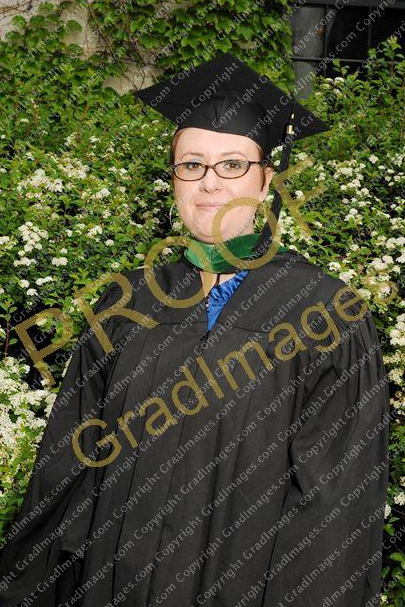
grad_imageSaturday, May 5, I graduated with my second bachelor’s degree, a Bachelor of Medical Science, from Dominican University. I walked in the graduation ceremony; I felt like that would make the whole two-year post-bac experience – and graduating – more “real,” if that makes sense. My parents and my boyfriend came to the ceremony, so that was nice.

Yes, you read that right … I have a boyfriend! We’ve been dating for about six weeks now, and things are going very well on that front. The whole online dating thing really DOES work!

But back to school. I finished out my program with a 3.95 cumulative GPA, for which I am quite proud. Not quite the 4.0 I was hoping for, but not too shabby. I wound up with an A- in both Biochemistry and Organic Chemistry II, definitely the two hardest classes I’ve taken in my program. And quite difficult by reputation, as well. Given that I got divorced in March, and that my grandma became very ill in April, I am satisfied with my performance. Along with my 3.94 GPA from my initial Journalism undergrad at UIUC, I’m at the top of the hill, for the most part, in terms of grades. Which is good, considering how competitive MD/PhD programs are.

I apply to medical school next month, which is a trial in itself. The application process is incredibly arduous, in terms of entering all your coursework and grades, biographical information, arranging for transcripts, getting your letter of recommendation writers to submit their letters on time, polishing your essays and extracurricular activities blurbs … it’s like a full-time job. And given everything else that’s on my plate right now, I’m a little stressed about it. Because in addition to the application, I’m taking the MCAT on June 21, and need to continue to prep for that.

Also, I’m moving. Which is always fun, right?! I’m moving in with my mom, which I mentioned in a previous post as a possibility. And it’s come to fruition. It’s not ideal; obviously I’d rather keep my own place. But I simply can’t afford it, given the expense of applying to medical school (several thousand dollars, literally), future interview expenses (hopefully!), etc.

Not to mention that I currently don’t have any income, since all I keep getting from my job application efforts are rejections, and my school loan money has almost run out. Thankfully, I do have a tentative part-time job opportunity at the UIC lab where I worked that last two summers. I met with the PI there a couple of weeks ago, and when I asked him for suggestions on where to apply for lab jobs, he said he would be willing to hire me part time, assuming he could scrape together the money. He is talking with the grants administration people, and hopefully getting back to me soon on that. What’s nice about working there, with a boss who would be completely supportive of my goals, is that it would be no problem for me to take a few days off for med school interviews now and again. That was one of the things I was really worried about in finding a job, given that most places don’t give you any vacation time until after you’ve worked there for some months, maybe even a year. And I couldn’t exactly keep calling in sick … I’d eventually get fired, definitely. So this is a best case scenario, in terms of logistics.

In summary, MCAT, moving, and job hunt … all of these things are definitely keeping me on my toes. Thankfully, we journalists are trained to deal with high-stress situations, so I’m handling things pretty well, and staying on task.

Well, I better get back to it. I move on Monday (Memorial Day … a day to remember for sure!), and I haven’t packed a single thing. At least I’ve bought the boxes. Although they’re still in my car. I better change that, and soon.

Wish me luck!

One Word Turn-Offs

I realized today, as I flipped through profiles on the online dating site where I am a  member, that I cannot date someone who is unable to spell everyday words correctly. Here is why.

I completely believe in putting your best foot forward. For example, if you have a job (or medical school) interview, you wear an appropriate suit. Not flip-flops, not Bermuda shorts, not a T-shirt. In the online dating world, this means writing a good profile. And by “good” I don’t mean Pulitzer Prize-winning writing. I mean something honest, sincere, maybe with a little humor, if that fits your style. But it also means, in my book, spelling things right. If you don’t, that suggests one of three things to me:

  1. You are lazy
  2. You are unprofessional
  3. You are uneducated

Or at the worst, perhaps all three. And pardon me if I don’t want to be with a guy who is uneducated, unprofessional, and lazy. My standards are a little higher than that at this point in my life.

As I said, I’m not looking for amazing writing. This has nothing to do whatsoever with content (I won’t get into that). But sloppiness, when it comes to language, makes me cringe. Fine examples that I found today (and just today!) include:

  • One guy spelled “Chicago” wrong. No, I’m not kidding. I wish I were.
  • When he meant to talk about his “role” model, another guy used the word “roll.” I realize that homophones (words that have the same pronunciation, but different meanings) can be confusing. But “role model” is a pretty commonly used phrase.
  • One profile question asks what you are looking for in a partner. One guy mentioned that he wanted somone funny and “quick whited.” I’m pretty sure he wasn’t talking about bleached blond hair here … or was he?

I know this doesn’t bother everyone, but words, as well as how people use (or abuse) them, matter to me. And I’m looking for someone who understands that, at least on a basic level.

My First Research Symposium

One thing I have learned about “being” in science is that it involves poster presentations. Some people like them, some people hate them, but they are a part of the job. I saw my mentor and supervisor at UIC, Olga, make several posters (to present at various conferences) while I was working there. And for the Drosophila genetics conference, Dr. Kreher made one as well (which I wrote about earlier, and which included me as a secondary author!).

Today, I will present my first and very own poster at Dominican University’s “Undergraduate Research, Scholarship, and Creative Investigations Expo” (“URSCI” for short). This is an annual event at Dominican, where students from across different disciplines present their research work through both presentations and posters. For the poster portion, which is what I am doing, you have a designated time that you are supposed to stand by your poster and explain it / answer questions about it to anyone who is interested. While this might make some people nervous, I am really excited about the opportunity. I love talking about science (obviously), and I am also adept at explaining it in more basic language for people who might not be familiar with the concepts or procedures. That is one thing I learned well in journalism – you have to know your audience. So I know how to tailor my explanation, based on the people with whom I am talking.

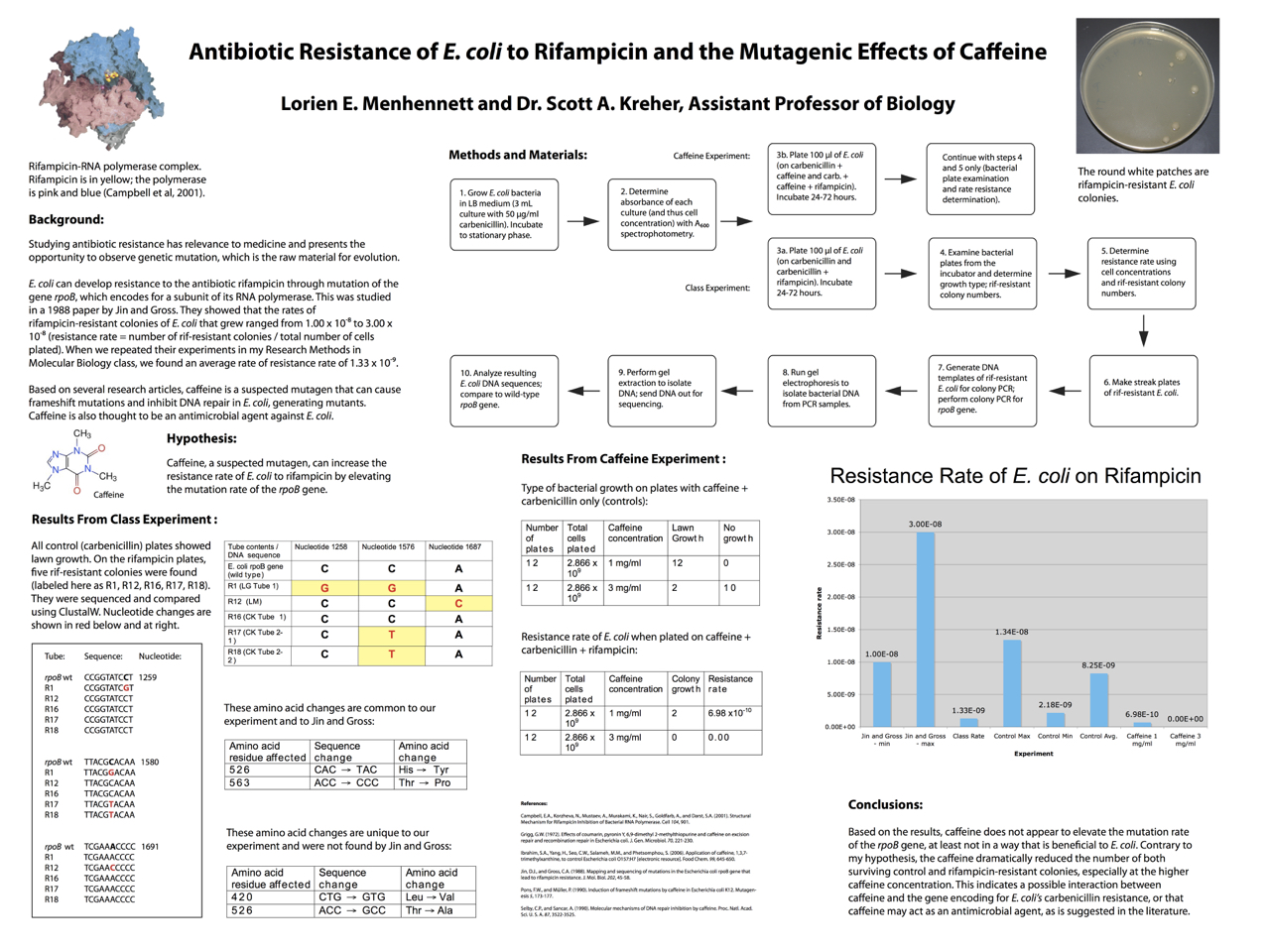
The title of my poster is “Antibiotic Resistance of E. coli to Rifampicin and the Mutagenic Effects of Caffeine.” The work stems from a project I did in my Research Methods in Molecular Biology class, which I took last spring with Dr. Kreher. (I am currently working in his genetics lab with the fruit fly larvae.)

Ecoli_Caffeine_LEM

It was a fascinating project, and it had two components. As a class, we reproduced the experiments done in the late 1980s by two researches, Jin and Gross. They investigated how E. coli develop antibiotic resistance to a drug called rifampicin, which is used for tuberculosis. Based on their research, and previous work, they determined that rifampicin inhibits the bacteria’s RNA polymerase (which is what transcribes mRNA, which is later used to synthesize proteins). That’s bad for the bacteria, because without the necessary cellular proteins, the bacteria will die. But Jin and Gross also discovered that the bacteria can develop, at a particular rate, specific mutations in the gene (rpoB) encoding for a particular subunit of its RNA polymerase. These mutations allow the bacteria to survive treatment with rifampicin.

We repeated Jin and Gross’s experiments, growing E. coli on agar plates containing rifampicin (as well as another antibiotic, carbenicillin, to which our bacteria had been engineered with a resistance gene, so that only the bacteria we were studying would grow – no random bacteria from the environement would grow, because the carbenicillin would kill it). We were able to generate resistant bacterial colonies as well, and sequenced their DNA. In comparing the sequenced DNA to the wild-type rpoB (RNA polymerase) gene, we found some of the same nucleotide mutations as Jin and Gross, as well as a couple of mutations that were unique to our experiments.

The second part of the project was to choose a substance – any substance within reason, that could be procured at a store or from a chemical supply company – and see how that affected the mutation rate. Each student (there were eight of us in the class) had to choose something different. I chose to work with caffeine, which is a suspected mutagen, based on some scientific literature that I found. So my hypothesis was that treating the bacteria with caffeine would increase the rate of mutation, and hence the rate of antibiotic resistance. I tested two concentrations of caffeine, 1 mg/mL and 3 mg/mL. What I found was very interesting – not only did the caffeine fail to increase the mutation rate, it actually (especially at the higher concentration) killed much of the E. coli! So I did some more literature research, and found that caffeine has been shown to also have an antimicrobial effect on E. coli. Who would’ve thought?!

I absolutely love science. You don’t always get what you expect, in terms of results (I certainly didn’t), but you usually learn something. And that’s the point: discovery.