doc w/ Pen

journalist + medical student + artist

Birth and Death

Home page of Now I Lay Me Down To Sleep, an organization that provides portraits to families whose babies are stillborn.

I’m in Florida for a few days. This morning, I went swimming with manatees. I might write more about that later. But now, about someone I met on the boat out into the bay. I sat next to a woman from Tennessee. As the only two single people on our boat trip, we temporarily paired up. We chatted. “What do you do?” I asked. “I’m a wedding photographer,” she said. “And a nurse.” Not your usual job combination, so I gently probed. She told me she did nursing no one else wanted to do. I tried to imagine what that could be. Trauma? No, there is the rush of adrenaline. Same with ER. Oncology, maybe? Hospice? Even with the grief in those fields, I know nurses who find them rewarding.

Not even close. This nurse really does do something unimaginable — she assists with the birth of stillborn babies. Then she puts her photographer’s hat on, and takes portraits for each family to remember the baby by.

The organization she works for is called Now I Lay Me Down To Sleep, after the children’s lullaby. The organization’s founder lost her own baby shortly after birth. In a blog entry of hers that I read, she wrote about the different nurses she met in the NICU while she was with her baby — the ones who were respectful, helpful, and kind, and the one who was cold and rude. I could feel the pain in her words, even though her own child died years ago.

Death is part of life. Especially in medicine. So the people in medicine — doctors, nurses, other health care workers — leave an emotional legacy to those who remain. That responsibility, and privilege, should not be taken lightly.

Tonsillectomy Tales

One surgery, 2 ambulance rides, 2 hospitals, 7 nurses, 8 ENTs (2 attendings and 6 residents), 40 hours in the hospital, and countless scoops of ice cream later, I’m feeling much better. But it’s been a nightmare. If you still have your tonsils, keep them if you can. For an adult, a tonsillectomy is serious business.

Losing mine was inevitable. Since having mono in March (read that story here), my tonsils remained very enlarged, to the point where swallowing was annoying. Add to that recurrent throat infections, and they were seriously interfering with my quality of life. So my ENT agreed that removing them was the way to go.

The surgery was brief, the procedure itself apparently lasting only about 15 minutes. Cut, cut, cauterize. No sutures, just a torched throat. I actually felt OK that night. Third day post-op was the worst. Swallowing ground glass would have felt better than every gulp I took. The thing about a tonsillectomy, unlike most surgeries, is that you can’t rest the affected area.

In the midst of the pain, I developed a bad cold. So along with pain medication, I was taking an antihistamine, a decongestant, and cough medicine. To prevent bleeding after the surgery, you’re supposed to avoid coughing or clearing your throat after the surgery. Needless to say, I was a total zombie. Right before I had my surgery, the ENT resident said to me, “I hope you have a lot of good books to read and movies to watch.” Yeah, right. I was lucky if I got out of bed.

Slowly, things started to improve. Minutely, but noticeably. Then nine days post-op, 7 p.m. to be precise, I started coughing up blood. First phlegm with blood, then just … blood. I’m not normally one to panic, but blood isn’t supposed to come out of your mouth in quarter-cupfuls at a time. Naturally, I called my dad, who lives not far away. Dads—especially dads who are doctors—can make everything right. Right?

“I’m coughing up blood,” I told him. “Can you take me to the ER?”

“If you are coughing up that much blood, you need to call 911,” he said. “They can get you there a lot faster than I can.”

So, somewhat reluctantly, I dialed 911. Put my shoes on, got my purse and phone—somehow I thought to bring my phone charger too—and went outside to wait for the ambulance. It came, flashing lights, sirens, handsome paramedics and all. I stepped up into the ambulance (no stretcher? what about the stretcher?) and off we went to the community hospital. In better times, I could walk there in 15 minutes. Clearly, these were not better times.

The benefit to arriving at the ER in an ambulance, I suppose, is that you jump the queue. Immediately to a curtained-off gurney I went. Vitals taken, throat examed, IV fluids started. My dad arrived soon after to keep me company. He had left a message for my mom; I’m living with her, and she had just left for a church function before I started coughing up the blood. She called back while we were sitting there.

“Yeah, I’m here with Lorien,” my dad told my mom nonchalantly. “She’s covered in blood head to toe. There are these cool blood bubbles coming out of her mouth and nose.”

Laughing after a tonsillectomy is really painful, so I was trying not to—he was totally egging my mom on, as he has done since I can remember. I later found out that she believed him. I guess I can understand why—when she left I was fine, then she gets a voicemail that I’m in an ambulance and on my way to the hospital. She’s my mom. She gave birth to me. Of course she was traumatized.

“I was very fragile!” she told me later.

The ER doctor looked at my throat. She didn’t see any blood or evidence of bleeding. In fact, the bleeding had mostly stopped at that point. She called the on-call ENT doctor at the main hospital in the Chicago. They wanted to see me—at the Chicago hospital. Hence ambulance ride #2. No flashing lights or sirens this time, although I did get a stretcher. About time.

Déjà vu. This was exactly what happened when I got mono. Went to community hospital ER. ENT docs in Chicago wanted to see me. Ambulance ride to main hospital. I didn’t complain, though. Who knew if the bleeding would start again. I certainly wasn’t taking any chances.

Once in the Chicago ER, more IV fluids, more vitals, more doctors and nurses asking questions—not fun, since talking after a tonsillectomy is painful. Once the flurry calmed down, I looked around the room. The wall clock said 2:05. I did a double take. I knew it was closer to 10 p.m. Then I realized I was in the same room as when I had mono. The same broken clock, still broken. Déjà vu indeed.

Observation for 24 hours, and NPO (no food or drink) for the time being. That was the ENT verdict. So I tried to get comfortable. Not easy when you’re hooked up to an IV, a pulse oximeter, and a monitor. Not to mention that with all the IV fluids I was getting, I had to go to the bathroom every hour. At least, that’s how it seemed. But since I was so tied up, I had to call my nurse to unhook me from everything, and then hook me back up. For a person as self-sufficient as I am, being that helpless and needy was very hard to accept. I had no choice.

Since I couldn’t take pills, they gave me morphine via IV. I got four milligrams every four hours, which my hospice mom tells me is a low dose. Even so, it was … interesting. Almost instantly, my whole body felt heavy, invisibly weighed down. The morphine did a little, though not much, for my pain. At least it helped me sleep.

As this was a dedicated observation room, not a regular ER room, it had a normal hospital bed as opposed to a gurney. So I was much more comfortable. It also had a TV, although the first thing I did when the paramedics brought me in was to turn it off. I didn’t want to watch the news, the weather, sitcom reruns, or bad talk shows. I wanted to sleep. As I said, the morphine helped, some. But I quickly realized—or remembered, from last time—that the hospital is no place for resting. It is, in fact, the worst place for a sick person to be. Electronic monitors chirping constantly, people talking, walking by my room. At least I had a sliding glass door, which they allowed me to keep shut, and a curtain. That helped. The worst was the number of people who kept wandering in: doctors, nurses, social workers, volunteers. All had what I’m sure they considered to be important questions. But many of them seemed irrelevant to me at the time.

“Do you have stairs at your home?” was the worst question I got.

Say what? I had a tonsillectomy, not a hip or knee replacement. There’s nothing wrong with my legs. What does it matter that I live on the second floor? I understand that they ask everyone the same questions. But it was overwhelming, especially since my throat hurt so much.

My own ENT—the one who operated on me a week and a half prior—came to see me the next afternoon. Apparently, bleeding around day nine is not uncommon, he said. The scabs on the throat are starting to fall off, and sometimes healthy tissue is torn off too. My throat looked OK, he added. But since my pain was still uncontrolled, he suggested staying another night. I remained skittish, so I agreed. I would get a regular room on the floor soon.

My mom came to visit me that afternoon after my ENT left. It was a nice diversion, after trying somewhat unsuccessfully to sleep all day. At that point, I was on clear liquids (exciting!) so I feasted on green jello and apple juice. Considering how hungry I was, it actually wasn’t bad.

After she left, they took me to a regular room. More nurses, but no doctors this time, more questions. I discovered that they monitored different things on the floor than in the ER. My urine output, for one—what goes in must come out. They checked me for skin breakdown, and I had to wear inflating sleeves on my lower legs to prevent deep vein thrombosis (blood clots in my legs). My wonderful nurse apologized for the hassle.

“This is really for older people,” she said. “But we have to do it for everyone.”

Another night of morphine, in-and-out sleeping, hooking and unhooking to go to the bathroom. The next morning, I was more than ready to leave, regardless of my pain. Around 10 a.m., I unceremoniously took a cab home. And then I took a long nap.

I spent the weekend recovering from my hospital stay. I’m back to work, starting with half days for this week. I’m better, especially on the pain front, but I still don’t feel myself.

Like I said. If you still have your tonsils, do yourself a favor and keep them.


Author’s note: Those 40 hours were awful. But I want to thank everyone who cared for me at the two hospitals where I stayed: the doctors, nurses, and other staff. Especially the nurses. Without their help, those 40 hours would have been much, much worse.

Rising Death Toll

My car ride home yesterday was quiet. Normally NPR is on, but the moment I heard the word “Gaza” I switched it off. I have heard too much about the rising death toll there—around 600 yesterday morning, if memory serves.

Rising death toll: I can’t count how many times I have heard iterations of that phrase since the current conflict in Gaza started. Or during others—Syria, Egypt, Iraq—the list goes on. It is a cold euphemism for loose limbs strewn about the street. A cold euphemism that protects us from other people’s reality: life among the grim reaper. A cold euphemism that allows us to hear the news, frown, throw up our hands, and move on with our day. I am as guilty of this as anyone.

How is this OK?

Yesterday morning, I heard that a hospital was hit. People died. There were supposedly military supplies nearby. And? This is justification? As a future physician, I am tasked with looking out for society’s most vulnerable—especially people who are sick or wounded, like those in that hospital, and those without physical protection or resources. The very people lumped into this rising death toll. This is unacceptable, in the worst possible way.

Don’t construe this as me siding with a political group. I don’t know who is right. No, I take that back—neither side is right; both are very wrong. Because their dual inability to keep even a temporary ceasefire is pushing that death toll ever higher. No, I’m not siding with politics. I’m siding with people. People who didn’t sign up for this. Who just want to eat and drink in peace. Say their prayers in peace. Work and play in peace. Live in peace. Instead, they are dead.

There seems no good way to conclude these thoughts except to say: I don’t know what to do about this. I don’t even know what to do with this information anymore.

And today, again, the death toll rises.

MCAT2015: Here’s the Scoop

The MCAT is my friend.

That was my mantra for three months, the amount of time I spent studying for this infamous medical school entrance exam. While content is clearly important, so is the mental component of this test. It wasn’t until I conquered my major fears and anxieties that my scores really soared, from upper 20s to mid 30s. (To answer the unspoken question, I got a nicely balanced 33: 10PS/12BS/11VR.)

With the new MCAT2015 approaching, I get the sense that this mental component continues to be key. People I have talked to seem more afraid than ever of the MCAT. While a healthy respect for this exam is important, fear will get you nowhere. It only makes things worse, actually. While I certainly never plan on taking the MCAT again (whew!), I am learning what I can about new exam to help those of you who are where I was a year or two ago—trying to make it into medical school. The purpose of this post, then, is to demystify the MCAT2015 using information from official sources (everything here comes straight from the AAMC) and to point you toward trustworthy resources to help you prepare.

Why change?

The current MCAT exam (last test administration date: January 23, 2015) has been around, in more or less the same form, since 1991. A lot has changed since then, say people at the Association of American Medical Colleges (AAMC)—in science, medicine, and in standardized testing. So the AAMC put together a committee in late 2008, called MR5. This committee gathered survey information from more than 2,700 medical school and university faculty, medical students, and residents, as well as compiling data from outreach events and other panels. The result was a set of recommendations that became the MCAT2015. The new test will be divided into four sections. Click on the title of the section to access the AAMC’s description of what the section will cover.

  1. Biological & Biochemical Foundations of Living Systems
  2. Chemical & Physical Foundations of Biological Systems
  3. Psychological, Social, & Biological Foundations of Behavior
  4. Critical Analysis & Reasoning Skills

Rather than focus on requiring specific courses, the new exam aims to focus on competencies. These competencies include topics in the biological and physical sciences of course, but extend to the social sciences as well—and this is new MCAT content. Each of these competencies aligns with what the AAMC calls a “Building Block” for learning in medical school. In other words, there is supposed to be a direct link between what you learn as you prepare for the MCAT and what you will learn in medical school.

In addition to these 10 foundational concepts (aka competencies), AAMC expects students to have mastered some specific Scientific & Inquiry Reasoning Skills. These include (1) knowledge of scientific principles, (2) scientific reasoning and problem solving, (3) reasoning about the design and execution of research, (4) data-based and statistical reasoning, and (5) general mathematical concepts and techniques.

What’s the big deal?

The big deal, for one, is that this exam will cover more content. In addition to the concepts usually taught in general chemistry, general biology, physics, and organic chemistry, content from the first semester of introductory biochemistry, psychology, and sociology is tested.

The MCAT2015, clocking in at 7 hours and 30 minutes of seat time, is a marathon exam. It’s 2 hours longer than the old MCAT, in fact. That requires dedication to prepare for, both mentally and physically (you think I’m joking—I’m not).

In addition to content and length changes, there are also changes in administration. While AAMC says there will be the same number of seats available for the MCAT2015, they will be spread across fewer dates (14 testing dates to be exact), with most test administrations on Saturday or Sunday. All tests now start at 8 a.m., and there are no more double-day administrations. (There used to be administrations in both the morning and the afternoon on the same day—no more with MCAT2015.) Click here for MCAT2015 test dates.

How is MCAT2015 scored?

According to the AAMC, MCAT2015 score reports will be more comprehensive and useful. Along with a total score (ranging from 472 to 528), there will be four section scores and several interpretation tools. These include:

  • Percentile rank for each score (applicable to THAT year’s test only)
  • Confidence band for each score (reliability and accuracy of the score)
  • Score profile (to highlight strengths and weaknesses of the test taker)

This new scoring system, says Scott Oppler, PhD, director of MCAT Development and Psychometrics, is “designed to draw attention to applicants who might otherwise be overlooked.” It does this, he explains, by highlighting the middle of scoring pack rather than the top third. (I’m still not quite clear on how this works, but I’m not a standardized test designer, or an ADCOM.)

In the beginning, percentile ranks will be based on a small number of test administrations (simply because there is no other data). This, and all the new analysis being done, will slightly delay scores for people who take the test first in April/May. Although AAMC is offering an incentive to those people: a $150 Amazon gift card.

Where are those resources?!

Right here:

  • MCAT2015 Offical AAMC site for the new MCAT
  • Which exam? A site dedicated to help students decide between the old and new MCAT tests (for those who have the option to take either exam)
  • What’s on the MCAT2015 Exam? An interactive site put together by the AAMC that lists the competencies, links to the content you should know, has videos and practice questions, lots of good stuff
  • Khan Academy partnership AAMC teamed up with the great people at Khan Academy (yes, that’s an endorsement) to create content to help students prepare for the new exam; there are free videos and tutorials, as well as practice questions
  • Resources for Administrators This site is geared toward administratos (like pre-health advisors), but it’s publicly accessible content, and you may find it helpful
  • MCAT2015@aamc.org: the e-mail address for questions related to the new MCAT exam

In addition, AAMC says a full-length practice test will be available this fall, MCAT2015 Study Sets (question compilations) available early 2015, and the Official MCAT2015 Practice Test #1 available fall 2015.

Given that no one has even taken the exam yet, it’s far too early to make any sort of judgment about it. The fact is, it’s coming. And AAMC’s goal is for it to last for 15 years. The best thing to do is prepare yourself as best you can. And as always, remember: Take a breath.

Priced out of a Medical School Education

Above is a screenshot from HOMEROOM: The Official Blog of the U.S. Department of Education. Click on the screenshot to read the post in its entirety (the article will open in a new browser window). This article was also cross-posted on the White House Blog.

Higher education should be affordable for everyone who wants it badly enough. Who has worked for it. That’s the message I get from President Barack Obama’s words – and deeds – of the last several months. Years, even.

But guess what, President Obama? This year, I was priced out of a higher education. At Weill Cornell Medical College, an Ivy League medical school, no less. Why? Because I can’t get a federal Grad PLUS loan. I find this unacceptable. I think you should, too.

When the U.S economy fell to its quivering knees in 2008, my credit fell along with it. Why? I was laid off. So was my husband. Bills piled up. We lost our home to foreclosure. We got divorced. I got sick. More bills piled up. Bills I couldn’t pay because I couldn’t find a job.

Somewhere in the chaos, this former journalist found another passion and purpose: medicine. After completing my medical school pre-requisites, I took the MCAT and applied to medical school. I was accepted – not once, not twice, but three times. Finally, I decided on Cornell.

But even Cornell, a private institution with an enormous endowment, couldn’t offer me enough financial aid. I still need a credit-based PLUS loan. And with my credit history, the U.S. Department of Education says “no-go.” Federal Student Aid refuses to even process my appeal, having returned my substantial documentation to me – clearly unread – in 24 minutes. (Yes, that’s a denial-to-process in 24 minutes, not hours.) That documentation was evidence of my extenuating circumstances, which the Department of Education says it will consider in an appeal. But apparently, the Department of Education takes a very narrow view of what “extenuating circumstances” means. The worst economic crisis since the Great Depression? Nah, that doesn’t count. Try again. Only this time, with a co-signer. Except, both my parents are nearing retirement age. Both co-signed on loans for earlier college coursework. So taking on more debt, for them, is highly inadvisable.

I have been granted a one-year deferral from Cornell to resolve my loan situation. But I seem to have exhausted most of my options. So I am making noise. Banging what pots and pans I have left, trying to get someone to hear my plight and help my cause.

Previous to today, my efforts included contacting:

  • The U.S. Senate Committee on Health, Education, Labor, & Pensions (all 22 senators)
  • The U.S. House of Representatives Subcommittee on Higher Education & Workforce Training (all 21 representatives)
  • Elected officials from my home state of Illinois

To date, I have heard back from 3 politicians:

  • U.S. Senator Mark Kirk (R-IL), whose office is in the process of working with the U.S. Department of Education my behalf
  • U.S. Senator Lamar Alexander (R-TN), whose field representative told me that my issue is an important piece of the student loan puzzle
  • U.S. Congressman Lou Barletta (R-PA, 11th District), whose office staff told me that unfortunately he cannot help me because I am out of the Congressman’s district

Today, I sent 64 more e-mails. Recipients included:

  • The White House
  • Multiple contacts at the U.S. Department of Education
  • The American Medical Association (all 16 people on the Board of Trustees, 2 staff members from the Section on Medical Schools, and 6 staff members from the Medical Education Group)
  • The Association of American Medical Colleges (the Chief Academic Officer and 5 staff members from the FIRST for Medical Education group)
  • Reporters and blog writers (from more than a dozen different media outlets) who cover higher education or health/medicine

I was certainly not the only one who lost a job and a house and a marriage during the economic collapse. I  know I am not the only one dealing with this student loan denial, either.

Please, help me spread the word. Because I completely agree with President Obama – “no hardworking young person should be priced out of a higher education.”

Together, let’s make sure that happens.

Weill Cornell Medical College, Class of 2019!

It’s been a busy 12 months, a veritable medical school roller coaster:

  • Applications: 25
  • Interviews: 6
  • Acceptances: 3

But as of last week, it’s finally official. I will be attending Weill Cornell Medical College, class of 2019.

Initially, I received acceptances to University of Illinois at Chicago and University of Colorado School of Medicine, and a wait list offer at Cornell. Initially, I accepted at University of Colorado. On July 3, I got the long-awaited e-mail from Cornell. Did I want to come after all? I didn’t have to think twice. Cornell it is.

The roller coaster ride continues, however. Class of 2019 – that’s 5 years away, if you do the math. Wait, you might be asking – isn’t medical school 4 years long? Yes. Due to my financial circumstances, I am deferring for one year, hoping to matriculate next August (2015). In the meantime, I am trying to resolve my student loan situation. That is, trying to GET a student loan.

More about that soon …

More FIFA Soccer, Less of its Official Sponsor

Lionel Messi

Unlike an estimated 3 billion people worldwide, I’m a lukewarm soccer fan, at best. Nothing against the sport, I just never got into it. (Though I have to admit, watching Lionel Messi’s goal against Bosnia on Father’s Day – with my dad, of course – was pretty incredible. I could see soccer growing on me.)

But that’s besides the point. What interests me about the World Cup at this moment, and about other worldwide sporting events like the Olympics, is event sponsorship. Not as a marketer, mind you, but as a viewer, consumer, citizen, and future physician. I get that only heavy business hitters like McDonald’s can afford the $20 million it costs to be the World Cup’s sponsor and official restaurant. (The 2014 Sochi Olympics, by the way, marked the tenth consecutive games with the Golden Arches as official restaurant.) I also get that these sporting events cost money to run. I get that sponsorships help make them happen. What I simply cannot understand is why it’s acceptable to link fast food with fitness activities.

Take one look at any of these chiseled players (Ronaldo? Fabiano? Casillas?), and you and I both know that they don’t eat at Mickey D’s on a regular basis. But you and I are adults. I’m less concerned about adult viewers. They are adults, after all, and should be able to make their own decisions when it comes to food. As in, whether to eat quality or crap. To be completely honest, I don’t always make good food choices. I’ve even been known to eat at McDonald’s (please don’t tell my internist). But it’s always a conscious choice. My choice.

What bothers me is the insidious message that junk food sports sponsorship sends to children – children who are impressionable, both physically and psychologically. For kids around the world, soccer is religion, the players their idols. When kids start associating crispy chicken with corner kicks, or French Fries with their favorite midfielder, there’s a serious problem. It’s not just soccer, either. It’s football (American football), baseball, and hockey. The list goes on. I’m not saying this is the cause of our country’s childhood obesity epidemic – that would be dangerously simplistic. But it certainly doesn’t help the situation.

Obesity is no joke. And being healthy is not just about looking nice in a bikini. Both of these messages seem lost on a great many people, adults and children alike. I’m not suggesting anyone boycott McDonald’s (or the World Cup). What I am saying is let’s be real about this. Discuss it. Because none of it – not the obesity, and not the junk food sponsorship – is going away on its own.


The Centers for Disease Control and Prevention (CDC) on childhood obesity:

Statistics

  • Childhood obesity has more than doubled in children and quadrupled in adolescents in the past 30 years.
  • The percentage of children aged 6–11 years in the United States who were obese increased from 7% in 1980 to nearly 18% in 2012. Similarly, the percentage of adolescents aged 12–19 years who were obese increased from 5% to nearly 21% over the same period.

Health effects

  • Children who are obese are more likely to have problems with sleep apnea, bones, and joints, as well as self-image. They are also at higher risk for prediabetes.
  • Childhood obesity increases the risk for being obese as an adult.
  • Adult obesity is associated with higher risk of cardiovascular disease, diabetes, stroke, cancer, and arthritis.

The Difference a Day Can Make

One of my mom’s patient’s died during the night. Given that she works in hospice, this is neither out of the ordinary nor surprising. Death is a daily part of life for her. What makes this particular situation heart breaking is that the patient’s son and granddaughters – whom she hadn’t seen in years – were traveling from across the country to visit today. One day too late.

I don’t know the family situation, and it’s not my business to. What I do know is that I feel sadness for the patient who died without seeing her son and granddaughters again, and for the family, for missing her by only a day. But this day spelled the difference between life and death.

At the same time, this situation serves as a reminder, to care for and nurture the relationships that matter. Like it or not, that day comes for everyone. For you, for me, for the people we love. I don’t want it to make such a difference.

For the Record …

Patient: What was my blood pressure at my last visit?

Doctor: That’s part of your medical record. I’d rather not say.

Sounds absurd, right? It is. And I’m guessing not many doctors have had that attitude. But prior to Congress passing the Health Insurance Portability and Accountability Act (HIPAA) in 1996, there was no federal law requiring health care practitioners to give you access to your own medical records or information. (Some states did have a law to that effect, though.) Now that access is guaranteed – even if you haven’t paid your bill – although practitioners are allowed to charge a “reasonable” amount for providing the information.

As more and more practitioners and facilities transition to electronic health records, some are piloting a new type of on-demand access: electronic patient portals. While they differ some in format or the extent of information available, the idea is that the portal is a secure, online repository of your medical information, from physician notes, to medication lists, to lab or test results, to upcoming visit schedules, and so on. These portals are often also interactive, allowing patients to schedule appointments, message their practitioners, and request medication refills.

Rush University Medical Center, which my internist is affiliated with, offers “MyChart,” its own patient portal system. There never seemed to be much reason to view it, though. After my recent run-in with the medical establishment, I decided to check it out, more for curiosity than anything.

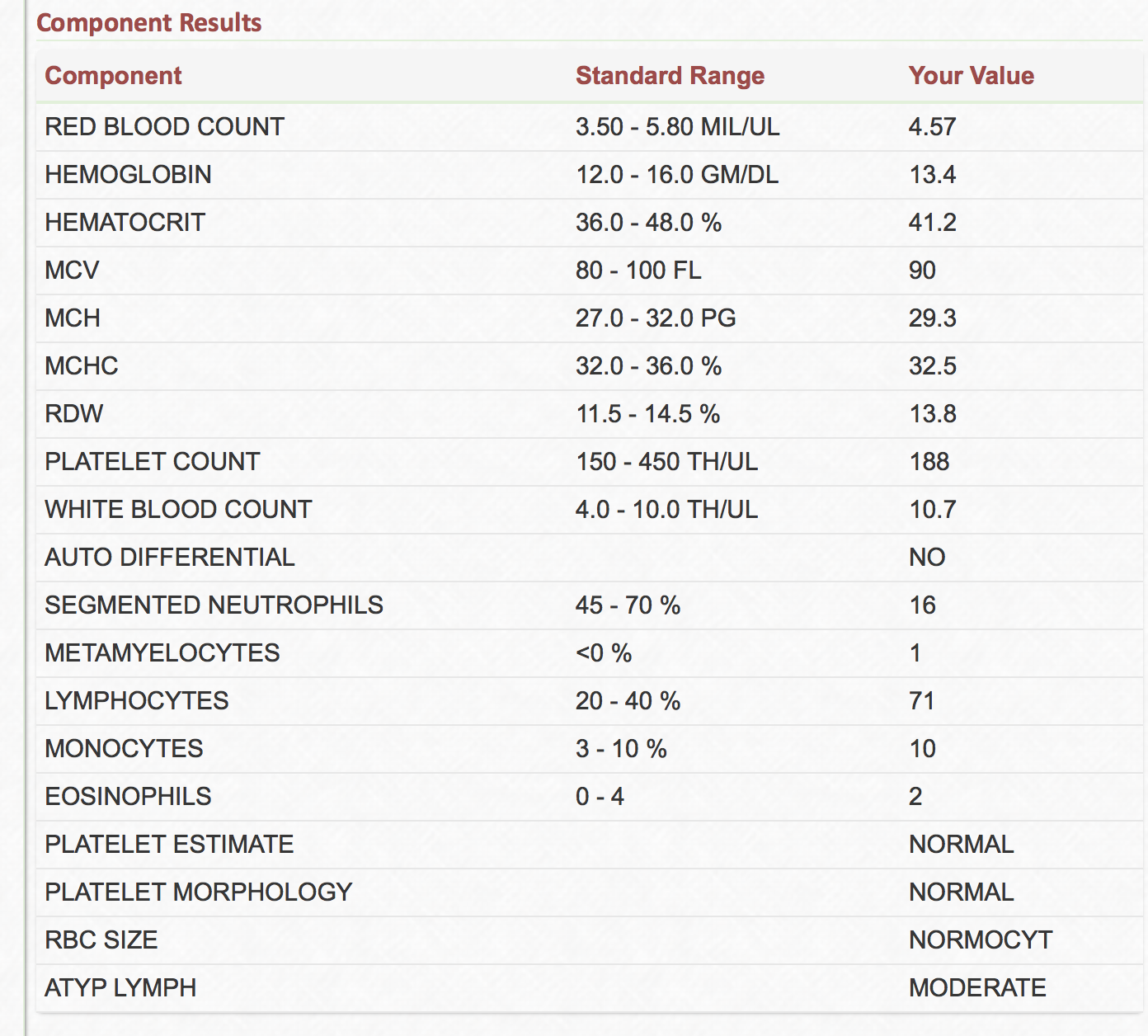
Through the MyChart patient portal, I have access to a wealth of medical information, including these lab values.

It’s really pretty cool (at least for a curious pre-medical student such as myself; its efficacy for the general public is still a matter of debate; more on that later). For example, I was able to view all my labs from when I was in the ER, everything from my mono test (positive) to my strep culture (negative) to all of my CBC values. Upon opening up the CBC link, for example, two columns appear – both the standard ranges and my values.

OK, I’m no doctor (yet). So when I see values outside the normal range, or narrative values that make no sense to me, I have the tendency to become curious (at the least). For example, what the heck does “ATYP LYMPH / MODERATE” (at the very bottom of the screenshot) mean? Enter my good friend Google: this signifies that my immune system is actively fighting an infection. One Web site I found even specifically referenced infectious mononucleosis, explaining that mono produces a lymphocyte morphology with a dented cytoplasm, in addition to some other specific characteristics. So. I’ve got dented lymphocytes. Who knew?

So far, my use of MyChart has really been more for curiosity’s sake than anything, though. The true purpose of an electronic patient portal is to better patient outcomes, increase transparency in health care, improve coordination and continuity of care, enhance practitioner-patient communication, and foster a sense of ownership regarding one’s care (among other things). The question is: do patient portals live up to these goals?

To answer this particular query, I turned to another dear online friend, PubMed.* While my search on the subject is by no means exhaustive (or particularly scientific), here is a theme I found repeated:

We don’t know yet.

In fancier, more scientific language:

Evidence is mixed about the effect of portals on patient outcomes and satisfaction, although they may be more effective when used with case management. The effect of portals on utilization and efficiency is unclear, although patient race and ethcnicity, education level or literacy, and degree of comorbid conditions may influence use.

[Source: “Electronic Patient Portals: Evidence on Health Outcomes, Satisfaction, Efficiency, and Attitudes,” Annals of Internal Medicine, 2013]

Like I said.

The reason we don’t yet know how beneficial patient portals are is that they are relatively new, which means studies on them lack the longitudinality, detail, and context necessary to make convincing conclusions. The review article quoted above mentioned that in the studies they looked at, patient attitudes regarding the portals are “generally positive.” On the other hand, it seemed that not all patients had equal access to or understanding of the information available: “… more widespread use may require efforts to overcome racial, ethnic, and literacy barriers.” In other words, it becomes a health literacy issue, one complicated by the involvement of technology.

The review article’s bottom line:

Portals represent a new technology with benefits that are still unclear. Better understanding requires studies that include details about context, implementation factors, and cost.

That said, there is anecdotal evidence that patient portals are a positive development. Another article in the Annals of Internal Medicine, from 2012, looked at a group of 105 primary care doctors who provided electronic links of their visit notes to some 13,564 patients across three different practice sites. The self-identified goal of the study was to “evaluate the effect on doctors and patients of giving patient access to notes over secure Internet portals.”

The overarching result of the study:

At the end of the experimental period, 99% of patients wanted open notes to continue and no doctor elected to stop.

[Source: “Inviting Patients to Read Their Doctors’ Notes: A Quasi-Experimental Study and a Look Ahead,” Annals of Internal Medicine, 2012]

More detailed statistical findings, summarized below, were quite interesting as well (statistical ranges are given to represent the differences between practice sites).

Of the 5,391 patients who opened at least 1 note and completed a postintervention survey:

  • 77% to 87% across the three sites reported that the open notes helped them feel more in control of their care
  • 60% to 78% of those taking medications reported increased medication adherence
  • 26% to 36% had privacy concerns
  • 1% to 8% reported that the notes caused confusion, worry, or offense
  • 20% to 42% reported sharing the notes with others

After the intervention, the physicians were surveyed as well:

  • 0% to 5% reported longer visits
  • 0% to 8% reported more time addressing patients’ questions outside of visits
  • 3% to 36% of doctors reported changing documentation content
  • 0% to 21% reported taking more time writing notes

This anecdotal study has both strengths and weaknesses. A strength, and something I appreciate as a future physician, is that the authors did survey the doctors as well – important because anytime you introduce something new like this, you need the doctors on board to make it work. Making conclusions from this study, though, is dicey. The authors acknowledge this upfront with a “Limitations” section at the top of the paper: Only three geographic areas were studied. Most patients were already experienced in using such portals. Both doctors and patients choosing to participate and complete the final survey “may tend to offer favorable feedback.” The end survey response rate was low (41%).

Still, the results are something to think about. If, somehow, we could develop strategies for overcoming the racial, ethnic, and literacy barriers (as cited by the first review article), then maybe we could see more of these positive results across the general population.

Or … maybe not. But if it might help people take ownership of their health, I think it’s worth a try.


* In case you’re not familir with PubMed, it is basically a ginormous collection of scientific and medical journal articles online, curated by the US National Library of Medicine and the National Institues of Health. Some of them are free; others are available for purchase on the specific journal’s Web site. Being a Northwestern University employee, though, I have access to most of the articles at no charge. Gotta love connections.

From Abscess, to Aspiration, to Ambulance: An ER Adventure

At least the IV stick didn’t leave a bruise on my arm.

That was one of my first thoughts upon waking up Monday morning of this week. Not a typical waking-up thought, but understandable given what I had experienced Saturday and Sunday. I’d had a health care adventure, all of it quite accidentally. The 18-gauge needle down my throat and ambulance ride (among other things) were never supposed to happen. But they did …

It all started around 4 p.m. Saturday afternoon with a trip to urgent care for something seemingly simple – a sore throat. I figured it for strep. Along with the pain, though, I had developed some difficulty swallowing, problems breathing at night, and a slightly muffled voice. The urgent care physician took one look at my bulging left tonsil and told me I needed to go to the ER immediately. “You don’t have strep,” he said. “You have a peritonsillar abscess.”

Peri-what?

Peritonsillar abscess: a bacterial infection of the head and neck that can progress into what is basically a collection of pus that forms next to the tonsil. Severe cases can lead to a muffled voice (check), difficulty swallowing (check), problems breathing (check), and eventually complete airway obstruction (yikes!). Hence the need to go to the ER.

So head to the ER I did, at Rush Oak Park Hospital, which is just blocks from my house. The nurse practitioner (NP) who saw me agreed with the urgent care doctor’s diagnosis, and said she would attempt to aspirate the abscess. In other words: poke a hole in it with a big needle and suck out some of the pus with a syringe.

Gulp.

She and the nurse took me back to the ear/nose/throat (ENT) room, sat me in what looked like a dental chair, and prepared their instruments. As the NP was unwrapping the syringe and needle, my eyes widened.

“What gauge needle is that?” I asked. “Is that a 16?” I would know, having seen the gamut of sizes during my mouse work in the research lab at Northwestern.

She smiled wanly. “An 18,” she said. “I didn’t want you to see it because I thought it would make you nervous.”

For those of you unfamiliar with needle gauges, the smaller the number, the bigger the needle. When it’s about to be shoved down your throat and into your tonsil, an 18 gauge looks like a silver coffee stirrer with a pointy end. Lovely.

Not wanting to decrease my gag reflex, the NP didn’t anesthetize my throat at all, just swabbed the spot where she was going to aspirate with a bit of betadine (a solution to prevent infection). As her hand, and the syringe, neared my mouth, I closed my eyes. And then … owwwwww. When I opened my eyes again, I looked at the syringe. Empty.

After the nurse had suctioned my mouth, I asked: “Did you get anything?”

“Just a few drops of blood,” the NP said. “I’m going to try again.”

Hooray.

The second time was just as painful, with no better results.

After more suctioning and rinsing my mouth with peroxide (“Don’t swallow this!” the nurse said), I asked what was next.

“On to Plan B,” the NP said.

“What’s that?” I was understandably nervous, given Plan A.

“I haven’t figured that out yet,” she replied.

So back to my corner in the ER, where I was given IV antibiotics, steroids, and some painkillers. Shortly after that, I got a head/neck CT scan to see whether the abscess had infiltrated other tissues. It had not, thankfully.

Eventually, the NP came back. “I talked to the ER doctor, and he said you need to be transferred to Rush downtown [an affiliated, and much bigger hospital] to see ENT,” she said. “We’re calling an ambulance.”

By now, it was about 10 p.m. I was exhausted and in pain. Not to mention hungry. I hadn’t eaten since lunch. My plan had been to eat dinner after my trip to urgent care, but that went out the window. At this point, though, because they didn’t know what ENT would want to do, which was a comforting thought, I was NPO (nil per os, Latin for nothing through the mouth, aka no food or fluids).

After what seemed like ages (more like an hour), the ambulance came. One thing about an ambulance ride is that you feel every single pothole in your bones. And there are a lot of them on I-290 heading toward Chicago.

Rush University Medical Center in the city, nearly brand new, is impressive. I had my own room (with lots of bells and whistles) and a real hospital bed (exciting after having been on something resembling a padded cot for several hours). My nurse quickly hooked me up to a monitor and gave me more antibiotics and pain meds. Oh yes, and drew more blood.

At this point it was after midnight Sunday, and I had been up since before 5 a.m. Saturday. But the ER is not exactly a good place to sleep, with alarms constantly going off, people chattering, and an IV sticking in my arm. Not to mention a painfully swollen throat. As I drifted in and out of semi-consciousness, various people came in and out of my room to check on me. My nurse. The ER doc (who took one look at my throat and said: “Yep, that’s a peritonsillar abscess”). A fourth year medical student (at 3 a.m.) who had never seen a peritonsillar abscess before. Yep. Glad to be of educational service.

I had been told ENT would come around 7 a.m. Which came and went. It was 8, then 9, then 10. Finally, two residents came. One of them did all the talking. He basically said there was good and bad news. The good news: “You don’t have a peritonsillar abscess.” The bad news: “You have mono.”

Seriously?

They gleaned this from the CT scan I’d had done at Rush Oak Park, my bloodwork, and then finally their physical exam.

After relaying their news, the residents left to confer with their attending. They all returned a bit later. The attending physician repeated the diagnosis and gave his treatment instructions. For at least a month: no alcohol, no strenuous exercise, at least 8 hours of sleep a night. And basically, no stress. Yeah, right.

“Just from meeting you, I can tell you’re the kind of person who needs to be told to take it easy,” the attending said. “If you don’t rest now, this will return with a vengeance, and you will be on your butt for two months.”

I certainly don’t want that. So I’m taking a week off work, at the doctor’s suggestion, sleeping a lot, and trying to avoid stress. Which is a challenge when you’re in the midst of medical school applications. But I’m doing my best.

While I wouldn’t exactly recommend this adventure to other doctors-to-be, it was very much a learning experience.

For one thing, nurses can make or break a hospital stay. I was fortunate enough to have three fantastic ones throughout this ordeal: Amelia, Carma, and Laura. All three were helpful, kind, compassionate, and responsive, both in big and little things. Doing an IV stick that didn’t leave a bruise. Bringing me a warm blanket. Ordering me breakfast even while I was still NPO, in anticipation of ENT allowing me to eat after their examination (which they did). I felt like a person, not merely a bar-coded patient.

Another thing that struck me was that everyone (up until ENT came) thought I had a peritonsillar abscess: multiple doctors, nurse practitioners, and nurses. This got me thinking about how easy it can be to misdiagnose something – how two different issues, in my case a peritonsillar abscess and mono, can have very similar symptoms and pathologies.

In other words: It takes everyone working together as a team to make the medical magic happen.

One of my first thoughts as I woke up Tuesday, thinking back on all that happened this past weekend:

At least I have fantastic insurance.