doc w/ Pen

journalist + medical student + artist

Category: Pre-Med

The immortality of memory
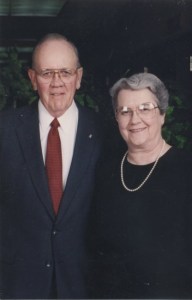
My grandpa, Alan E. Menhennett, who died recently. He is pictured here with my grandma, Harriet.

I started this blog with the intent of writing about my journey into the world of medicine. I want to write not only about my intellectual journey, but also my personal one. That means detailing the lessons I learn both as a student, and also as a ser humano – a human being. And no lesson hits closer to home than one you learn through your own family.

As some of you may know, my Grandpa died recently. Learning about death – so clearly a part of life, and especially part of the life of any doctor – is not pleasant. But we have no choice.

I do not pretend that I have figured out how to deal with the grief of losing someone who meant so much to me. What I do know is this: there is power in sharing our memories. I will paraphrase one of the ministers at my Grandpa’s service: “As long as we remember, [that person’s] life never ends.” Because we keep that person alive through our memories. (To those of you who know me well: YES, I actually agreed with a minister on something. Shocking, I know.)

Turns out I believe in immortality after all. Of a sort.

Along with a handful of relatives, I had the privilege of sharing one of my own memories of Grandpa at his memorial service. I will share that memory here:

Two things that Grandpa really impressed on me were the importance of giving, and the value of education. When each of us grandchildren was born, he and Grandma set up a fund for us. He wanted us to use the money to pay for our education. He was very firm on this. In fact, he basically said that the he would disown the first grandchild who used that money to buy a car. So, as the eldest grandchild, what did I do? I used that money to buy a car. And he must have loved me a lot, because he didn’t disown me.

Now, I did not do this to spite him – I bought the car after I graduated from college, and I had gotten a lot of scholarships and help from my parents to pay my tuition, so I didn’t need Grandpa’s money for school. What I did need was a car. And what his money allowed me to do was pay for my nice little Honda Civic – I named her Zippy, because I probably drive a little faster than I should – in full, in cash. No loan payments, no interest – something very fiscally responsible, which I think Grandpa would’ve approved of.

I still have that car, which I bought almost seven years ago, and it’s taken me a lot of places, from commuting to work to cross-country roadtrips. And starting this fall, I’ll be using my car to take me to and from school, since I’m returning to college pursue another degree. So in a way, I’m using the money to further my education after all. Which I know would make Grandpa proud. And Grandpa, when I get in that car, I will think of you. I love you and will miss you very much.

You can view my Grandpa’s online memorial and obituary by clicking here.

A new season begins

“Lorien, Congratulations in advance on your acceptance to Dominican University’s Post-Baccalaureate Pre-Medical program … ”

So began the e-mail I received Monday afternoon from Michael Morosovillo, Director of Transfer Admission at Dominican University. I skimmed the rest of the e-mail – something about submitting a $100 deposit, then contacting the program director, Dr. Louis Scannicchio, about enrolling for classes – and then reread the first sentence again. And again. And again.

I am really doing this. And with each step forward, each small victory, it becomes more real.

My news couldn’t have come at a more interesting time in the world of health care. Monday was the day in between the Sunday night passage of President Barack Obama’s landmark health care reform bill and his signing of it on Tuesday. His victory means that the medical profession I will enter will be – hopefully – a much changed one.

“Today, after almost a century of trying; today, after over a year of debate; today, after all the votes have been tallied, health insurance reform becomes law in the United States of America,” Obama said at the bill signing Tuesday (as quoted in the New York Times). “You know, it is fitting that Congress passed this historic legislation this week, for as we mark the turning of spring, we also mark a new season in America.”

A new season for me; a new season for the country.

And this year – the year I begin my journey toward a career in medicine – some of the proposed changes will go into effect, according to Obama’s remarks at the White House:

  • 4 million small business people will receive tax credits to help them cover the cost of health insurance for their employees
  • tens of thousands of people with pre-existing conditions will now be able to buy health care coverage
  • insurance companies will no longer be able to drop people’s coverage when they become ill
  • insurance companies will no longer be able to place restrictions or annual/lifetime limits on the amount of care people receive
  • new insurance plans will be required to offer free preventive care
  • young adults will be allowed to stay on their parents’ insurance plans until age 26
  • Medicare recipients will receive preventive care without copayments or deductibles

And in four years – by the time I am (hopefully) in medical school – more health care system changes will have been implemented.

Some people are terrified of these changes. Some believe that these reforms do not bode well for medical practitioners. But I believe that doctors truly have a lot to gain in these reforms, for they will make it possible to adequately care for more patients. Those who really have something to lose are the insurance companies and their executives, who have been milking the American people for decades.

We have yet to see exactly how things will shake out, of course; only time will tell. And there are battles yet to be fought, as many in Congress have vowed to work for the repeal of this bill. Others have talked about lawsuits. Change is always hard, and hard-fought, and this is obviously no exception.

But it is time for change. For me, and for my country. I am looking forward to being a part of it.

Putting a face to some medical jargon

Note: I wrote this post while in Colorado about two weeks ago, but just now finished editing it. So my use of the present tense is a bit outdated. But you get the idea.

Anemia. Neutropenia.Thrombocytopenia. Anemia, I’m familiar with. But those other two? Total medical jargon to me. Until today. Because if you present with these three symptoms – low red blood cell count, low neutrophil (a type of white blood cell) count, and low platelet count – you may get to spend a good amount of time where I was this morning: the local cancer center.
I don’t have cancer; my grandpa does. And I am here in Boulder, Co. for what will likely be my last visit with him. His doctors give him just a few months to live. At most.

The diagnosis? Myelodysplastic syndrome. More medical jargon, right? But this may ring a bell: leukemia. Myelodysplastic syndrome (MDS) is a kind of pre-leukemia, and can develop into acute myelogenous leukemia (AML). But just because it has the affix “pre” in front of the “leukemia” part doesn’t mean it isn’t deadly. The bone marrow in people who have MDS doesn’t produce blood cells correctly, leaving the patients susceptible to infections and severe bleeding, as well as to leukemia itself.

My grandpa’s treatment? Vidaza. More commonly know as (one type of) chemotherapy. One treatment cycle of three injections per day, five days a week, one week per month. Vidaza, according to drug manufacturer Celgene Corporation’s Web site, “may be able to help your bone marrow make healthy blood cells again” (www.vidaza.com). But Vidaza can also cause the things it is supposed to help your body avoid – a reduction in red, white, and platelet blood cells. It can also make you miserable, causing nausea, vomiting, diarrhea, and other adverse reactions in some patients. This treatment conundrum not unique to Vidaza, of course; other chemotherapies have similar pro/con effects.

Luckily, Grandpa doesn’t seem to have any side effects from the medication, other than tenderness at the injection site. But the effects of the MDS are quite visible. His skin is pale, almost gray, from the lack of red blood cells. He tires easily and moves more slowly.

It’s difficult to watch a man who was once so active, who would take me fishing and target shooting up at my grandparents’ mountain cabin, who would play whiffle ball with me at the park, who drove out to Chicago in all kinds of weather to see his three out-of-town granddaughters, like this. He can’t drive at all now, and the mere thought of those activities would exhaust him these days.

Seeing him reminded me of all those times, and more. Of ice cream cones at Baskin Robbins, of barbecues at my grandparents’ house with all of the aunts, uncles, and cousins present, of games of Old Maid and Monopoly, of fish-fry breakfasts, of mountain trail rides in the Land Rover. As we made another happy memory – an extended family dinner at our favorite local spaghetti restaurant, The Blue Parrot (in Louisville, Co.) – I was reminded of all those times we spend together, and reminded that the dinner I was then eating, sitting just to the left of my grandpa, would likely be our last meal together. I listened to him tell and retell the stories of his and my grandma’s lives. I looked past the fact that I had heard most of those stories twice, three, ten times, and soaked in every word. I asked questions I already knew the answer to, because I wanted him to keep talking forever, to keep that moment alive forever, as if it would keep him alive forever.

From parabolic purgatory to elliptical elation

It feels good when things make sense. When even just a tiny piece of the world is ordered, and you get that order.

I wasn’t getting it.

By “it” I mean parabolas. You know, those U-shaped graphs. They look so innocent, don’t they? Until you learn that you’re to locate not only the graph’s vertex (a simple task, really), but also its axis, focus, and directrix. My precalculus review book spelled it all out – all 10 formulas that I had to remember, depending on whether the parabola opened vertically or horizontally. But there was no explanation as to why these formulas existed. How were they derived? What did all those variables mean?

Nothing. I was just expected to remember them. And to use them upon command.

Uh, yeah, right. Just call me a math monkey.

No. I need to understand why. To have things make sense in a larger way. But apparently my book’s author wasn’t interested in that. Or perhaps there was a budget cut and the book had to be shortened and that piece of instructional text cut out. Maybe.

Not that it matters. Either way, I was on my own in my parabolic purgatory. I avoided math for a day or two. Then today I picked it up again. I looked at the graphs. I looked at the equations. I looked at the graphs again. And a light went on.

“Ohhhhh ………. ” The sound of relief. “So that’s what “p” represents. I GET it now!”

With that one bit of knowledge – the meaning of “p” – I completely understood all 10 formulas, and rather than blindly memorizing them, was able to reason through them while completing (successfully) the practice set.

Nearly dizzy with glee, I turned the page. Next topic: ellipses. And thought to myself, OK, they’re just flattened circles, no big deal. But wait. There are two kinds of ellipses – horizontally squashed ones and vertically stretched ones. And for each, there are seven (for a total of 14) important points to remember. Plus two formulas. Plus the equation for finding “c.” (Whatever “c” is …) That’s 17 things to remember, minimum!  And again, no explanation of how or why, no way to help me remember. Ack.

I could feel the pressure building up in my brain. A serious case of mathocephalus.

I took a long draw on my espresso. I prayed for an ephiphany. But just as with parabolas, there would be no epiphany. There would only be hard work, there would be me reasoning things through and helping me help myself.

I sighed and focused on the graphs. OK, this length represents “a,” that’s “b,” the other one is “c,” hold on, THIS MAKES SENSE! (It is math, after all.)

Elation. But also a realization: I would probably have to do the same thing with the next page, and the page after that … I would have to keep working through things. I was past the easy stuff. This required work. And sometimes work is frustrating. It is also rewarding, when you put the necessary time and effort into it.

$$ Taking control $$

I can’t afford to pay for school. A glance at my checking account makes that painfully obvious. Then again, most people can’t afford to pay for school on their own. That’s what grants and loans are for. But to get access to that money, you have to fill out the dreaded FAFSA.

FAFSA stands for “Free Application for Federal Student Aid.” And it is free to fill out – except that time is money, and the FAFSA can take a good while to complete. Plus, you have to have already filed your taxes. Which take even longer.

At least, that’s what I thought. But thanks to the electronic age and the ability to do everything online, I e-filed my taxes in about an hour (three thumbs up, TurboTax!), and filled out the FAFSA in half that time.

Whew.

Now I just need to get accepted to Dominican so I can use the loan money I’ll (hopefully) be approved for …

Random things about me

I realized today that I never formally introduced myself here on my blog (just in case someone who doesn’t really know me discovers this one day). Oops. I’m awful with introductions. Better late than never, though, I suppose.

Name: Lorien Elisa Menhennett

Age: 28 (DOB: 9/28/1981)

And then some other random things about me:


50 Questions To Really Get To Know Someone
1) Are you a morning or night person? Morning – I get so much more done then.
2) Which do you prefer, sweet or salty foods? Can’t I have both?
3) Ninjas or pirates? Ninjas, for sure.
4) Ninjas vs pirates, discuss. It’s all about the martial arts.
5) Autobots or Decepticons? Um, I’m not a Transformers person, sorry.
6) What was your favorite childhood television program? 3-2-1 Contact. (Go PBS!)
7) Are you a collector of anything? All things vintage – hats, clothes, purses, jewelry, you name it.
8) If you could be any animal, what would you be? Dolphin
9) If you could have any superpower, what would it be? Invisibility
10) What is usually your first thought when you wake up? NEED COFFEE NOW
11) What do you usually think about right before falling asleep? I can’t wait until I have coffee with my husband Geoff tomorrow morning.
12) What’s your favorite color? Orange
13) What’s your favorite animal? Penguin
14) Do you believe in extraterrestrials or life on other planets? Sure, why not? The universe is pretty damn big.
15) Do you believe in ghosts? No to the physical kind, but yes to the psychological kind.
16) Ever been addicted to a video/computer game? Which one(s)? Yes – Mario Bros. 3 (NES), Barrack, Lemmings
17) You’re given 1 million dollars, what do you spend it on? Trips to as many different and amazing places as possible
18) Have any bad habits? Too much caffeine
19) Which bad habits, if any, drive you crazy? People who employ double-standards
20) List 3 of your best personality traits: Empathy, sense of humor, curiosity
21) List 3 of your worst personality traits: Impatience, impatience, impatience
22) Have any celebrity crushes? Johnny Depp
23) List 1 thing you wish you could change about yourself: Be more patient
24) Any tattoos or piercings? Ears are pierced
25) What’s the first thing you notice in the opposite sex? Eyes
26) What personality traits do you look for in a partner? Humor, sensitivity
27) What personality traits do you dislike in other people? Selfishness
28) Do you see yourself getting married in the next 5 years? Already married (have been for 5+ years! I love you, Geoff!)
29) Are you mostly a clean or messy person? I am an organized person, but sometimes my living space has random clutter in it (but all of the clutter has a place where it belongs)
30) If you could live anywhere in the world, where would you live? Right here in Chicago
31) If you could visit anywhere in the world, where would you go? Costa Rica
32) List 5 goals on your life’s to-do list: 1. Become a doctor
2. Be a more loving and patient person
3. Travel around the world
4. Get a dog
5. Finish rehabbing our house
33) Name 1 regret you have: I don’t believe in regrets, just in learning from your past and your mistakes.
34) Name 1 thing you miss about being a kid: Not having to worry about money.
35) Name 1 thing you love about being an adult: Getting to drive yourself places whenever you want.
36) What’s your favorite song of the moment? “1,000,000” (yes, that’s the song title)
37) What’s your favorite song of all time? “Ruiner”
38) What’s your favorite thing to do on a Saturday night? Champagne with good friends
39) What’s your favorite thing to do on a Sunday afternoon? You’re lookin’ at it
40) Have any hidden talents? They’re not hidden, but I do have talents
41) You’re about to walk the green mile, what do you have as your last meal? Thai food
42) What would be your dream job? Dr. Menhennett
43) Which would you rather have, 100 million dollars or true love? True love (I know, I’m a sap)
44) If you could have 3 wishes granted, what would they be? 1. End hunger
2. Peace
3. Fix the damage we’ve done to the environment
45) Ever wish you were born the opposite sex? If so, why? Not really
46) Name 1 thing not many people know about you: I’m addicted to Chapstick
47) If you HAD to change your name, what would you change it to? Charlotte
48) Do you believe in the afterlife? No, what we see is what we get. So we better make the most of it.
49) On the topic of abortion, how do you feel about cookies? Not going there. Not here, at least.

Math lessons

Use row operations to find the multiplicative inverse of the following matrix. 

Those were my instructions from my precalculus review book. Multiplicative? Inverse? Matrix? Say what?

Don’t get me wrong. I really do enjoy math. And I’m pretty good at it: I got through calculus in high school, and even got college credit for it by taking the Advanced Placement exam (I got the highest possible score of 5).

Why the regression to precalculus? Well, I haven’t been in a math class for more than a decade – it was last century, as a matter of fact (1999) – so I’m a little rusty. And I need calculus for physics, which I hope to take next year. So I started with the basics (college algebra) and now am about two-thirds through precalc.

I had no problems with combination functions, rate of decay, or slant asymptopes. (I really do like that word, asymptopes …) But something about matrices just gets me all hung up like an old coiled plastic telephone cord. It’s terribly aggravating.

But even more frustrating than not understanding something right off the bat is not having anyone to help me. I’m on my own. Me and my (McGraw-Hill!) review book. Which, in this weather, seems to be worth more as kindling than as a curriculum. (And no, that’s not ex-employee bitterness. At least, I don’t think so.)

I need a flesh-and-blood teacher. Someone who can see where I’m going wrong and can help me work through it. Books can’t anticipate everyone’s difficulties, meaning they can’t address everyone’s difficulties, either. That’s just how it works.

I will make it through matrices and on to conic sections. And I will make it through conic sections too, and trigonometry, and the chapter on series and sequences. And then I will be done with precalculus and ready for *gulp* calculus (again).

I will make it through not as much because I’m intelligent (although I am, and that definitely helps), but because I am determined and resourceful. I keep trying, even when things are hard. And when something doesn’t make sense, I keep searching for the right teaching/learning method that will make sense to me. If I had a human teacher, that would be much easier. But since I am on my own until this fall, that means searching for a teacher whose name begins with “http” or “www.” Which is better than nothing, but pales in comparison to a real person who can work with me and help me understand what I don’t.

Teachers are invaluable. I am fortunate that along with giving me a solid educational foundation (one that is slowly returning to life), mine taught me to not give up. That’s a lesson you don’t forget.

Go Illini

The power of networking: It’s often not about what you know, but who you know.

Good things do not come to those who wait.

I don’t believe so, anyway. You must plumb the deepest depths, travel every street and avenue. I learned that as a journalist – the stories certainly didn’t come to me; I had to hunt them down like a bloodhound. And I developed a good sense of smell.

It’s coming in handy now. Because unfortunately, as they say, it’s often not what you know, it’s who(m) you know. That’s how you get opportunities – from good stories to good shadowing or volunteer opportunities. And I don’t know many people in medicine. So I’m trying to find some. I’m trying to create educational opportunities for myself. I want to learn. I just need a venue. First, I need someone to believe in me – to trust that I am honest, serious, motivated, trustworthy, reliable. You don’t get that if you cold-call a doctor’s office and ask whether you can shadow one of the physicians. Why would they agree? They wouldn’t know me from, well, Eve.

So where can I connect? The other day it dawned on me: my alma mater. UIUC (University of Illinois at Urbana-Champaign, for those who don’t know) has an extended network of people from all walks of life (including doctors) who live in the Chicago area. How to contact them … wait, I’m a member of Always Illinois, UIUC’s equivalent of LinkedIn. So I went online and searched for health care practitioners who were willing to offer career advice or opportunities (that’s one of the search filters you can apply), nixed the veterinarians, and was left with three or four MDs in the Chicago region. And we’re talking high profile, well-respected, experienced physicians who have been doing their thing for a good while. I messaged them all, briefly explaining my situation/background and asking whether they had any advice or help to offer a fellow UIUC alum on volunteering or career shadowing in medicine. The way I figure, I have nothing to lose. Even if they all completely ignore my message, I have neither gained nor lost anything. And they all willingly put down on their profiles that they were willing to share career advice, so I’m just taking them up on their offer.

I heard back from one of the alums within an hour. By the next day (today), after looking at my CV, he had offered to meet with me. He gave me his assistant’s e-mail address and told me to set something up.

Go Illini.

Ready, set, go

When it comes to writing, once I’ve got a plan, I fly. But right now I don’t have any plan. A writing plan for this first blog post, that is. Everything that comes to mind is a cliche (and I refuse to publish anything containing cliches): “Life is full of surprises.” “Things they are a-changing.” “It’s time to move on.” Ugh.

But while my current writing plan may be full of cliches (please forgive me, my journalism mentors), I’m pretty sure that what I’m planning to do with my life is not a cliche.

OK, well maybe it is, in a way. But I’ll bet you a million bucks (ha! another one!) that the path I’m taking there isn’t.

I better stop beating around the bush, for I can’t dodge this bullet forever. (Yes, I will burn in hell for those last two.)

I’m going to medical school.

But not by the traditional route. I’m going via journalism school and jobs as a newspaper reporter, magazine editor, and textbook editor. And then (hopefully starting fall 2010), via a local university’s post baccalaureate pre-medical program, which will prepare me (academically, at least) for *gulp* medical school.

Why?

A few reasons: Because it is time to move on. Because I miss science. Because medicine fascinates me. Because I want to directly help people. Because this has always been my dream. Because a dream deferred sags like a heavy load … or does it explode?

No explosions, please.

But I want to have my cake and eat it too: I want to pursue medicine and to continue writing. Which is one of the reasons I am keeping this blog. I am also doing this to keep an honest record of my experiences. I believe that writing about what happens to me and what I think about it allows me to access a deeper understanding of those experiences. Doing so also can show me where I have been, and the progress I have (hopefully) made. It also can highlight what I need to work on. In short, I believe in the power of reflection. If people read it, great. If not, that’s fine too. (Note: I do welcome comments, so feel free to leave your own thoughts if that strikes your fancy.)

I have heard the journey to and through medical school compared to a marathon. Unlike my sister Sarah, I am no *real* marathon runner (best wishes for Boston!). But I think I am ready for this long race. With the help and support of my husband, family, and friends, I think I can make it. Because I’m in for the long haul.

Runner, take your mark …