doc w/ Pen

journalist + medical student + artist

Category: Medical School: Year 2

Take your “stage.” Speak up.

The day after our recent presidential election, I wrote here that I don’t “normally” write about politics on my blog. I’ve reexamined that perspective in the last few days. The main intent of this blog does remain the same: to chronicle my journey to, through, and beyond medical school. But given the broad, international implications, these election results are now a part of my journey. Not just because Donald Trump has vowed to decimate the Affordable Care Act, which will affect my future patients. But because his proposed actions, and the cabinet appointments he has recently made, threaten the lives and rights of so many people in this country and the world beyond our borders.

I will continue to write about medical school here. As the cast of “Hamilton” recently reminded us though (see the YouTube video clip above), those of us who are concerned about the direction this country is headed have an obligation to stand up and voice those concerns from whatever platform we happen to have — whether it’s a literal stage, a blog, or a cocktail party.

My goal is not to incite fear or hopelessness. First, there is enough of that already. Second, alone they accomplish nothing. My goal is to provoke awareness and spur cohesion. Maybe that awareness and cohesion can actually foment hope — hope that by speaking our minds, by working together, we can eventually hobble this political malignancy.

With this introduction in mind, I want to share something I read a couple days ago from Humans of New York, which chronicles, through brief interviews and photos, the everyday lives of people in the city I now call home. This woman’s words resonated with me. They saddened me. They also helped me understand why this happened.

http://www.humansofnewyork.com/post/153443560561/i-feel-homeless-like-this-isnt-the-place-that-i

A computer lesson on pain control

Our required EMR training includes a 10-minute lesson on how to order PCAs.

Our required EMR training includes a 10-minute lesson on how to order PCAs.

$560 – $635 billion.

That’s the estimated annual cost of pain, according to a 2011 Institute of Medicine study called Relieving Pain in America.

Having spent this past summer immersed in the world of palliative care, I’ve seen how pain carries a heavy personal cost too. I’ve also seen the remarkable difference it makes in a person’s life when that pain is diminished or eliminated.

So as I continued to work on my mandated electronic medical records training last night, I was pleased to see a 10-minute module on how to order patient-controlled analgesia (PCA). PCA involves a computerized pump connected to the patient’s IV line. With PCA, it’s the patient who controls the amount of pain medication they receive (with a limit established by the prescribing physician). PCA is not appropriate in all situations, but it’s one more option in the doctor’s pain management armamentarium.

I don’t imagine PCA ordering is something medical students actually deal with, but I’m glad the module was there — if only to remind us all how important pain management is.

Sunny Sunday in Central Park

On this sunny, Sunday afternoon I headed to Central Park to get some natural vitamin D exposure. (And to revel in the fall foliage.) It was a lovely escape from the concrete streets and skyscrapers. Here are some photos from my excursion.

Note: Click to see larger images.

No regrets

I started college as a biology major, pre-med. I changed my major to journalism after taking an introductory writing class — a course that changed the course of my life. Over the last few years, since coming full circle and deciding to pursue medicine after all, I’ve been asked many times whether I wish I’d stuck with pre-med in college. After all, if I had, I’d be a full-fledged physician by now rather than a lowly medical student.

“No.”

That’s my unwavering answer.

I changed my major back in 2000 in part because I fell in love with writing, and in part because I wasn’t committed to the idea of four years of medical school followed by another three or four of residency. And don’t forget the major debt — a scary prospect for a 19-year-old.

It took me some 15 years to make my way to medical school. But that was the right timeline for me, for me to fully realize that this is what I want in my life, for me to be ready. I wouldn’t change any of it because I wasn’t ready back then. And those 15 years brought all kinds of adventures of their own — all of which provide me with a rich set of life experiences to draw upon as I make my way in my new career. In unexpected moments, those events, and the lessons I learned from them, brighten the path in front of me.

One of those moments occurred during our last unit, where we learned about rheumatology and the musculoskeletal system. Part of the curriculum involved learning various physical exam maneuvers to test for musculoskeletal problems. We had lectures, then brief, proctored practice sessions to learn how to test for rotator cuff tears, for example, or carpal tunnel syndrome. Some maneuvers were easier than others. And while they all made sense while I was sitting in the room surrounded by our orthopaedist-teachers, when I got home, the details of the trickier exams (especially for ACL and meniscus problems in the knee) had faded.

You never know when the past will come back to help you.

You never know when the past will come back to help you.

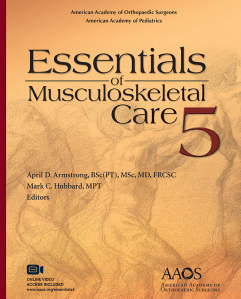
My past life in publishing, though, offered an answer. The year before I started medical school, I worked for the American Academy of Orthopaedic Surgeons (AAOS). AAOS is the medical society for orthopaedic surgeons, and also publishes orthopaedic books. When I left, I was graciously given a copy of Essentials of Musculoskeletal Care 5, a book on general musculoskeletal problems actually directed at non-surgeons — primary care physicians, nurse practitioners, physical therapists, residents, medical students, and others. Aside from hunderds of pages of expertly written text, the book includes more than 200 video demonstrations of exam maneuvers and procedures. So rather than turn to YouTube for  videos of unknown origin, I had a trustworthy source. And when I practiced the manuevers with my classmates, the videos were something I could share with them, too.

Sure, I could have bought the book. But I’m a broke medical student, and it’s really not in my budget right now. It’s part of the package of my past life, a past life that informs and enhances my current one. And while it might have taken me longer to get here, that time certainly wasn’t wasted.

Parlez-vous français?

Trying to learn about thrombosis in French is pointless for someone (like me) who doesn't speak French. But for the writer and word-nerd in me, the foreign phrases are fun to look at anyway.

Trying to learn about thrombosis in French is pointless for someone who doesn’t speak French (like me). But for the writer and word-nerd (also me), the foreign phrases are fun to look at anyway.

The answer to the question posed in this blog title — whether I speak French — is a resounding “no.” The little I do know about French is that it is a beautiful language, one gentle on the ears, eyes, and tongue. When I hear it spoken or see it written, I have little idea what the words mean. But to me they are lovely words nonetheless.

This love of French words extends, I learned this week, to medical texts. Yesterday our class received an e-mail with this subject line: “Dr. Erkan’s Printed Material – The English Version is Now Posted on Canvas.” (“Canvas” being our online education portal.) I was immediately intrigued. This implied that at some point, a non-English version was available (clearly an accident), but had since been removed. A kind classmate who’d inadvertantly downloaded the foreign language version — in French! — forwarded me the PDF. I had already watched the lecture in English, and had read the English slides. So as I skimmed through the French materials, I had a vague idea of what I was reading. My fluency in Spanish helped a little, as both are Romance languages, with some similarities. This was not at all a productive use of my precious time. I had a test to study for. Looking at the French version obviously would not help. This was pure linguistic voyeurism.

My first childhood crush was on Jaromir Jagr, a Czech hockey player. More than anything, I was enthralled with his last name, which according to English grammar rules was mysteriously missing a vowel between the two terminal consonants.

My first childhood crush was on Jaromir Jagr, a Czech hockey player. More than anything, I was enthralled with his last name, which according to English grammar rules was mysteriously missing a vowel between the two terminal consonants.

I guess I shouldn’t be surprised at this fascination with a foreign tongue. The signs were there at an early age, when I started watching National Hockey League games with my dad. It’s a fast-paced, exciting game, which helped hold my attention. But just as fascinating were the players’ names — especially the Eastern European ones. My first childhood crush was on Jaromir Jagr, a Czech who played then for the Penguins. I didn’t even really know what he looked like, as he was covered in protective padding and a helmet all the time. My true attraction was to his last name, which was seductively missing a vowel between the “g” and the terminal “r.” “How was this possible?!” the young grammarian in me wondered. It was my introduction to foreign languages, to rules so different from the familiar English ones that they took on a magical, mystical quality. I had to learn more.

But life puts time constraints on you. Fluency takes years of dedicated practice — you must choose a language to focus on. So I chose Spanish, and I’m glad I did. It, too, is a lovely language with curious and detailed rules whose application can make me giddy. Spanish is also highly practical in the United States, especially in urban areas like my former home, Chicago, and my current one, New York City. If I could choose another language to learn, disregarding practicality and difficulty, it would be Russian. It hearkens back to the genesis of my linguistic interests, which started with those Eastern European tongues.

I’m in medical school now though, learning a foreign language of another kind: doctor-speak. Fluency here is by fire and immersion. No time for nation-languages. So I must be content, at least in this season of my life, with things like browsing medical texts in French. And dreaming about how someday, I might have time for more.

Foresight is 2020

I don’t normally write about politics here. It’s not the intent of this blog. But today, it’s personally imperative for me to say something about last night’s presidential election results.

Those of you who know me well will attest that I am a nonjudgmental, “live and let live” kind of person. But everyone has a breaking point, and Donald Trump is mine. I cannot watch him climb to the most influential political office in the world and stand by, silent. To simply say “I disagree” with this result, and that I simply “disagree” with half of the electorate in this nation, is also insufficient. No. I am terrified and sickened as I contemplate the next four years under the thumb of a man who seems more likely to rule with the principles of tyranny than with those of democracy.

More specifically, here are a few things I want to say publicly, and in print.

As a woman, I refute the misogyny Donald Trump has spewed during this campaign. As someone with friends of many racial, ethnic, religious, and geographic backgrounds, I refute the racism and intolerance Donald Trump clearly espouses. As a future physician, I refute Donald Trump’s positions on health care availability and funding. As a decent human being, I refute Donald Trump’s stance on the provision of social services. As an American citizen, I refute Donald Trump’s capacity to serve as our president.

I could go on, but you get the idea.

I voted. I’m glad I did. But I wish I had done more. Would it have made a difference? Just me, no. Though maybe if a lot of people had decided to do more, it would have.

In four years, in the 2020 presidential election, I’ll be deep in the harried, sleep-deprived life that is medical residency. I’ll have even less time than I do now. I’m not sure what I’ll be able to contribute. But we can’t let this happen again. All I can come up with in this dark moment is that we need to start thinking ahead now.

Who’s ready to start campaigning for Elizabeth Warren with me?

Priorities

This is staying up on my refrigerator.

This is staying up on my refrigerator.

It’s 1:30 p.m. I have checked off only 3 things from my to-do list for today. It’s a long list. But I’ve already done the most important task of the day: vote.

I hope you have too. Or if not, that it’s on your list.

#ImWithHer

Learning EMR: an important attitude adjustment

Learning how to use the hospital's electronic medical record system via a series of videos and short practice sessions is not my idea of fun. But changing my attitude about the experience helped me see it differently.

Learning how to use the hospital’s electronic medical records system via a series of videos and short practice sessions is not my idea of fun. But changing my attitude about the experience helped me see it differently.

Yesterday, I spent a good hour and a half staring at my computer screen, watching modules on how to use the hospital’s electronic medical records system. I don’t think I’m even halfway done. And after the modules, I have a classroom session to attend too. This was tedious and aggravating, as you can imagine. Not to mention overwhelming — so many menu bars, buttons, and icons.

As I watched one of the early videos, I thought to myself: “I won’t learn the system by watching videos. I’ll learn it by doing it.” And then it hit me. As grating as this task is, what it represents — my transition from classroom to hospital — is something to celebrate. Soon I will be using this system to write notes and enter orders. How far I’ve come in such a short time!

That thought didn’t make the videos any more interesting, per se. But it altered my attitude. And that made a world of difference. While the short practice exercises I was doing alongside the videos wouldn’t be my definitive learning experience, I began to see them as an important first introduction to a foreign system.

Always a good reminder: attitude matters. In everything.

Sidewalk talk

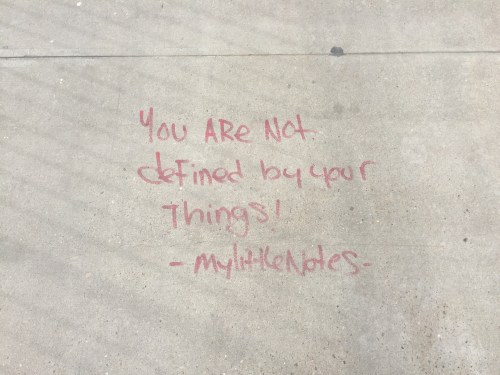
You see a lot of strange things living in New York City. Some of them funny, others upsetting. But today as I walked down the sidewalk, I saw something pleasantly poignant. So much so that though I was hurrying back to my apartment to study, I paused to take a photo. The message, faded by rain and the elements, is a good reminder for us all.

sidewalk-talk

Apparently, there are more of these messages. See images of them here.

Cerebral humor

The brain is complex. Studying it is fascinating — and also frustrating. Thankfully, I have people in my life who help me keep my sense of humor about this amazing organ, and the two months spent studying it during medical school.

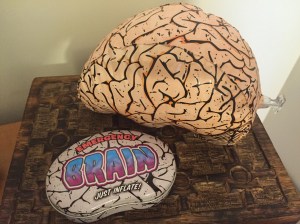
"Just inflate!"

“Just inflate!”

First, there’s the Emergency Brain, with the tag line “Just inflate!” If only it were that easy, right? It’s a nice thought though, and one that makes me laugh.

Second, there’s The Handy Brain Model. This is a brain model like you’ve never seen, a mitten of sorts that you put on your hand to simulate the lobes of the cortex as well other structures like the amygdala and the hippocampus. It’s both funny and practical. Who could ask for more?

Thanks, guys. Laughter really is the best medicine.