doc w/ Pen

journalist + medical student + artist

Category: Medical School: Year 1

Learning to Live Without a Car

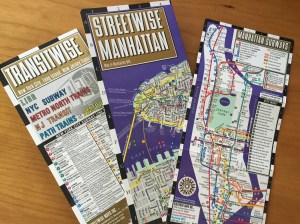
Knowing that cell phone service is less than certain amid skyscrapers, not to mention the threat of my battery dying, I thought buying maps would be prudent. These Streetwise maps, which are laminated, got great reviews on Amazon.com. One covers Manhattan, one covers the multitude of transit options (NYC subway, Long Island Railroad, etc.), and the other exclusively covers the Manhattan subway.

In 2003, just after graduating from college, I bought my first car. I’ve owned one ever since. My car hasn’t been my only means of transportation though – while working at the University of Illinois at Chicago, I commuted on the El (short for “elevated train”), and have often taken the train into the city rather than fight traffic and pay $30 to park. But taking the train or bus to work is different than taking the train or bus to buy groceries, which is what I will be doing while living in Manhattan. The thought is a little nerve-wracking – that there will be no trunk, no back seat, to haul stuff in. No immediate wheels. No straight shot to where I’m headed. Add to that the complexity of the New York City transit system, and it’s overwhelming. I remind myself that I survived taking the bus everywhere (and not having a car) for five months when I lived in Chile during college, and that was in a foreign country where I had to speak a foreign language. So I can certainly do it in New York. Because as foreign as NYC might seem at times, I’m still on home soil. And soon enough, NYC will come to be my home too.

I’m especially excited about the foldable subway map.

This Book’s a Keeper

Reading immunology on the front porch on a beautiful day is rather pleasant.

A few days ago, I wrote about some books I *might* be using during my first year in medical school. I already know this one is a keeper: How the Immune System Works, by Lauren Sompayrac (Wiley-Blackwell).

Before I talk about this book, let me take a step back. It’s said (by people more knowledgeable than I am) that in addition to the required basic science classes in college, there are three upper-division courses that may help you in medical school: genetics, biochemistry, and immunology. I’ve taken genetics and biochemistry, and done well in both. But immunology is a world I know nothing about. To put it bluntly: I didn’t know my neutrophils from my natural killer cells (which is embarrassing, if you know anything about the subject).

Enter Lauren Sompayrac’s book, which is a “big picture” view of immuno designed to prepare you for more a complex course by showing how parts of the immune system act and interact at a very basic level. At only 132 pages of actual chapter material, it’s a short read. The writing is entertaining, with plenty of analogies and quips thrown in. From now on, when I think of the major histocompatibility complex (MHC) – a molecule that essentially serves as a billboard to tell what’s going on either inside or outside the cell it’s attached to – I will think of a hot dog bun. (Yes, there is a photo of a hot dog bun in the book. It works.) There are also plenty of astounding facts too which keep me engaged with the general topic. (Did you know that the area covered by the mucous membranes lining our digestive, respiratory, and reporductive tracts – part of our body’s perimeter that needs defended – measures about 400 square meters? That’s two tennis courts! Immune cells have to patrol all that!)

My goal isn’t to master the immune system before medical school. That’s what medical school is for. But since I have exactly zero background in this, I want to develop a basic understanding of the players before I’m expected to know the whole playbook.

Read All About It: Basic Science Books for Medical School

Note: This post is at the request of one of my readers, who asked me to share what books I plan to use in my first year of medical school. I will update as the year goes by to talk about what I actually used. But here’s the plan …

textbook stackDuring undergrad, each new semester meant heading to the school bookstore, dropping a few hundred dollars, and lugging a giant stack of heavy textbooks back to my dorm or apartment.

Things have changed. First, I’m in medical school now, not undergrad. In medical school, the prevailing wisdom is that you wait for your second year classmates to tell you what you really need before buying any books. Second, the trend across the publishing world is to use eBooks on your laptop or iPad rather than giant hardback tomes. And many medical schools – Cornell included – offer access to a selection of these eBooks through the school’s library. Cornell’s top-of-the-line resources mean that I have access to a LOT of eBooks this way, so I anticipate not having to buy many titles at all. Another bonus of these eBook offerings, which are usually accessed through an institutional subscription to part of a publisher’s catalog, is that in addition to the books there are related videos and self-assessments.

I do have a list of books I plan to use as necessary, most of which I can access as eBooks. This list was developed with the help of a dear friend, Dr. Hoffheimer, who is now a third year internal medicine resident in the Detroit area. I thumbed through the books she had used, and selected those that seemed to best fit my learning style. Most of these are not traditional textbooks, but review-style books, offering a bigger picture of the concepts rather than excessive minutiae. I have these bookmarked in my web browser, ready to go.
 

LIR biochemIn terms of the basic sciences, I found I preferred the Lippincott Williams & Wilkins series Lippincott’s Illustrated Reviews. From what I’ve seen so far (I’ve spent some time with the biochemistry title), the LIR series does a good job of giving you an overview, while also providing enough detail – but not so much that it’s overwhelming. These eBooks also offer online self-assessment, video/audio components, and a print feature (great for reading offline, if you print to PDF and throw it on the iPad). I have bookmarked the following through the LWW Health Library website. I’ve linked the titles to their Amazon.com pages if you’d like to read more about them or see customer reviews.
netter's atlasFrom Elsevier, I bookmarked:

From McGraw-Hill, I bookmarked three titles that I haven’t ever flipped through, but looked promising. What I like about these is that there are interactive self-assessments for each, with USMLE-style questions. So even if I don’t use the books, I’ll likely use the test prep component.
metabolism at a glanceI did buy four books in advance, titles I felt confident I’d need, were worth the price, and I wanted as tangible objects instead of eBooks.

  • First Aid for the USMLE Step 1: Highly recommended by people I trust. And I know I’ll need to start doing USMLE-style questions pretty much right off the bat.
  • Neuroanatomy in Clinical Context: An Atlas of Structures, Sections, Systems, and Syndromes: Neuroanatomy has a reputation for being a tough block, and this book looks amazing. I do have access to this as an eBook, but there are some writing components that made me want to buy it in print.
  • Metabolism at a Glance: This large-format book puts all the pieces of metabolism (Krebs cycle etc.) together in an integrated way, rather than looking at them separately.
  • How the Immune System Works: This title presents a high-level view of the immune system, which should be great to have before I dive into my medical school block. I felt I needed this background since I’ve never taken an immunology course.

How many of these titles I use remains to be seen. But I felt it was important to have them bookmarked ahead of time so that if I get to a topic where I need more information, I have a trustworthy source to go to – and by “trustworthy” I don’t mean Wikipedia.

Thanks to Dr. Hoffheimer for her help in developing this list. And thanks to Varia for prompting the post.
Packing It Up

Time to start packing …

I packed my first three boxes today. One milestone among many over the last several days, weeks, and months – each bringing me closer to medical school. Other recent notable events:

  • Buying my one-way plane ticket to New York City (I leave Wednesday, August 12)
  • Getting my Weill Cornell mailing address, e-mail address, and campus user ID
  • Logging into the Cornell system for the first time
  • Taking a peek at my first medical school assignment: a “prematriculation assessment module” aimed to determine how much we remember from our premedical classes (scored but not graded)
  • Buying lots of stuff on Amazon.com for my new dormitory nest
  • Quitting my job
  • Applying for a student loan (again)

It’s been a few months since I posted here on my blog, and the last two items on that list – quitting my job and applying for a student loan – deserve explanations of their own.

Last July, I left my research lab job at Northwestern University and in August began working for the American Academy of Orthopaedic Surgeons (AAOS). This “acquisitions specialist” position brought me back to my publishing roots, though with more of an emphasis on competitive analytics and market trends. Sort of a hybrid publishing/marketing position. With research, writing, and science in my background, the job was a wonderful fit (or so I gleaned from the positive feedback from my manager and colleagues). Besides being a great job, I met some dear people and was immersed in the amazing world of surgery – a world that quickly fascinated me. But with things looking good for my student loan, I left AAOS in early June to focus on getting ready for medical school.

Ah yes, my student loan. Those of you who kept up with my story last year may remember that my 2014 student loan rejection prevented me from starting medical school last August, and threatened to keep me out of medical school entirely. The reason was my foreclosure, an adverse credit event that turned my loan application – even my appeal – into automatic denials.

That old maxim though – “if at first you don’t succeed, try, try again” – is so true. I sent dozens of faxes to politicians, journalists, and other pundits across the country. My goal was to make so much noise that someone with authority and power would listen to me, take up my case, and force the Department of Education to change its tune. It took time, but it worked, thanks to Senator Mark Kirk, a U.S. senator from my home state of Illinois. A legislative aide from Kirk’s office was on the phone with me within 48 hours of my pleading fax arriving at his office. Within a few weeks, my loan denial was reversed. The approval came too late for me to attend school last year. And I still have to reapply this year (nothing is automatic with the Department of Education, believe me). But now there is precedent for my loan being approved, and I am confident it will go through again. (It’s currently rattling around in the DOE system somewhere.)

In the meantime, I better pack up more boxes. Because in two and a half weeks, I’ll officially be in medical school.